Welcome to our second lesson on Vectors and 3D Geometry. In the previous session, we explored the dot and cross products, learning how they help us find angles between vectors and areas of parallelograms. Today, we'll build directly on that knowledge by combining these two operations to form the scalar triple product.
Our goal is to understand how this product is calculated and, more importantly, how to apply it to two key geometric problems: calculating the volume of a three-dimensional shape called a parallelepiped, and determining if three vectors lie on the same plane (a property known as coplanarity). These are classic problems that frequently appear in the MHT-CET.
1. Defining and Calculating the Scalar Triple Product
As its name suggests, the scalar triple product involves three vectors and results in a scalar value. It is defined as the dot product of one vector with the cross product of the other two.
For three vectors , , and , the scalar triple product is written as . It is often denoted using a shorthand notation called the "box product": .
In our last lesson, you learned to compute the cross product first, then the dot product. However, there's a much more direct way to compute the scalar triple product using determinants, a topic you covered in Module 1. This method combines both steps into one.
The following video provides an excellent explanation of what the scalar triple product is and how this determinant "shortcut" works.
Volume of a Parallelepiped Using The Triple Scalar Product | Calculus 3 Lesson 14 - JK Math
This video from JK Math introduces the scalar triple product and clearly demonstrates how the determinant form is derived from the two-step process of a cross product followed by a dot product.
Watch the initial segment from the beginning. Focus on how the components of the first vector in the dot product replace the \hat{i}, \hat{j}, \hat{k} vectors in the determinant for the cross product.
So, the key formula for calculation is:
If , , and , then their scalar triple product is given by the 3x3 determinant of their components:
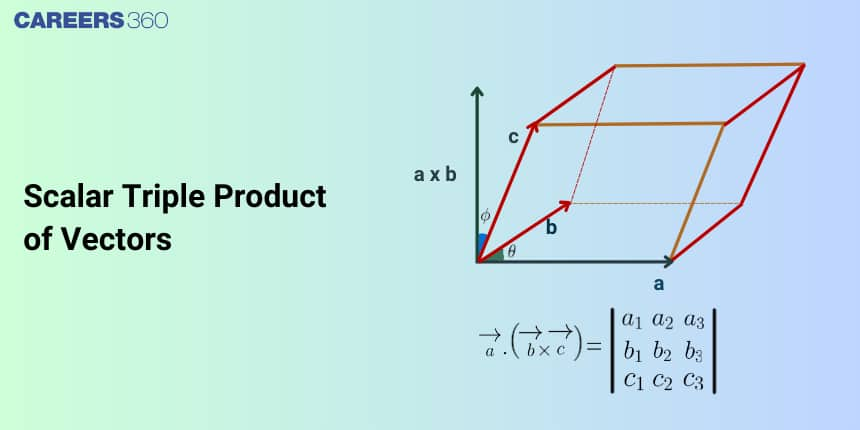
2. Geometric Interpretation: The Volume of a Parallelepiped
The scalar triple product isn't just an abstract calculation; it has a powerful geometric meaning. The absolute value of the scalar triple product, , represents the volume of the parallelepiped formed by the three vectors , , and when they are placed tail-to-tail (as coterminous edges).
Let's break down why this is true. The volume of any prism-like solid is (Area of Base) × (Height).
- Area of the Base: As we learned, the magnitude of the cross product, , gives the area of the parallelogram forming the base.
- Height: The vector is perpendicular to the base. The dot product calculates the projection of onto this perpendicular vector, effectively finding the height of the parallelepiped, and multiplies it by the base area.
The next segment of the JK Math video provides a detailed visual derivation of this relationship.
Volume of a Parallelepiped Using The Triple Scalar Product | Calculus 3 Lesson 14 - JK Math
Let's continue with the same video to see the geometric derivation for the volume of a parallelepiped.
Watch this segment from the explanation. Pay close attention to how the area of the base (|\vec{u} \times \vec{w}|) and the height (the projection of \vec{v}) combine to form the final scalar triple product formula.

The formula for the volume is:
A related shape is the tetrahedron. The volume of a tetrahedron with coterminous edges , , and is one-sixth of the volume of the corresponding parallelepiped.
This is a very common formula tested in the MHT-CET.
Let's watch a problem that uses these concepts in a typical MHT-CET context. This problem also involves finding a minimum value, which links to the "Application of Derivatives" topic.
VECTORS LEC 1 🔥 MHT-CET 2026 | EKLAVYA 6.0 Batch ✅ | CET 10 MARKS IMP CHAPTER 🚀 | Dinesh Sir
This video from Dinesh Sir's Eklavya batch is tailored for MHT-CET. The instructor solves a problem involving the volume of a parallelepiped.
Watch from this problem. Observe how he sets up the determinant for the volume and then uses derivatives to find the minimum value. This shows how different topics can be combined in one question.
3. Application: Testing for Coplanarity
What happens if the volume of the parallelepiped is zero? Geometrically, this means the three vectors cannot form a 3D solid; they must all lie flat on the same plane. Such vectors are called coplanar.
This gives us a crucial test:
Three vectors , , and are coplanar if and only if their scalar triple product is zero.
This concept is explained very clearly in the following short clip.
Volume of a Parallelepiped Using The Triple Scalar Product | Calculus 3 Lesson 14 - JK Math
Let's return to the JK Math video for a final conceptual point about what a zero-volume result implies.
Watch this brief explanation on coplanarity from this section.
The condition for coplanarity is fundamental and is often used in problems where you need to find an unknown variable that makes three given vectors lie in the same plane.
Dinesh Sir also emphasizes this rule as it's a frequently tested concept in MHT-CET.
VECTORS LEC 1 🔥 MHT-CET 2026 | EKLAVYA 6.0 Batch ✅ | CET 10 MARKS IMP CHAPTER 🚀 | Dinesh Sir
Here, Dinesh Sir directly states the condition for coplanarity, which is a key takeaway for your exam preparation.
Watch from this short clip where he explains that if three vectors are coplanar, their box product is zero.
Now, let's practice this with a textbook example.
Scalar Triple Product - Formula, Geometrical Interpretation, ...
This article from Cuemath provides clear, solved examples. We will look at an example of testing for coplanarity.
Please scroll to the "Scalar Triple Product Examples" section and carefully study Example 2. Follow the steps to see how calculating the determinant and getting a result of zero proves that the three given vectors are coplanar.
Conclusion
In this lesson, we've added a powerful tool to our vector toolkit. By combining the dot and cross products, we've unlocked the ability to solve problems in three dimensions.
Here are the key takeaways:
- The Scalar Triple Product (or box product) of vectors is .
- It is most efficiently calculated using a 3x3 determinant of the vector components.
- The absolute value, , gives the volume of the parallelepiped with those vectors as coterminous edges.
- The scalar triple product is zero if and only if the three vectors are coplanar (lie in the same plane).
Mastering these two applications—volume and coplanarity—is essential for the MHT-CET. In our next lesson, we will shift our focus to representing lines in 3D space using both vector and Cartesian equations, further building our understanding of 3D geometry.