Hello! Welcome to your third English lesson.
In our last lesson, we learned how to form basic sentences and ask simple yes/no questions like, "Do you have a computer?". This is a great start, but conversations need more than just "yes" or "no" answers.
Today, we will build on that knowledge to ask and answer basic questions using who, what, where, when, and why. These are often called "Wh- questions" and they are essential for getting information and having interesting conversations, which I know is one of your key goals. By the end of this lesson, you'll be able to ask for details about people, things, places, times, and reasons.
What are Wh- Question Words?
Wh- question words help us ask for specific information. We can't answer these questions with a simple 'yes' or 'no'. Look at the image below for a quick summary.
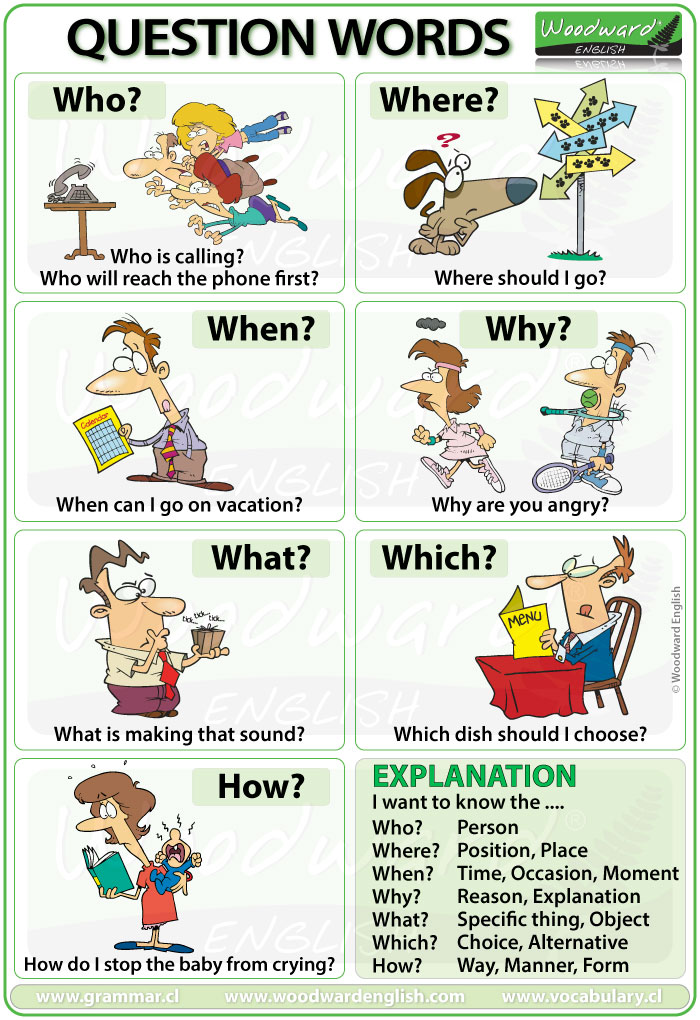
Here are the five we will focus on today:
- Who? - asks about a person.
- What? - asks about a thing or an action.
- Where? - asks about a place.
- When? - asks about a time.
- Why? - asks about a reason.
Using these words is the key to moving from simple questions to real, dynamic conversations. To see how they make conversations better, let's watch a short, fun video.
Improve your conversation skills with WH questions
The speaker in this video from English with Ronnie explains why these questions are so important for having good conversations. She gives some great examples.
Watch from the beginning until 05:20. Pay attention to how each question word (Who, What, When, Where, Why) is used to get more information in a conversation about dinner.
As the video shows, asking "What did you eat?" is much more interesting than just knowing if someone ate dinner. These questions open up the conversation.
How to Form Wh- Questions
Now that you know what the question words are, let's look at how to build the sentences correctly. The structure is very similar to the yes/no questions you learned in the last lesson, but we add the Wh- word at the beginning.
There are two main patterns.
Pattern 1: With the verb 'to be' (is, are)
The structure is: Wh-word + be + Subject?
Whereisthe office?Whoarethey?Whenisthe meeting?
Pattern 2: With other verbs (work, start, live)
The structure is: Wh-word + do/does + Subject + Verb (base form)?
Wheredoyouwork?Whendoesthe programstart?Whatdoyouthink?
The next video explains these two patterns very clearly.
Wh- Questions – English Grammar Lessons
This animated video from Ellii gives a clear, step-by-step guide to the grammar rules for forming Wh- questions. It's a perfect follow-up to the conversational video.
Watch from 00:48 to 02:53. Focus on the two main question patterns shown: one for the verb 'be' and one for all other verbs using 'do' or 'does'.
Test your understanding!
You want to ask your colleague about the location of a file. Which question is correct?
- Where the file is?
- Where is the file?
- Where does the file?
Show answer
Number 2, "Where is the file?", is correct. We use Pattern 1 (Wh-word + be + Subject) because the verb is 'is'.
Let's Practice!
Now it's time to put this into practice. The following worksheet has several exercises to help you master Wh- questions. We will focus on three activities.
Wh- Questions – Grammar Practice Worksheets
This worksheet from Ellii contains excellent exercises for practicing what we've just learned. We will use it to check your understanding of the words and practice forming questions.
Please open the PDF. You don't need to do everything. Go to page 7 and complete Exercise 1 (WH- WORDS & USES). Match the question word to its meaning. Then, go to page 8 and complete Exercise 3 (MATCHUP). Match the questions to the correct answers. Finally, go to page 9 and try Exercise 5 (WRITE THE QUESTION) for the first five answers (1-5). This is the most important part, as you will be creating the questions yourself. You can check your work using the Answer Key on page 16.
Speaking Practice
Your goal is to have confident conversations, so let's practice speaking. The image below has conversation cards on different topics.

Choose one or two topics that you find interesting (like 'HOBBY' or 'MOVIES'). Read the questions aloud, and then answer them in full sentences. For example:
- (You read the question) "What is your favorite movie?"
- (You answer aloud) "My favorite movie is [Your Favorite Movie]."
Try to do this for all the questions on the card. This will help you get comfortable both asking and answering these essential questions. If you can, record yourself on your phone and listen back to your pronunciation.
Conclusion
Great job today! You have learned one of the most powerful tools for communication in English. Asking good questions is the best way to learn about the world and connect with people.
Key Takeaways:
- Wh- question words (
who,what,where,when,why) are used to ask for specific information. - The structure for questions with the verb
beis: Wh-word +be+ Subject? (e.g., Where is the manager?) - The structure for questions with other verbs is: Wh-word +
do/does+ Subject + Verb? (e.g., When do you finish work?)
Preview of the next lesson:
In our next lesson, we will continue building our descriptive skills. You'll learn how to use common adjectives to describe people, places, and things. This will allow you to answer questions like "What is your city like?" with more interesting detail.