Hello! Welcome to the fourth lesson in your English course.
In our last lesson, you learned how to ask for specific information using question words like what, where, and who. This is a vital skill for starting and continuing conversations.
Today, we will learn how to use common adjectives to describe people, places, and things. Adjectives are the words that make our language colorful and interesting. They help us answer questions like "What is your apartment like?" or "What is your teacher like?" with more than just a simple "It's good." By the end of this lesson, you'll be able to paint a picture with your words, a key step toward your goal of speaking with more confidence and detail.
What are Adjectives?
Adjectives are describing words. They add information about nouns (a person, a place, a thing). Is the food spicy or sweet? Is the teacher friendly or strict? Is the room big or small? Let's see how adjectives work in a real conversation.
Describing People, Places and Things
In this video from Easy English, a woman named Denise describes her new apartment and her roommate to her parents. Listen for all the words she uses to describe things.
Please watch the video from the beginning until 02:29. As you watch, try to notice the words Denise uses to describe her apartment, her room, and the kitchen. For example, she says her apartment is 'cozy' and 'convenient'.
You probably heard many describing words like cozy, convenient, large, small, organized, bright, and comfortable. These are all adjectives. They make her description much more vivid and interesting.
How to Use Adjectives in Sentences
Now that you've seen adjectives in action, let's look at the simple rules for using them. In English, there are two main places to put an adjective in a sentence.
To learn these rules, please read the short grammar explanation in the resource below.
Beginner English - A1 - Adjectives (1)
This page from elllo.org provides a very clear and simple explanation of the two main grammar rules for adjectives, with easy-to-understand examples.
Scroll down to the section titled Adjectives. Read the three 'Points' that explain how to use them. Focus on Point 1 and Point 2, which show the two most common sentence structures.
As you just read, the two main patterns are:
-
After the verb
be(is,am,are):- My apartment is
spacious. - The teacher is
nice. - They are
friendly.
- My apartment is
-
Before a noun:
- It is a
spaciousapartment. - She is a
niceteacher. - They are
friendlypeople.
- It is a
A very important and helpful rule in English is that adjectives do not change. They are the same for singular nouns, plural nouns, men, and women.
- A
tallman. - A
tallwoman. Tallpeople.
This is different from Arabic, where adjectives often change to match the noun. In English, it's simpler!
Describing People: Appearance vs. Personality
We often use adjectives to describe people. We can describe how they look (their appearance) or what they are like as a person (their personality). We use two different questions for this:
- "What does he/she look like?" asks about appearance (e.g.,
tall,short,long hair). - "What is he/she like?" asks about personality (e.g.,
friendly,funny,quiet).
Let's watch the next part of the video where Denise describes her roommate. Pay attention to which adjectives describe appearance and which describe personality.
Describing People, Places and Things
In this part of the conversation, Denise answers questions about her roommate's appearance and personality. This is a perfect example of the two types of description.
Watch the clip from 02:29 to 03:05. Notice how she answers 'What does she look like?' and 'What is she like?' differently.
For appearance, she said: pretty, long dark brown hair, green eyes, short, skinny.
For personality, she said: friendly, outgoing, fun, nice, kind.
This difference is very important for natural conversations.
Test your understanding!
Your friend asks you: "I have a new manager. What should I ask you to learn about his personality?"
- What is your new manager like?
- What does your new manager look like?
- How is your new manager?
Show answer
Number 1, "What is your new manager like?", is the correct question to ask about someone's personality.
Building Your Adjective Vocabulary
To describe the world around you, you need a good collection of adjectives. A great way to learn them is by seeing opposites.
Look at the image below. It shows pairs of opposite adjectives with pictures to help you understand their meaning.

Now, let's practice what you've learned.
Practice Describing People, Places, and Things
Your main goal is to use English in conversation, so let's practice speaking. I will ask you some questions. Try to answer them out loud using at least two adjectives from this lesson.
- What is your city or town like?
- Example answer: "My city is
bigandbusy."
- Example answer: "My city is
- Think of a friend. What are they like?
- Example answer: "My friend is
funnyand verykind."
- Example answer: "My friend is
- What does your favorite food taste like?
- Example answer: "It is
spicyanddelicious."
- Example answer: "It is
- What is your home like?
- Example answer: "My home is
comfortableandcozy."
- Example answer: "My home is
Recording yourself on your phone and listening back is a fantastic way to check your own speaking and build confidence.
Finally, let's do a short written exercise to practice using adjectives in sentences.
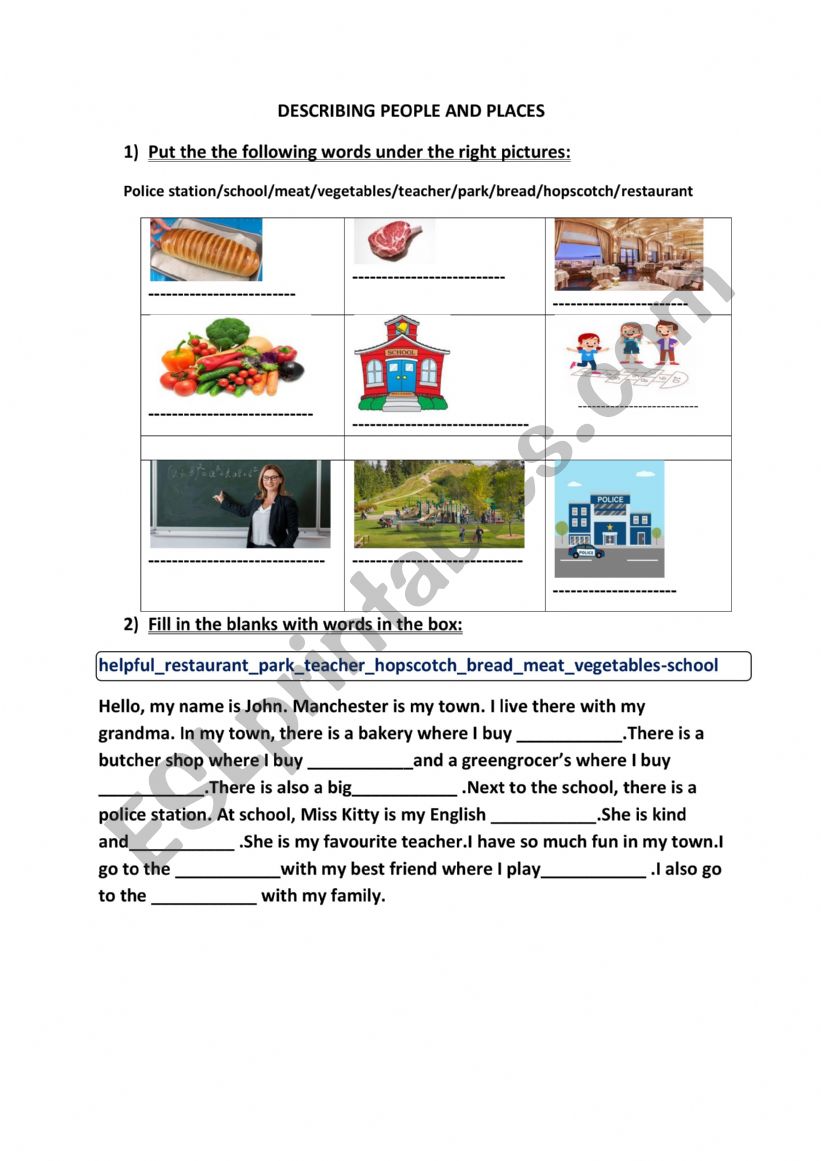
Complete Part 2 of the worksheet in the image above. Fill in the gaps in the story with the correct words from the box. This will help you practice using adjectives in the context of a short story. You can write your answers down on a piece of paper.
Conclusion
Well done! Today, you learned how to make your English more descriptive and interesting. Using adjectives well is a big step towards expressing yourself more clearly and having richer conversations.
Key Takeaways:
- Adjectives are words that describe nouns (people, places, things).
- Adjectives can go after the verb
be(e.g., "The movie isinteresting.") or before a noun (e.g., "It is aninterestingmovie."). - In English, adjectives don't change for plural or gender.
- Use "What does... look like?" for appearance and "What is... like?" for personality.
Preview of the next lesson:
In our next lesson, we will continue to add detail to your sentences by learning how to use basic prepositions of place (in, on, at) and time (in, on, at). This will help you say exactly where things are and when things happen.