Hello! Welcome back to your second English lesson.
In our first lesson, you learned about 50 essential English words, including nouns for objects (book, computer), verbs for actions (work, read), and phrases for conversation (by the way). Today, we'll put those building blocks to use.
Our goal for this lesson is to learn how to form simple affirmative, negative, and question sentences using the Subject-Verb-Object structure. This is the fundamental grammar for creating almost any basic sentence in English. By the end of this lesson, you will be able to take the words you know and build clear, correct sentences to express ideas, say something is not true, and ask simple questions.
The Basic Sentence: Subject + Verb + Object
The most common sentence structure in English is Subject - Verb - Object (SVO). The word order is very important and generally does not change.
- Subject: The person or thing that does the action. (Who or what?)
- Verb: The action. (What is the action?)
- Object: The person or thing that receives theaction. (Who or what receives the action?)
Let's look at an example using words from our last lesson:
- I read a book.
- Subject:
I - Verb:
read - Object:
a book
- Subject:
To see this structure explained with many clear examples, let's watch a video.
English Sentence Structure: Subject, Verb, Object (SVO) -2025.
This video from English Evolution Step 1 will clearly show you the Subject-Verb-Object pattern. The use of colors for each part of the sentence will help you see the structure.
Watch the video from the beginning to 07:15. Pay close attention to the order of the words in each example sentence. Listen to the pronunciation and repeat some of the sentences aloud.
As the video showed, this SVO pattern is very consistent. Here are a few more examples using vocabulary you already know:
- You have a computer. (Subject:
You, Verb:have, Object:a computer) - She cooks dinner. (Subject:
She, Verb:cooks, Object:dinner) - We watch movies. (Subject:
We, Verb:watch, Object:movies)
Test your understanding!
Identify the Subject, Verb, and Object in this sentence: "They play soccer."
Show answer
- Subject: They
- Verb: play
- Object: soccer
Making Sentences Negative
Now, how do we say something is not true? We create a negative sentence. The structure changes slightly depending on the verb.
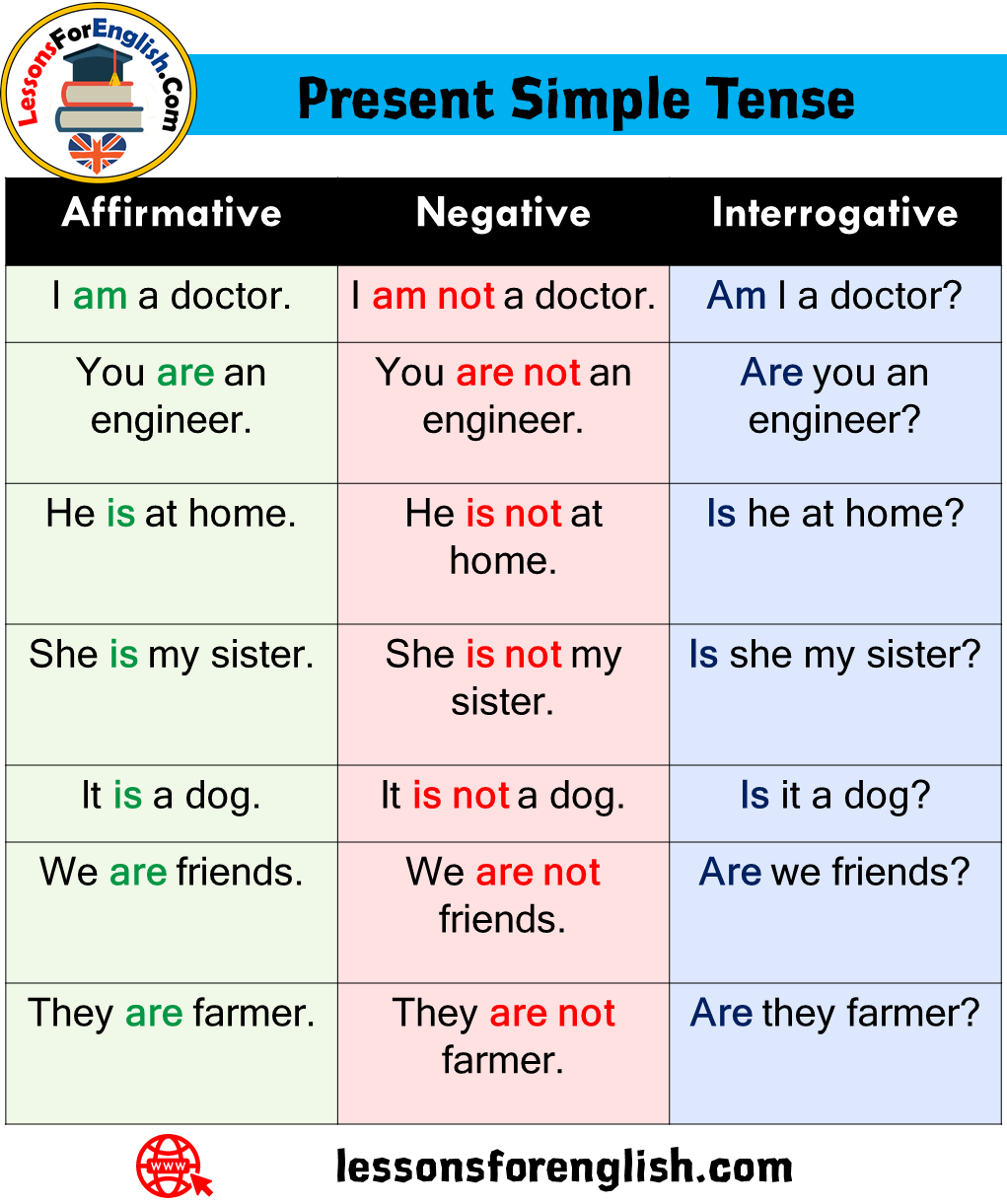
1. With the verb 'to be' (am, is, are)
For sentences with the verb to be, you simply add not after the verb.
- Affirmative: I am a student. -> Negative: I am not a student.
- Affirmative: He is messy. -> Negative: He is not messy. (or
isn't) - Affirmative: They are late. -> Negative: They are not late. (or
aren't)
This table clearly shows the structure for affirmative, negative, and question forms with the verb 'to be'.
2. With all other verbs
For most other verbs (like like, work, have, read), you need a "helping verb" to make the sentence negative. This helping verb is do or does.
The structure is: Subject + do/does + not + Verb (base form) + Object.
- Use
do not(or the contractiondon't) forI,you,we,they. - Use
does not(or the contractiondoesn't) forhe,she,it.
Important: After don't or doesn't, the main verb is always in its base form (e.g., like, not likes).
Examples:
- Affirmative: I like coffee. -> Negative: I do not like coffee.
- Affirmative: She cooks dinner. -> Negative: She does not cook dinner.
- Affirmative: We have a car. -> Negative: We do not have a car.
Test your understanding!
Change the following affirmative sentence into a negative sentence:
"He reads a book."
Show answer
"He does not read a book." (or "He doesn't read a book.")
Asking Simple Questions
Now let's learn to ask Yes/No questions. These are questions that can be answered with a simple "yes" or "no".
Just like with negative sentences, we use the helping verb do or does. To make a question, we simply move it to the beginning of the sentence.
The structure is: Do/Does + Subject + Verb (base form) + Object?
- Statement: You like pizza. -> Question: Do you like pizza?
- Statement: He works at home. -> Question: Does he work at home?
- Statement: They have a car. -> Question: Do they have a car?
The following resource shows these sentence patterns in the context of short, natural conversations. This is a great way to see how the grammar works in real life.
Beginner English - A1 - Likes and Dislikes
This page from elllo.org provides simple conversations about likes and dislikes. It's a perfect example of how affirmative, negative, and question sentences are used in a real discussion.
First, read the four short conversations. Notice how people ask and answer questions. Then, scroll down to the 'Grammar' section and study 'Point 1', 'Point 2', and 'Point 3' to see the exact patterns for questions and statements.
After reviewing the resource, you can see these clear patterns:
- Statement: I like ice cream. (S+V+O)
- Question: Do you like pizza? (Do+S+V+O?)
- Short Answer: Yes, I do. / No, I don't.
Test your understanding!
You want to know if your friend has a computer. What question do you ask?
Show answer
"Do you have a computer?"
Conclusion
Excellent work! You've just learned the most important rule for building sentences in English. Mastering this will give you a strong foundation for everything that follows.
Key Takeaways:
- The standard English sentence order is Subject - Verb - Object (SVO).
- Affirmative:
I read a book. - Negative: To make a sentence negative, you add
not. For most verbs, you need a helping verb:He **does not** read a book. - Question: To ask a yes/no question, you start with the helping verb
doordoes:**Do** you read books?
Practice this by thinking of simple sentences about your day. Try saying one positive sentence, one negative sentence, and one question. For example: "I have breakfast." "I don't have lunch at home." "Do you work in an office?"
Preview of the next lesson:
In our next lesson, we will expand on asking questions. We will learn how to use question words like who, what, where, when, and why to ask for specific information, moving beyond simple yes/no answers.