Welcome to your fifth lesson. In our last session, we established the blueprint for any AI project: the AI Development Life Cycle. We mapped out the key stages of Data, Model, Deploy, and Monitor, framing it within the MLOps context that is crucial for building production-grade systems.
Today, we'll zoom into the "Model" stage, starting with the most fundamental decision you'll make as an AI architect. This lesson focuses on differentiating between supervised, unsupervised, and reinforcement learning. Correctly categorizing a business problem into one of these paradigms is the first and most critical step in model design. It dictates the data you'll need, the algorithms you can apply, and how you will ultimately measure success.
The Three Paradigms at a Glance
From a systems perspective, machine learning models are processors that transform data. The primary difference between the major ML paradigms lies in the nature of their inputs and the mechanism through which they learn.
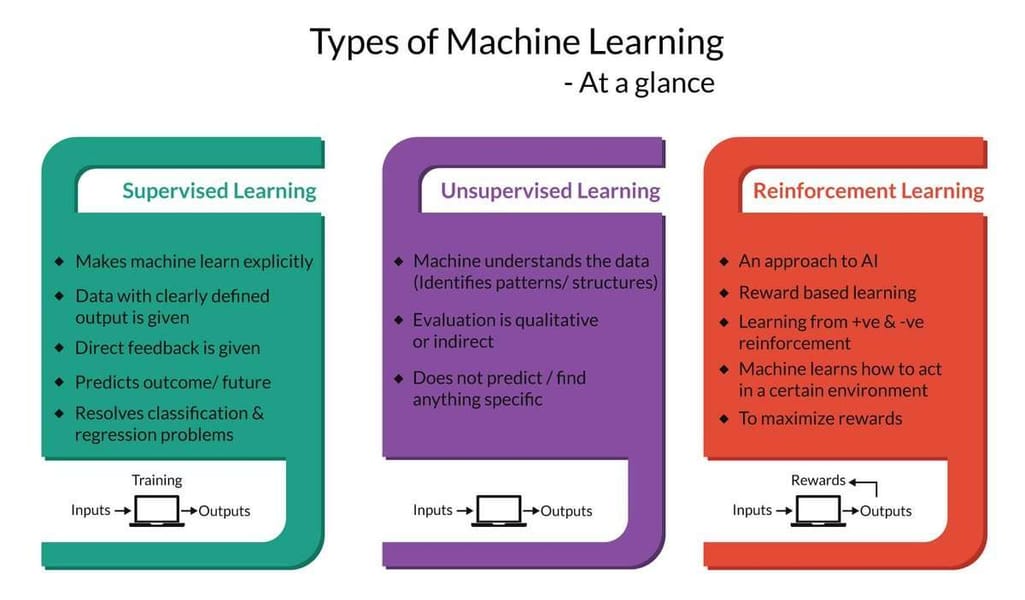
Let's start with a high-level flowchart. This visual distinguishes the three learning types based on their input data and their ultimate output.

As you can see:
- Supervised Learning starts with "Data With Labels." It learns a mapping from input to a known, correct output.
- Unsupervised Learning starts with "Data Without Labels." Its goal is to find inherent structure or classes within the data.
- Reinforcement Learning operates on "States + Actions." It learns by interacting with an environment, receiving feedback in the form of rewards.
Now, let's explore each of these in more detail.
A Deeper Dive into the Learning Types
The following article from Clarifai provides an excellent, structured breakdown of each paradigm. It covers the core concepts, provides creative examples, and offers expert insights that are valuable for an architect's perspective.
Types of Machine Learning Explained: Supervised ...
This article will serve as our primary guide for understanding the three main ML types. As you read, focus on the distinct goals and data requirements of each approach, and think about how they might apply to features in your subscription platform.
Please read the following sections: Supervised Learning: Start with the initial overview. This is the most common type of ML in business applications. Your goal of building a /predict-churn endpoint is a classic supervised learning problem. Unsupervised Learning: Read the section on Unsupervised Learning, starting from the quick summary through the explanation of clustering and dimensionality reduction. This paradigm is key for exploratory analysis and for problems like fraud detection, where you're looking for unusual patterns. Reinforcement Learning: Finally, read the section on Reinforcement Learning. Focus on the core concepts of an agent learning through rewards in an environment. This directly relates to your interest in building a "smart coupon/discount optimization" engine.
Connecting the Paradigms to Your Goals
Having read the overviews, let's explicitly connect each paradigm to the AI systems you plan to build.
1. Supervised Learning: Predicting Known Outcomes
This is your go-to for problems where you have historical data with known answers.
- Core Idea: You train a model on data where you already know the correct output (the "label"). The model learns the relationship between the input features and the output label.
- Your Projects:
- Churn Prediction: You have historical user data (features: subscription tier, usage activity, tenure) and a known outcome (label:
churned=true/false). The model learns a functionf(user_data) -> churn_probability. This is binary classification. - Lead Conversion Prediction: You have data on leads and know which ones converted into paying customers. The model learns to predict the likelihood of a new lead converting. This is also binary classification.
- Churn Prediction: You have historical user data (features: subscription tier, usage activity, tenure) and a known outcome (label:
- Architectural Consideration: The biggest system requirement for supervised learning is a reliable pipeline for generating and storing high-quality labels. In your case, this means ensuring your PostgreSQL database accurately captures events like subscription cancellations or successful conversions that can serve as the "ground truth" for training.
2. Unsupervised Learning: Discovering Hidden Structure
This is the tool for exploration and discovery when you don't have predefined labels.
- Core Idea: The algorithm sifts through data to find patterns, groupings, or anomalies on its own.
- Your Projects:
- User Segmentation: You could apply clustering to your user base to identify distinct personas (e.g., "power users," "weekend-only users," "at-risk users") based on their behavior. These segments don't exist as labels in your database; the algorithm discovers them. The output could inform targeted marketing or feature development.
- Fraud Detection: To build a
/fraud-detectionservice, you might use anomaly detection. The model learns what "normal" user behavior looks like (e.g., login times, transaction frequency). Any activity that deviates significantly from this norm is flagged as potentially fraudulent.
- Architectural Consideration: The challenge with unsupervised learning is that model evaluation is less direct. There's no "right" answer to compare against. Success is often measured by the business utility of the patterns discovered.
3. Reinforcement Learning: Learning Optimal Actions
This is the most complex but powerful paradigm for problems involving sequential decision-making to achieve a long-term goal.
- Core Idea: An "agent" learns by doing. It performs actions in an "environment" and receives rewards or penalties, adjusting its strategy (policy) to maximize its total reward over time.
- Your Projects:
- Smart Coupon/Discount Optimization: This is a perfect RL problem.
- Agent: Your pricing/discount model.
- Environment: Your user base and the market.
- Action: Offer a specific user a 5%, 10%, or 15% discount, or no discount.
- Reward: A positive reward for a successful conversion, with the magnitude perhaps inversely related to the discount size (to protect margin). A penalty or zero reward if the user doesn't convert.
The goal is to learn a policy that decides the optimal discount to offer each user to maximize overall revenue, not just individual conversions.
- Smart Coupon/Discount Optimization: This is a perfect RL problem.
- Architectural Consideration: RL systems are dynamic. They require a tight feedback loop between the live environment (your platform), the action-taking agent, and the reward calculation mechanism. This is a significant step up in complexity from a simple, static prediction API.
Consolidating Your Understanding
To hear these concepts explained in a different way, the following video provides a systematic comparison across several dimensions, including the type of data, the training process, and the feedback mechanism.
Supervised vs Unsupervised vs Reinforcement Learning | Data Science Certification Training | Edureka
This Edureka video offers a detailed side-by-side comparison of the three learning types, reinforcing the concepts from the article.
Watch the following segments to solidify your understanding: Types of Problems: The video explains the classic problems solved by each paradigm, such as classification/regression for supervised and clustering/association for unsupervised. Watch from this section. Type of Data & Training: This is a crucial distinction for an architect. The speaker contrasts the labeled, unlabeled, and self-generated data used in each approach. Watch from this part. Approach & Feedback: This segment summarizes the core learning mechanism: mapping for supervised, pattern-finding for unsupervised, and trial-and-error for reinforcement learning. Watch from the approach.
The Architect's Decision Framework
Ultimately, your job as an architect isn't just to understand these concepts but to choose the right one for a given business problem. The decision hinges on three key questions:
- What is the business question you are trying to answer?
- What kind of data do you have available?
- How will the model's output be used to drive an action or decision?
To make this even more concrete, the Clarifai article you read earlier contains a superb decision guide.
Types of Machine Learning Explained: Supervised ...
Let's revisit the Clarifai article for its concluding decision framework. This section directly addresses the architect's task of mapping a business problem to an ML paradigm.
Please read the final section of the article, Decision Guide. This provides a clear, actionable checklist for selecting the right approach.
Conclusion
In this lesson, we have demystified the three principal paradigms of machine learning. You can now see how each one represents a different tool for a different job.
Key Takeaways:
- Supervised Learning is about prediction, using labeled historical data as a "teacher." This will be the foundation for your initial churn and lead conversion models.
- Unsupervised Learning is about discovery, finding hidden structures in unlabeled data. This is your tool for user segmentation and anomaly detection.
- Reinforcement Learning is about optimizing actions, learning through trial-and-error interaction with an environment. This is the advanced approach you could use for dynamic pricing or discount strategies.
- As an AI System Architect, your first task is to correctly frame the business problem, which determines the appropriate learning paradigm and sets the entire direction for data collection, model development, and system design.
Now that you understand what kind of model you might build, the next logical question is how. In our next lesson, we will address a critical architectural choice: explaining the trade-offs between using Python (Scikit-learn/FastAPI) vs. C# (ML.NET) for ML model deployment. This will move us from theory into the concrete technology stack decisions you'll face when integrating these models into your existing .NET and AWS environment.