Welcome to our fourth lesson. In our previous sessions, we've established a solid foundation by setting up your Python environment, learning to manipulate data with Pandas, and, most recently, using visualization to explore that data. These skills are all critical components of the initial "Data" phase of an AI project.
Today, we will zoom out from the individual tasks to understand the entire landscape. This lesson directly addresses the learning outcome of outlining the key stages of the AI Development Life Cycle. For you, aspiring to be an AI System Architect, this isn't just a list of steps; it's the master blueprint. It's the framework you'll use to plan projects, design systems, and lead teams in building and maintaining production-grade AI applications. We'll connect this lifecycle to the Software Development Life Cycle (SDLC) you know well, and then explore how to operationalize it using MLOps principles.
From SDLC to MDLC: A Familiar Framework
As a seasoned technical lead and architect, you've lived and breathed the Software Development Life Cycle (SDLC)—from requirements gathering and design to implementation, testing, deployment, and maintenance. The good news is that the AI Development Life Cycle, often called the Model Development Life Cycle (MDLC), follows a similar iterative pattern. However, it introduces new complexities, primarily because data and models become first-class citizens alongside code.
The following video provides an excellent introduction by explicitly comparing the SDLC you're familiar with to the MDLC.
What is machine learning lifecycle? | What is Model Development Life Cycle (MDLC)? MDLC vs SDLC
This video from codebasics is a great starting point, as it frames the ML lifecycle in terms of the familiar SDLC.
Watch the first two minutes of the video, from the beginning. The speaker's analogy of building an e-commerce website and then adding a recommendation feature is a perfect illustration of how SDLC and MDLC intersect.
The Stages of the AI Development Life Cycle
While different practitioners might use slightly different names for the stages, the core process can be distilled into four major phases, forming a continuous loop: Data -> Model -> Deploy -> Monitor.
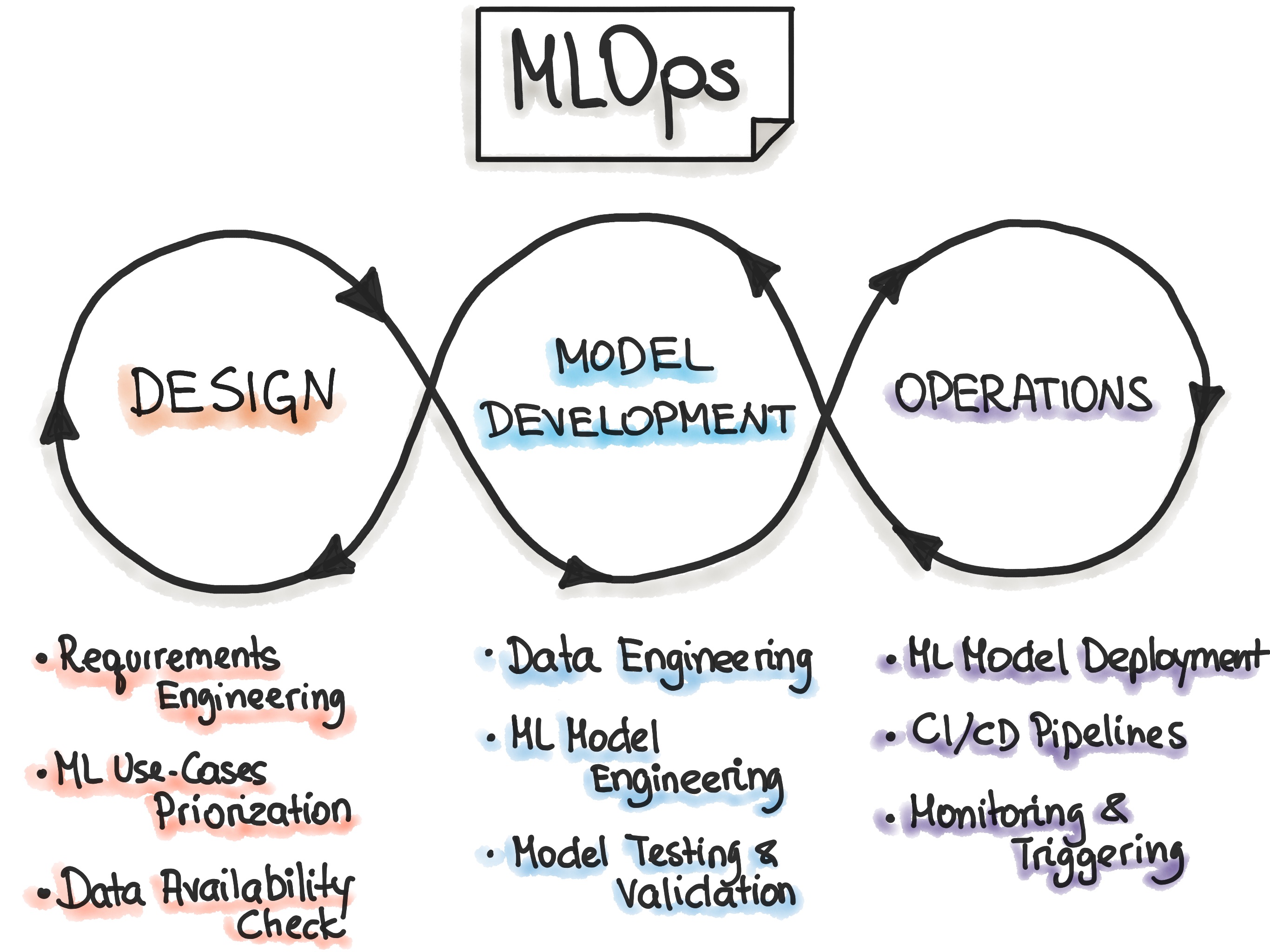
Let's break down what happens in each of these phases. The following article provides a very detailed and structured overview.
What Is the AI Development Lifecycle?
This article from Palo Alto Networks gives a comprehensive breakdown of an 8-phase lifecycle. We will map these 8 phases to our 4-stage framework. As you read, think about how these steps map to your own experience in software delivery.
Read through the article, focusing on the following phases: The Data Stage (Phases 1-3): This covers everything from idea to ready-to-use data. Read about Problem Definition, Data Collection, and Data Preparation. Notice that the Pandas and visualization skills you've just learned are core activities in Phase 3. The Model Stage (Phases 4-6): This is the core data science work of creating a predictive model. Read about Model Design, Model Training, and Model Evaluation. The Deploy Stage (Phase 7): This is where your backend and DevOps expertise is paramount. Read about Model Deployment. Pay attention to concepts like containerization and model serving via RESTful APIs, which should be very familiar. The Monitor Stage (Phase 8): Once deployed, the job isn't over. Read about Model Monitoring. This phase is critical for detecting performance degradation (model drift) and triggering the retraining process, thus closing the loop.
Operationalizing the Lifecycle: An Introduction to MLOps
Knowing the stages is one thing; building a robust, automated system to manage them is another. This is the domain of MLOps (Machine Learning Operations). MLOps applies DevOps principles to the machine learning lifecycle to enable teams to build and deploy models quickly and reliably.
From an architect's perspective, the key challenge is that you're not just managing the deployment of a single artifact (a code binary). As the diagram below shows, you're managing a pipeline through which code, models, and data all flow. A change in any of these can trigger a new "build."
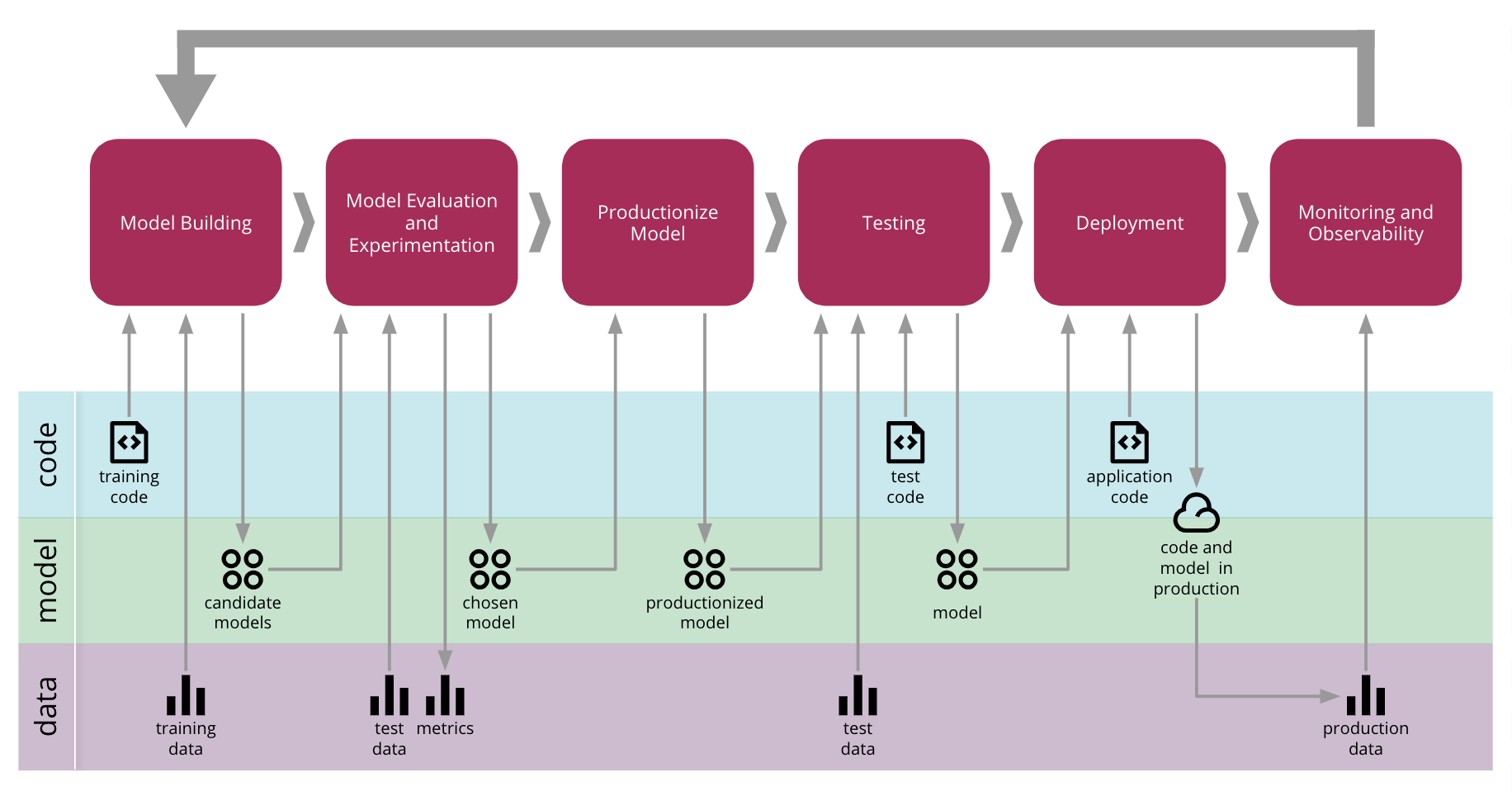
This introduces new considerations that go beyond traditional CI/CD:
- Versioning: You must version not only your training code but also your datasets and the trained models themselves.
- Testing: In addition to unit/integration tests for code, you need tests for data validation, model quality, and fairness.
- Continuous Training (CT): A concept unique to MLOps, where a production model can be automatically retrained and redeployed when new data is available or performance degrades.
The principles of MLOps are what elevate a one-off data science project into a scalable, maintainable production system.
An Architect's View: A Practical MLOps Setup on AWS
Let's make this concrete. Given your experience with AWS, seeing how these lifecycle stages translate into a tangible architecture is the most valuable step. The following video from an AWS Summit, aimed specifically at architects, provides a fantastic walkthrough.
AWS Summit ANZ 2022 - End-to-end MLOps for architects (ARCH3)
This presentation details how to construct an MLOps pipeline on AWS, starting from a very basic setup and progressively adding components.
We'll focus on the initial parts that lay the groundwork: The ML Process & MLOps Definition: First, watch the segment that outlines the standard ML process and defines MLOps. This reinforces the concepts we've just discussed. Watch from The machine learning process and then jump to the definition of MLOps from What is MLOps?. A Minimal MLOps Architecture: This is the most important part. The presenter builds a practical, starter MLOps architecture using core AWS services. This directly addresses your goals of building scalable, production-ready systems. Watch the detailed walkthrough from minimal MLOps setup. Pay close attention to how services like Git, ECR (for container versioning), S3 (for artifact storage), SageMaker Pipelines (for automation), and Model Registry are used to operationalize the lifecycle.
The architecture presented in the video beautifully illustrates how the abstract stages of "Data, Model, Deploy, Monitor" are realized with specific, interconnected services. This is the blueprint for the systems you aim to build.
Conclusion
In this lesson, we've defined the essential map for your journey as an AI System Architect. You now have a high-level understanding of the entire end-to-end process for bringing an AI solution to life.
Key Takeaways:
- The AI Development Life Cycle (Data -> Model -> Deploy -> Monitor) is an iterative loop, not a linear process. It's an extension of the SDLC principles you already master.
- The main challenge compared to traditional software is managing three evolving components: code, data, and models.
- MLOps is the engineering discipline that applies DevOps practices like CI/CD, versioning, and automation to the unique challenges of the AI lifecycle.
- As an architect, your role is to design and build the robust, automated systems (like the AWS architecture we reviewed) that enable this entire lifecycle to function efficiently and reliably in production.
With this high-level framework in place, we can now start to dive into the specifics of each stage. In our next lesson, we will take our first step into the "Model" phase by exploring how to differentiate between supervised, unsupervised, and reinforcement learning. This will equip you to take a business problem, like predicting customer churn, and correctly frame it as a specific machine learning task.