Welcome to your sixth lesson. In our previous session, we established a high-level map of the machine learning world by differentiating between supervised, unsupervised, and reinforcement learning. You now have a framework for categorizing a business problem and selecting the right paradigm, which is the foundational first step in designing any AI system.
Today, we transition from the what to the how. As an architect with a strong .NET background, one of the most immediate and critical decisions you'll face is choosing the right technology stack for deploying your ML models. This lesson directly tackles that choice by explaining the trade-offs between using Python vs. C#/.NET for ML model deployment. We will analyze this not as a "which is better" debate, but as a strategic decision with specific implications for performance, integration, and maintainability within your existing AWS and .NET environment.
The Two Worlds of AI Development
At a high level, the AI development landscape is dominated by two ecosystems. Python is the undisputed leader in research, experimentation, and data science. In contrast, C# and .NET are titans of enterprise application development, valued for their performance, reliability, and robust backend capabilities. Historically, these two worlds were separate, creating a "two-language problem" for companies wanting to productionize AI. Today, the lines are blurring.
The image below provides an excellent visualization of the traditional division of labor:
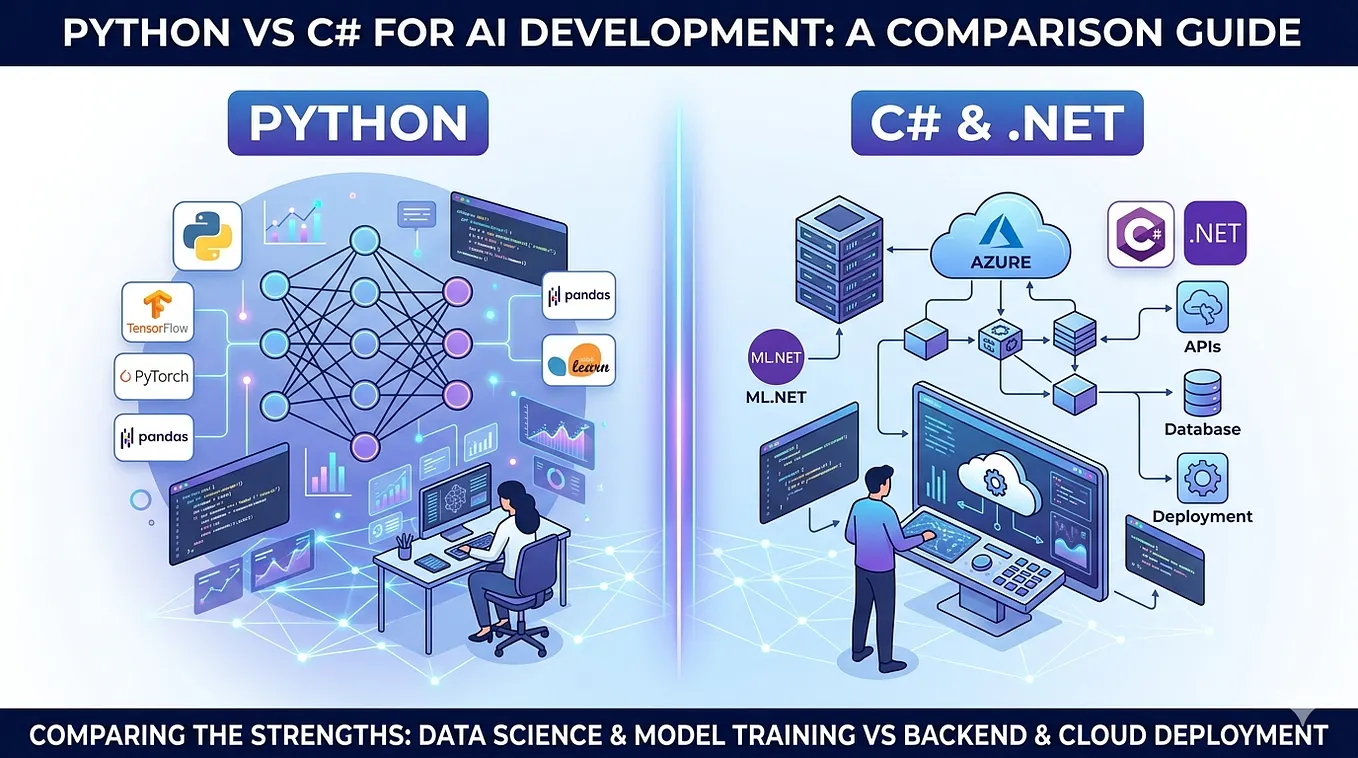
Your goal as an AI System Architect is to bridge this gap effectively. Let's break down the factors you need to consider.
A Structured Comparison of Python and .NET for ML
To make an informed architectural decision, we need to compare the two ecosystems across several key dimensions. The following article from Zenkins provides a solid, balanced overview.
.NET Vs. Python For Machine Learning Development | Zenkins
This article will provide the detailed points for our comparison. As you read, think about how each point relates to your current stack and team's expertise.
Please read the following sections to build a comprehensive picture of the trade-offs: Start by reviewing the overviews of the .NET ecosystem and the Python ecosystem for ML. Next, focus on the direct comparison of features and capabilities. Pay close attention to the discussion on language syntax, performance, and integration. Then, read about performance and scalability, which covers benchmarks and handling large datasets—key concerns for your PostgreSQL database. Finally, review the section on community and resources, as this impacts the speed of development and problem-solving.
Based on that reading and other industry observations, let's summarize the trade-offs in a table format that's useful for an architect's decision-making process.
| Factor | Python (with Scikit-learn, TensorFlow, FastAPI) | C# / .NET (with ML.NET) | Architect's Takeaway |
|---|---|---|---|
| Ecosystem & Libraries | Unmatched. Home to virtually all cutting-edge research, libraries (Hugging Face for LLMs, PyTorch for deep learning), and data tools (Pandas). | Growing but smaller. ML.NET is robust for common tasks (classification, regression, clustering). Good integration with frameworks like TensorFlow, but the ecosystem is less comprehensive. | Python is the default for R&D and complex, novel models. .NET is sufficient and often preferable for integrating well-understood ML tasks into existing business applications. |
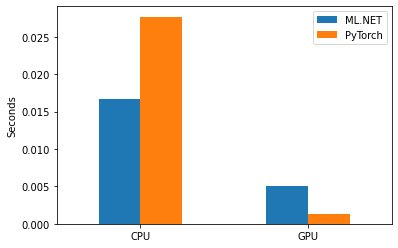
| Performance | Slower for general-purpose code (interpreted language). Relies on C/C++/CUDA backends for heavy computation. The Global Interpreter Lock (GIL) can be a bottleneck for true parallelism in a single process. | Generally higher. C# is a compiled language, offering superior performance for application logic. ML.NET is highly optimized and often outperforms Python frameworks for inference on CPU tasks. | For the raw model computation on a GPU, the difference may be minimal. For the surrounding API logic (data validation, logging, I/O), .NET will be faster. This matters in low-latency, high-throughput services. |
| Integration | High friction in a .NET shop. Requires a separate service, introducing network latency, cross-language contracts (REST/gRPC), and separate CI/CD pipelines. | Seamless. The model lives inside your existing .NET application. It's just another class library. You can leverage your existing DI, configuration, logging, and deployment patterns on AWS ECS. | This is the most compelling argument for using .NET. It dramatically simplifies the architecture, reduces operational overhead, and leverages your team's existing skills. |
| Community & Talent | Vast. An enormous global community of data scientists and ML engineers. Abundant learning resources and quick answers on Stack Overflow. | Smaller but strong. A dedicated community of .NET developers. Microsoft provides excellent documentation and support, but finding ML-specific expertise is harder. | Your team is .NET-native, which is a strong point for ML.NET. However, if you hire a dedicated data scientist, they will almost certainly be a Python expert. Your architecture must account for this. |
This performance chart illustrates a common finding when comparing inference time (the time to make one prediction) for a trained model on a CPU vs. GPU.
The Architect's Playbook: Three Deployment Strategies
The choice is not a simple binary. As an architect, your role is to select the right pattern for the job. Here are three primary strategies for deploying a model like your planned churn predictor.
Strategy 1: The Python Microservice
This is the most common pattern in polyglot environments.
- How it works: You build and train your model in Python. You then wrap it in a lightweight web framework like FastAPI and containerize it with Docker. This container is deployed on AWS ECS as a standalone microservice. Your main .NET application makes a network call to this service's
/predict-churnendpoint. - Pros: Clean separation of concerns. Your data scientists can iterate independently in their preferred environment.
- Cons: Introduces network latency. Increases operational complexity (two services to deploy, monitor, and scale). You need to manage the API contract between the services carefully.
Strategy 2: The Native .NET Solution
This is the path of least resistance for a .NET-centric organization.
- How it works: You use ML.NET to train your model directly in C#. ML.NET includes features like AutoML (Automated Machine Learning) which can automatically test different algorithms and find the best one for your data. The trained model is a file (
.zip) that you simply load and consume within your existing .NET web API. - Pros: Maximum performance, minimal architectural complexity, and seamless integration. You stay entirely within the .NET ecosystem.
- Cons: You are limited to the algorithms and capabilities available within ML.NET. This is fine for churn prediction, but might be a blocker for more advanced, research-oriented tasks.
This video from the .NET team gives a great sense of this "all-in-one" workflow.
ML.NET: Machine learning from data to production in less than 30 minutes
This video showcases the end-to-end process with ML.NET, from the challenges of productionizing ML to integrating a trained model into a .NET MAUI app.
Pay attention to these key segments: Why ML.NET?: Watch the introduction from the start to understand the core value proposition: staying in the .NET ecosystem. Production Challenges: The discussion from this point on the difficulties of moving from training to consumption is highly relevant to an architect's mindset. Model Consumption: Skip ahead and watch the demonstration from here. It shows how a trained model (.zip file) is loaded and used natively within a .NET application, highlighting the simplicity of this approach.
Strategy 3: The Hybrid Model (Train in Python, Deploy in .NET)
This strategy aims to get the best of both worlds.
- How it works: You use Python's rich ecosystem to train your model. Then, you export the trained model to the ONNX (Open Neural Network Exchange) format, an open standard for ML models. Your C# application uses the
ONNX Runtimelibrary to load this.onnxfile and run inference natively. - Pros: You get Python's best-in-class training environment and .NET's superior performance and integration for deployment. You solve the "two-language problem."
- Cons: The ONNX conversion process can sometimes be tricky for very complex or custom models. It requires your team to have some familiarity with both ecosystems.
This forward-looking article provides great context for this hybrid approach and shows how the gap between Python and C# is closing.
Is .NET 10 for AI Replacing Python?
This article argues that while Python will remain the king of research, .NET is becoming a first-class citizen for production AI.
Focus on these key ideas: Understand Python's limits in a production enterprise context. See how the C# and .NET ecosystem is evolving to be AI-native. Most importantly, read the final sections on how the future is hybrid. This directly describes Strategy 3 and is likely the most powerful long-term approach for your organization.
Conclusion
You've now dissected the critical trade-offs between the Python and .NET ecosystems for deploying machine learning models. This isn't about picking a "winner" but about making a pragmatic architectural choice based on the specific context of a project.
Key Takeaways:
- Python's strength lies in its unparalleled ecosystem for research and experimentation. Its weakness for a .NET shop is the integration friction it creates.
- .NET's strength is its seamless integration, performance, and enterprise-grade robustness, allowing you to leverage your team's existing expertise and infrastructure. Its weakness is a smaller, less mature ML ecosystem compared to Python.
- You have three primary architectural patterns:
- Python Microservice: Simple to start, but adds operational complexity and latency.
- Native .NET (ML.NET): Ideal for common ML tasks, offering the tightest integration and best performance for the service layer.
- Hybrid (Python train, .NET deploy via ONNX): A powerful strategy that combines the strengths of both worlds, representing a mature, long-term solution.
For your initial churn prediction project, both the Native .NET (Strategy 2) and Hybrid (Strategy 3) approaches are excellent choices. Strategy 1 would also work, but likely adds unnecessary complexity for this stage.
In our next lesson, we will move from architectural theory to practical application. We will take the first concrete step in our churn prediction project: formulating the business problem as a machine learning task. You'll learn how to translate a business goal like "reduce churn" into a precise, technical problem definition (binary classification) that a model can actually solve.