Welcome to the next lesson in our exploration of Azure's Data Platform. In our previous session, we developed a detailed framework for choosing between Azure SQL and Azure Database for PostgreSQL, weighing factors like ecosystem integration, workload type, and portability. That discussion was about optimizing the primary data store. Today, we turn our attention to a complementary and equally critical topic: dramatically improving application performance by adding a caching layer.
This lesson will focus on analyzing caching strategies using Azure Cache for Redis. Your primary goal is to understand the architectural trade-offs between different caching patterns, with a special emphasis on the widely-used cache-aside pattern. For a Principal Engineer, knowing when and how to implement a cache is just as important as choosing the right database, as it directly impacts performance, cost, and system resilience.
The Caching Imperative: Why Bother?
Before we dive into patterns, let's establish the fundamental value proposition of caching. A well-implemented cache can be one of the single most effective performance optimizations in a system architecture. It reduces the load on your primary database, decreases latency for your users, and can even lower costs by reducing the need to scale up expensive database tiers.
The impact is not subtle. Look at the following benchmark from Microsoft, comparing an Azure SQL Database workload with and without Azure Cache for Redis.
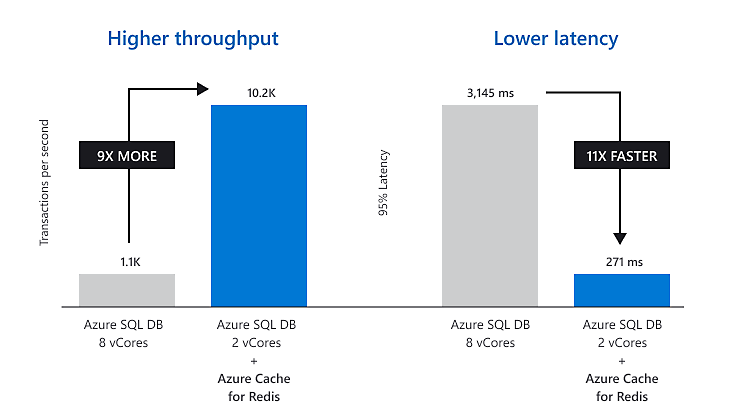
As the chart demonstrates, adding a cache isn't a minor tweak; it's a transformative architectural decision. The cache, in this case, is Azure's managed service for Redis.
What is Azure Cache for Redis?
Redis, short for REmote DIctionary Server, is an open-source, in-memory data structure store used as a database, cache, and message broker. Its main strength lies in its speed, as it keeps the dataset primarily in memory. It operates on a key-value model but supports various data structures like strings, hashes, lists, and sets, making it incredibly versatile. Azure Cache for Redis is the fully managed PaaS offering, handling the operational overhead of deployment, patching, and scaling.
Let's get a foundational overview of Redis and its most common application pattern.
John Savill provides a clear and concise introduction to Redis and the fundamental caching pattern we will be discussing.
Watch the first five minutes and forty-five seconds of the video. Focus on these key segments: The introduction to Redis explains its in-memory nature and the key-value data model. The core caching scenario walks through the logic of an application checking the cache before hitting the database. This is a perfect illustration of the cache-aside pattern. The implementation note is crucial: John explicitly states that Redis does not have a built-in "read-through" capability and that the application is responsible for the cache-aside logic.
John's walkthrough perfectly illustrates the most common caching strategy, where the cache is "to the side" of the primary data store. This brings us to the core of our lesson: the architectural patterns that govern the interaction between the application, the cache, and the database.
A Visual Guide to Caching Strategies
Choosing a caching strategy is an architectural decision that defines who controls the data flow, who owns data consistency, and where the performance trade-offs lie. The image below provides a great high-level overview of the most common patterns. We will focus primarily on Cache-Aside, but understanding the others is essential for making informed architectural comparisons.

Deep Dive: The Cache-Aside Pattern (Lazy Loading)
The Cache-Aside pattern is the most common and, as you'll see, often the most robust and pragmatic choice. Its logic is exactly what John Savill described: the application code is responsible for managing the cache.
Cache-Aside Pattern - Azure Architecture Center
This document from the Azure Architecture Center provides the canonical definition of the Cache-Aside pattern.
Read the Solution section, paying close attention to the three steps in the read flow and the accompanying diagram. Also, note the recommended approach for handling data updates: modify the data store first, then invalidate the corresponding item in the cache.
The flow is straightforward:
- The application requests data and first tries to retrieve it from the cache.
- Cache Hit: If the data is in the cache, it is returned to the application.
- Cache Miss: If the data is not in the cache, the application reads the data from the primary database.
- The application then writes this data into the cache (usually with an expiration time, or Time-To-Live/TTL) and returns it to the caller.
- For Writes/Updates: The application writes the change directly to the database and then issues a command to delete the corresponding entry from the cache. The next time the data is requested, a cache miss will occur, and the updated data will be freshly loaded from the database.
Why delete instead of update the cache on a write? Deleting (invalidating) is simpler and prevents a potential race condition where you might write a stale value into the cache if another process updated the database in the interim.
This pattern is so prevalent because it's simple, effective, and resilient.
Redis Cache Patterns Explained: Cache-Aside vs Read-Through vs Write-Through vs Write-Behind
This article from C# Corner offers a pragmatic, real-world perspective on why Cache-Aside is the architect's default choice.
Read the sections titled "Pattern 1: Cache-Aside (Lazy Loading)" and the discussion of its production benefits and trade-offs.
The key architectural benefit highlighted here is resilience. If your Redis cache fails, the application doesn't crash. It continues to function by falling back to the database, albeit with degraded performance. For a Principal Engineer, designing systems that degrade gracefully rather than fail catastrophically is a top priority.
Comparing Caching Patterns: An Architect's Framework
While Cache-Aside is the default, other patterns exist to solve for different trade-offs, particularly around data consistency and write performance. Understanding them is key to justifying your choice of Cache-Aside or knowing when to deviate.
Let's use a "compare and contrast" approach.
5 Caching Strategies | System Design Interview | Cache Aside, Read through, Write through | Patterns
This short video provides a quick, visual walkthrough of five key patterns, making it easy to compare their data flows.
Watch the segments for each pattern to solidify your mental model of the data flow: Cache-Aside (as we've discussed) Read-Through Write-Through Write-Back Write-Around
Let's synthesize this into a decision framework:
| Pattern | Read Path | Write Path | Key Benefit | Major Drawback | Best For |
|---|---|---|---|---|---|
| Cache-Aside | App checks cache; on miss, reads DB & populates cache. | App writes to DB, then invalidates cache entry. | Resilience. App works if cache fails (just slower). Loose coupling. | Potential for stale data until TTL expires or invalidation. | General-purpose, read-heavy workloads. The safe default choice. |
| Read-Through | App reads from cache. Cache reads from DB on miss. | (Paired with Write-Through or Write-Around) | Simplified app code. Caching logic is encapsulated. | Tight coupling. Cache failure means read failure. Not native to Redis. | Read-heavy workloads where cache availability is guaranteed. |
| Write-Through | App reads from cache (data is generally fresh). | App writes to cache; cache writes synchronously to DB. | Strong consistency. Cache and DB are always in sync after a write. | High write latency. The write operation is only as fast as the slowest of cache + DB. | Workloads where data consistency is critical and write latency is acceptable. |
| Write-Behind (Write-Back) | App reads from cache (data is fresh). | App writes to cache; cache writes asynchronously to DB later. | Extremely low write latency. Great for write-heavy workloads. | High risk of data loss if cache fails before writing to DB. | Analytics, logging, or workloads where some data loss is acceptable for performance. Not for transactional data. |
Beyond Database Caching: A Modern Use Case for AI
Your interest in AI tools for software development makes this final point particularly relevant. The utility of Redis caching extends far beyond just offloading a relational database. A powerful modern application is in the world of Large Language Models (LLMs).
Let's return to John Savill's video to see a forward-looking application of Redis caching.
Watch the segment from "Artificial Intelligence". He explains how Redis can be used for semantic caching of LLM responses to reduce both latency and, crucially, the cost of token consumption.
This is an excellent example of applying a classic architectural pattern to a modern problem. By caching the vector embeddings of prompts and their corresponding responses, you can serve answers for semantically similar questions directly from the cache, bypassing expensive and time-consuming calls to the LLM. This demonstrates how a deep understanding of foundational patterns allows an architect to innovate and optimize in new domains.
Conclusion
In this lesson, we analyzed how to dramatically improve application performance by implementing a caching layer with Azure Cache for Redis. You learned that choosing a caching strategy is a critical architectural decision with direct impacts on performance, consistency, and resilience.
Here are your key takeaways:
- Caching provides a massive performance boost by reducing latency and offloading the primary database, often enabling you to use smaller, cheaper database tiers.
- The Cache-Aside pattern is the pragmatic default for most applications. It provides a good balance of performance and resilience, as the application can continue to function (though slower) even if the cache fails.
- Other patterns (Read-Through, Write-Through, Write-Behind) optimize for different goals, such as code simplicity or write consistency, but often introduce tighter coupling or higher risks (like data loss or increased latency).
- Understanding the trade-offs is paramount. As an architect, you must be able to justify your choice of pattern based on the specific requirements of the application for consistency, performance, and fault tolerance.
- Caching is a versatile pattern with applications beyond traditional database offloading, including modern use cases like optimizing cost and latency in AI applications.
In our final lesson for this module, we will synthesize all we've learned about Azure's database and caching services. You will develop a comprehensive decision framework for selecting the right combination of data services for any given architectural scenario, cementing your ability to make these critical platform decisions.