Welcome to the final lesson in our module on Azure's Data Platform. Over the past few lessons, we've dissected individual services, comparing Azure SQL with PostgreSQL, exploring Cosmos DB's APIs, and analyzing caching patterns with Azure Cache for Redis. Now, we'll synthesize this knowledge into a coherent, overarching methodology.
Your goal for this lesson is to develop a decision framework for choosing the right Azure database service for a given architectural scenario. This is arguably one of the most critical skills for a Principal Engineer, as these foundational choices have long-lasting impacts on a system's performance, scalability, cost, and maintainability. We will construct a step-by-step mental model for navigating Azure's diverse data landscape, moving from high-level requirements to specific service selection.
The First Question: A Litmus Test for Engineering Maturity
Before we even begin to compare Azure services, a senior engineer asks a more fundamental question: "Are we certain we need a new database?" Migrating a production data store is a high-risk, high-cost endeavor. The impulse to adopt a new, "better" technology must be tempered with rigorous analysis of the existing system.
The following video from ByteByteGo, while vendor-agnostic, perfectly captures this crucial first step in the decision process. It's a mindset check before embarking on a major architectural change.
How To Choose The Right Database?
This video discusses the critical questions to ask before deciding to migrate to a new database.
Watch the segment from the beginning until the conclusion on migration risks. Pay close attention to the proposed alternatives to migration, such as configuration tuning, architectural changes like adding a cache or read replicas, and sharding.
This line of questioning should feel familiar. The strategies mentioned—especially adding a cache—directly connect to our previous lesson on Azure Cache for Redis. The core principle is to first exhaust optimization opportunities before undertaking a migration. Only when you've proven that the current architecture's fundamental limits have been reached should you proceed. This discipline separates a senior architect from a technology enthusiast.
Step 1: Codifying Requirements - The Foundation of Your Framework
Assuming you've passed the initial test and a new data store is genuinely required, the next step is to move from a vague problem statement ("the database is slow") to a precise set of requirements. A robust decision is impossible without first defining the criteria for success.
The Azure Well-Architected Framework provides a superb structure for this. It's not about solutions yet; it's about deeply understanding the problem domain.
This document from the Well-Architected Framework outlines how to approach service selection by starting with requirements.
First, read the section "Understand workload requirements." Then, jump down to the sections "Evaluate data store requirements" and "Evaluate database requirements." These sections emphasize assessing needs like data model, read/write patterns, and scalability before choosing a technology.
To make this process concrete, Microsoft provides a checklist of requirement categories. Systematically working through these areas will form the input for your decision.
Prepare to Choose a Data Store in Azure - Microsoft Learn
This guide offers a detailed breakdown of the different facets of data service requirements.
Please read the section "Identify data services requirements." Focus on the five key categories: Functional, Nonfunctional, Cost and management, Security and governance, and DevOps.
Let's summarize the critical questions you should be asking within these categories, keeping your Principal Engineer role in mind:
- Functional: What is the nature of the data? Is it structured relational data, or semi-structured JSON that benefits from a flexible
schema-on-readmodel? What consistency level is required? Strong consistency for a financial ledger is very different from eventual consistency for a social media feed. - Nonfunctional: What are the specific latency and throughput targets (e.g., "P99 latency for reads must be <50ms")? Does the application require global distribution with low-latency reads and writes in multiple regions?
- Management: What is your team's operational appetite? Do you require OS-level control (IaaS), or do you prefer to offload patching and maintenance to a managed platform (PaaS)? This is a direct trade-off between control and operational overhead.
- Security: How will data be secured at rest and in transit? Does the service need to integrate into a VNet with private endpoints?
- DevOps: What are your team's existing skills? Choosing a PostgreSQL-based service for a team of Postgres experts is a lower-risk proposition than adopting a niche NoSQL database that requires significant ramp-up.
Having explicit, written answers to these questions is the bedrock of a defensible architectural decision.
Step 2: Navigating the Options - A Decision Tree Approach
With your requirements clearly defined, you can now begin to map them to Azure's services. A decision tree is an excellent tool for this, as it forces you to address the most impactful questions first.
The flowchart below provides a visual guide for navigating the Azure data store landscape. Let's walk through its logic, using your defined requirements to guide our path.
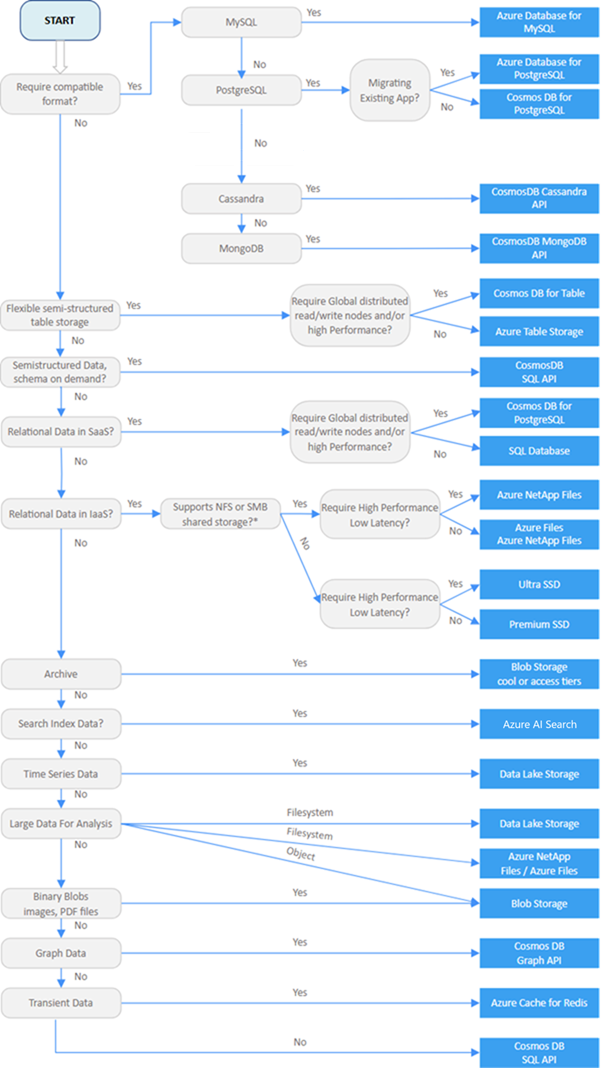
We can trace paths through this tree using the "Key questions" identified by Microsoft.
Prepare to Choose a Data Store in Azure - Microsoft Learn
This article lists the key questions that correspond to the branches in the decision tree.
Read the section "Key questions" to understand the logic behind the flowchart's decision points.
Let's analyze the major forks in the road:
-
Level of Control (IaaS vs. PaaS): One of the first branches distinguishes between "Relational Data in IaaS" and "Relational Data in SaaS (PaaS)." If your requirements dictate full control over the OS and database configuration (e.g., installing custom extensions not supported by PaaS), your path leads to SQL Server on an Azure VM. If not, you proceed down the more common PaaS route.
-
Data Model (Relational vs. NoSQL): This is the most significant fork.
- If your data is strongly relational and requires complex joins and transactions, you'll follow the path to services like Azure SQL Database, Azure Database for PostgreSQL, or Azure Database for MySQL. The choice between them depends on factors like open-source compatibility requirements or specific SQL Server ecosystem features.
- If your data is non-relational, the tree branches further based on the specific NoSQL model.
-
NoSQL Data Models: Your familiarity with AWS DynamoDB is relevant here. Just as DynamoDB supports a key-value/document model, Azure's NoSQL offerings are specialized.
- Key-Value/Table: For simple key-value lookups, the tree presents Azure Table Storage (cost-effective, basic) and Cosmos DB for Table. The key differentiator is the question "Require Global distributed read/write nodes and/or high Performance?". If yes, Cosmos DB is the clear choice due to its turnkey global distribution and single-digit millisecond latency guarantees.
- Document: For semi-structured data like JSON ("schema on demand?"), the path leads to Cosmos DB SQL API. This is Azure's flagship NoSQL offering, analogous in many ways to DynamoDB but with a familiar SQL-like query language.
- Column-Family/Graph/etc.: If you are migrating from Cassandra or need a native graph model, the tree points to the corresponding Cosmos DB APIs (Cassandra, Gremlin). This highlights Cosmos DB's multi-model capability, allowing you to use different APIs against the same underlying engine.
-
Specialized Workloads: The tree also accounts for highly specific use cases like Search Index Data (Azure AI Search), Time Series Data (Azure Data Explorer), and Large Data for Analysis (Azure Data Lake Storage).
Step 3: Embracing Complexity - Polyglot Persistence
The decision tree is a powerful tool for choosing a primary data store for a specific workload component. However, modern, complex applications are rarely served by a single database. The reality is that different parts of a system have different requirements, leading to an architecture that uses multiple, specialized data stores. This is the principle of polyglot persistence.
For example, a large e-commerce platform might use:
- Azure SQL Managed Instance for its core transactional engine (orders, payments, customer data) for strong consistency.
- Cosmos DB SQL API for its product catalog, which benefits from a flexible schema and global read distribution for fast page loads worldwide.
- Azure Cache for Redis to store user session data and shopping carts for extreme low-latency access.
- Azure AI Search to power the product search bar.
- Azure Data Lake Storage as the sink for all operational data, feeding into an analytics platform.
As a Principal Engineer, your role is not to find the "one true database" but to compose a solution from these specialized services, applying the decision framework to each component of the architecture.
Step 4: Final Validation - Due Diligence and Benchmarking
Once your framework has helped you narrow the choices to one or two candidates for a given workload, the final step is rigorous validation. This is where you apply healthy skepticism and empirical testing.
Let's return to the ByteByteGo video for advice on this final, critical phase.
How To Choose The Right Database?
This video offers excellent, real-world advice on vetting and testing your chosen database candidates.
Watch the remaining two segments. First, watch the section on performing due diligence. Note the advice to prefer battle-tested technologies and to be skeptical of marketing claims by digging into the "Limits" and "FAQ" documentation. Next, watch the segment on benchmarking and migration planning. The emphasis on testing with realistic data, focusing on P99 latency, and trying risky operational tasks is paramount.
This final step is non-negotiable. No amount of on-paper analysis can replace a proof-of-concept that tests the service against your specific access patterns and failure scenarios. Benchmarking validates your assumptions and uncovers the "hidden costs" or trade-offs that might not be obvious from the marketing materials.
Conclusion
In this capstone lesson, you've constructed a comprehensive decision framework for selecting Azure data services, a process that goes far beyond simply picking a name from a list. It's a multi-stage methodology rooted in engineering discipline.
Here are your key takeaways:
- Question the Premise First: Before choosing a new database, always validate that you've exhausted optimization options (tuning, caching, scaling) for your current system.
- Build on a Foundation of Requirements: Use a structured approach (Functional, Nonfunctional, Management, Security, DevOps) to codify the precise needs of your workload before evaluating any solutions.
- Use a Decision Tree to Navigate: A decision tree, guided by key questions about data model and characteristics, provides a logical path through Azure's diverse service offerings.
- Think in Compositions (Polyglot Persistence): Recognize that complex applications are best served by a combination of specialized data stores, not a single monolithic database.
- Validate with Rigorous Due Diligence: Never trust marketing claims alone. Always read the fine print ("Limits" pages) and perform realistic benchmarks to validate that a service meets your P99 performance and operational requirements.
This concludes our module on the Azure Data Platform. You now have the tools to analyze requirements, compare services, and design robust, scalable, and performant data solutions on Azure.
In our next module, we will move up the technology stack to focus on Application Architecture, starting with how to build resilient and decoupled systems using Azure's messaging and eventing services.