Welcome to our next lesson in the Data Platform module. In our previous session, we established a critical distinction: "Azure Cosmos DB for PostgreSQL" is not a native Cosmos DB API but a separate, distributed PostgreSQL service based on the Citus extension. This distinction perfectly sets the stage for today's topic, where we will move fully into the world of managed relational databases on Azure.
This lesson focuses on one of the most common and fundamental architectural decisions you will face: choosing between a Microsoft-native relational database and a managed open-source equivalent. We will compare Azure SQL Database with Azure Database for PostgreSQL (Flexible Server). Your goal is to develop a decision framework for selecting the right service, not just based on technical features, but on the broader context of cost, ecosystem integration, team expertise, and long-term strategy—precisely the kind of analysis expected of a Principal Engineer.
The Central Decision: Ecosystem vs. Portability
At its core, the choice between Azure SQL and Azure PostgreSQL is a strategic one. Are you building within the tightly integrated Microsoft ecosystem, or are you prioritizing open-source standards and cloud portability? Both are superb databases, but they are optimized for different philosophical and technical approaches.
SQL Server vs PostgreSQL | Enterprise Comparison | FreedomDev
This article from FreedomDev, a consultancy with deep experience in both databases, provides a refreshingly pragmatic and senior-level perspective that cuts through marketing claims. It frames the decision exactly as an architect should: in terms of total cost, existing stack, and strategic direction.
First, read the introduction, "The Enterprise Database Decision", to grasp the high-level business and technical trade-offs. Then, jump to the section "Ecosystem & Integration". This part crystallizes the core value proposition of each database within its respective technology stack.
As the article makes clear, the decision is rarely about which database is "faster" in a universal sense. It's about friction. Azure SQL is the path of least friction in a Microsoft-centric world of .NET, Power BI, and Microsoft Entra ID. PostgreSQL is the natural fit for polyglot, Linux-based microservice architectures that value open standards and avoiding vendor lock-in.
With this strategic frame in mind, let's dive into the architectural specifics of each managed offering in Azure.
Azure Database for PostgreSQL – Flexible Server
Azure Database for PostgreSQL (Flexible Server) is Microsoft's premier PaaS offering for open-source PostgreSQL. It is designed to provide maximum control and flexibility, closely mirroring a self-managed environment while handling the operational burdens of patching, backups, and high availability.
Azure PostgreSQL Flexible Deep Dive
John Savill's deep dive on Flexible Server provides an excellent and clear walkthrough of its architecture and capabilities.
Watch the first twelve minutes to get a comprehensive overview. Start with the introduction to understand why PostgreSQL is a compelling choice, its open-source nature, and common use cases like Oracle migrations. Next, watch the segment on managed offerings in Azure, which clarifies that Flexible Server is the current, primary offering. Finally, focus on the core building blocks of the service. Pay close attention to the concepts of the single primary instance, VM-based isolation, extensive server parameters, and compute/storage options like burstable SKUs.
The key architectural takeaways from the video are:
- Linux-Native: The service runs on a Linux VM, which is the natural habitat for PostgreSQL, leading to a simplified and performant architecture.
- High Control: You have access to hundreds of server parameters, allowing for deep tuning that is often not possible in more abstracted PaaS offerings.
- Cost-Effective Options: Features like burstable compute tiers and the ability to stop/start the server make it economical for development and test environments.

High Availability and Disaster Recovery
For production workloads, high availability is non-negotiable. Flexible Server implements a robust, zone-redundant HA model.
Azure PostgreSQL Flexible Deep Dive
Continuing with John Savill's video, let's look at how Flexible Server handles reliability.
First, watch the segment on High Availability. This covers the use of a hot standby with synchronous physical streaming replication to provide zero data loss (RPO=0) and automatic failover within a region. Then, watch the explanation of Read Replicas. Understand that these use asynchronous replication and serve two purposes: read-scaling for performance and disaster recovery (with manual failover) across regions.
Here is a diagram illustrating the high-availability architecture:
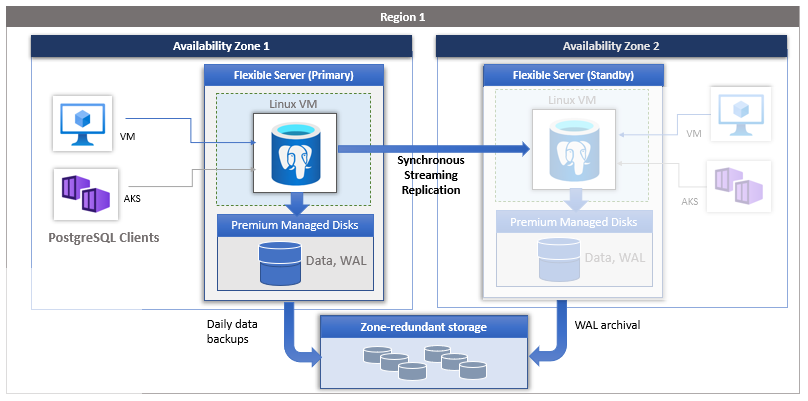
This architecture of a primary, a synchronous hot-standby for HA, and asynchronous read replicas for DR/read-scaling is a classic, robust pattern. As the freedomdev.com article noted, PostgreSQL HA is an architecture you build from proven components (streaming replication, etc.), and Azure's Flexible Server packages this architecture into a managed service.
Azure SQL Database
Azure SQL is Microsoft's flagship relational Database-as-a-Service (DBaaS), representing the pinnacle of integration with the Microsoft ecosystem. It's the cloud-native evolution of SQL Server, a product with decades of enterprise pedigree.
Where PostgreSQL on Azure offers flexibility and control that feels close to IaaS, Azure SQL offers a more abstracted, "serverless" feel in its most common deployment models, with features that are deeply integrated into the platform.
Prepare to Choose a Data Store in Azure - Microsoft Learn
This Microsoft Learn document provides the official positioning for SQL Server options in Azure.
Read the section asking "Will your workloads use SQL Server?" to understand the fundamental choice between IaaS and PaaS. Then, review the table under the "Your goal" heading, specifically the rows for SQL Database and Azure Database for PostgreSQL to see how Microsoft positions their primary use cases.
Key Differentiators and Strengths
While PostgreSQL Flexible Server provides an excellent managed open-source experience, Azure SQL (and its on-premise ancestor, SQL Server) has unique features that make it a compelling choice in certain scenarios.
SQL Server vs PostgreSQL | Enterprise Comparison | FreedomDev
Let's return to the FreedomDev article to examine the specific technical advantages of SQL Server.
First, read the section on Performance. Pay close attention to the description of columnstore indexes, a significant advantage for analytical (OLAP) workloads. Next, read about High Availability. Note the description of Always On Availability Groups as a polished, integrated "product" in contrast to PostgreSQL's component-based "architecture".
The key architectural takeaways for Azure SQL are:
- Integrated HA: "Always On" technology is a mature, built-in feature that provides HA and DR with less manual configuration compared to assembling PostgreSQL components.
- Analytics Powerhouse: The native columnstore index feature provides a massive performance boost for data warehousing and analytical queries by organizing data by column instead of by row. This allows for better compression and vectorized query execution. For mixed transactional and analytical workloads (HTAP), this can be a decisive advantage.
- Deep Ecosystem Integration: As previously discussed, native integration with .NET's Entity Framework, Power BI, and Microsoft Entra ID simplifies development and management within a Microsoft-centric environment.
The Architect's Decision Framework
Now, let's synthesize this into a framework. When presented with a new relational database requirement, here are the key questions to guide your decision between Azure Database for PostgreSQL and Azure SQL.
| Dimension | Favorable to Azure Database for PostgreSQL | Favorable to Azure SQL Database | Rationale & Key Considerations |
|---|---|---|---|
| Primary Workload | OLTP, Web Apps, JSON-heavy workloads | OLTP, Data Warehousing, Mixed (HTAP) workloads | PostgreSQL's JSONB type is more mature and performant. SQL Server's columnstore indexes give it a significant edge for analytics. |
| Technology Stack | Linux, Python, Java, Node.js, Go (Polyglot) | .NET/C#, Power BI, SSIS, Microsoft Entra ID | Choose the path of least friction. Deep integration with Entity Framework and SSIS makes Azure SQL a natural choice for Microsoft shops. |
| Team Expertise | Team knows PostgreSQL, values open-source standards | Team knows SQL Server / T-SQL, leverages SSMS | Leverage existing skills to reduce training overhead and increase operational velocity. |
| Portability & Lock-in | High priority: goal is multi-cloud or easy migration off Azure | Low priority: deeply invested in the Azure ecosystem | PostgreSQL is an open standard. Migrating between AWS RDS, Google Cloud SQL, and Azure is straightforward. Azure SQL ties you to the Microsoft platform. |
| Cost | Cost-sensitivity is high, especially for non-production | Performance and integrated features are worth the premium | PostgreSQL is open source with no licensing fees. In Azure, managed PostgreSQL is typically 30-50% cheaper than a comparable Azure SQL tier. |
| Control vs. Abstraction | Need fine-grained control over server parameters | Prefer a more managed, abstracted PaaS experience | Flexible Server exposes hundreds of postgresql.conf settings. Azure SQL's higher-level tiers manage more of this for you. |
SQL Server vs PostgreSQL | Enterprise Comparison | FreedomDev
To see this framework in action, let's look at some real-world scenarios.
Read the section "Perfect Use Cases". It provides four concrete examples that illustrate when to choose one, the other, or even both.
These examples—a new app choosing PostgreSQL for its extensions, a SaaS company migrating to PostgreSQL to cut costs, a healthcare firm staying on SQL Server to mitigate risk, and a hybrid architecture using both—are powerful illustrations of how architectural decisions are made in the real world.
Conclusion
In this lesson, we established a comprehensive framework for comparing Azure's premier managed relational databases. You learned that the decision between Azure Database for PostgreSQL (Flexible Server) and Azure SQL Database is not a simple matter of technical benchmarks but a strategic choice based on your architectural priorities.
Here are the key takeaways:
- It's a Trade-off: The core decision balances the deep ecosystem integration and unique analytical features of Azure SQL against the open-source portability, cost-effectiveness, and community-driven innovation of PostgreSQL.
- Architecture Matters: Both services offer robust, zone-redundant high availability. Azure SQL provides it as a polished, integrated "product" (Always On), while Flexible Server offers a managed version of the classic PostgreSQL "architecture" (synchronous streaming replication).
- Workloads are Specific: For mixed analytical and transactional (HTAP) workloads, Azure SQL's columnstore indexes are a major advantage. For applications with heavy JSON manipulation, PostgreSQL's mature
JSONBsupport is superior. - Context is King: The right choice depends on your organization's existing technology stack, team expertise, risk tolerance, and long-term cloud strategy.
In our next lesson, we will explore a service that complements both of these databases: Azure Cache for Redis. We will analyze caching strategies and patterns, like cache-aside, to see how you can dramatically improve application performance by reducing the load on your primary database.