Welcome to our second lesson on Azure's database services. In the previous lesson, we established a decision framework for choosing between Azure's PaaS offerings for relational data: Azure SQL Database and Managed Instance. We focused on the trade-off between cloud-native design and migration compatibility.
Now, we shift our focus from the relational world to the flexible, globally-distributed domain of NoSQL. This lesson introduces Azure Cosmos DB, Microsoft's flagship multi-model database service. Specifically, we will address a core architectural concept that is critical for designing scalable, global applications: describing Azure Cosmos DB's consistency models and their trade-offs.
Your experience with AWS DynamoDB provides an excellent reference point. While DynamoDB offers a binary choice between eventual and strong consistency, you will find that Cosmos DB provides a more nuanced spectrum of five distinct levels. Understanding this spectrum is key to making precise architectural decisions that balance consistency, latency, availability, and cost.
The Consistency Spectrum: A Fundamental Trade-off
In any distributed database that replicates data across multiple locations for high availability and low latency, there is an inherent tension between these goals and the guarantee that every read returns the most up-to-date data. This trade-off is often described by the PACELC theorem, an extension of the CAP theorem, which states that in case of a network partition (P), a system must choose between Availability (A) and Consistency (C), and even when the system is running normally (Else), it must trade between Latency (L) and Consistency (C).
Azure Cosmos DB makes this trade-off explicit by offering five well-defined consistency levels. As an architect, your choice determines the fundamental behavior of your application.
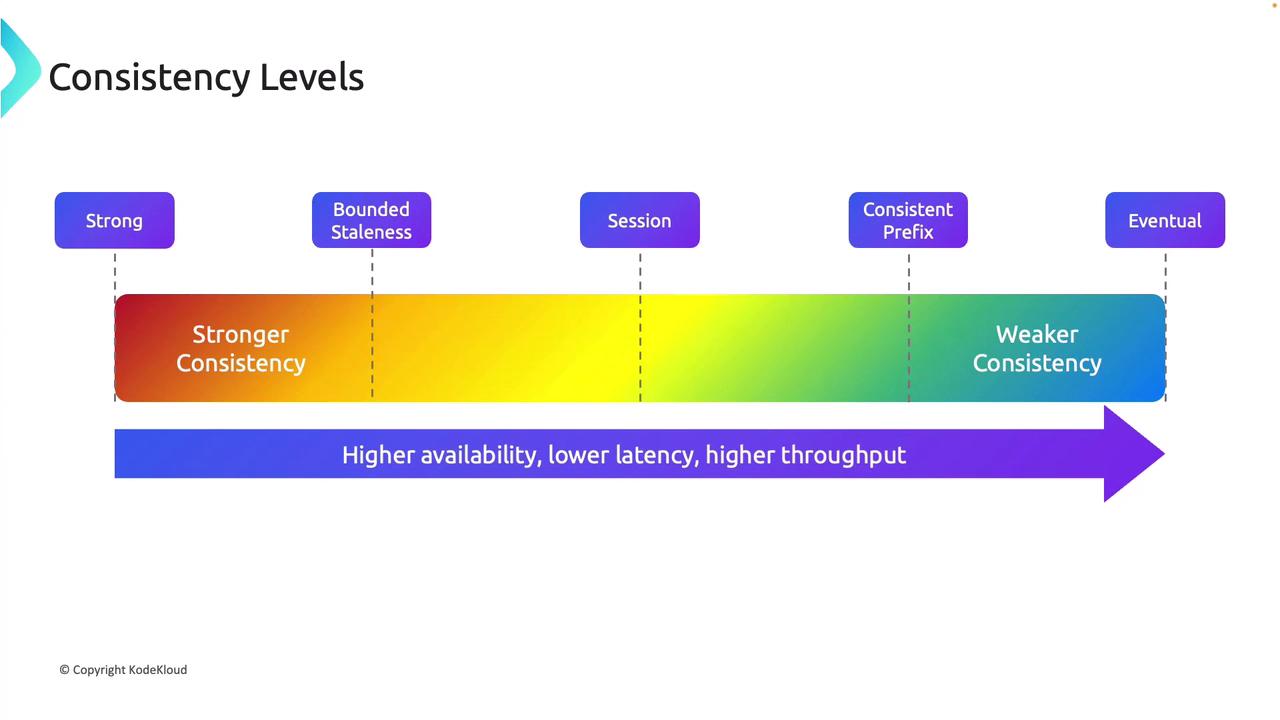
A Broader Spectrum than DynamoDB
Before diving into each level, it's helpful to frame this in the context of your familiarity with DynamoDB. DynamoDB provides two options: Strongly Consistent Reads and Eventually Consistent Reads (the default). Cosmos DB expands on this by providing three intermediate levels, giving you more granular control.
The most important of these is Session consistency, which is the default for Cosmos DB accounts. Let's hear a quick take on why this is a significant advantage.
Comparing AWS DynamoDB with Azure Cosmos DB
This clip from a comparison video by Nick Chapsas highlights the key difference in consistency options between DynamoDB and Cosmos DB.
Watch the brief segment from discussing the consistency levels. The speaker specifically calls out Session consistency as a powerful default that guarantees a user can read their own writes, a common requirement that often forces developers to use strong consistency in other systems.
This ability to choose a "good enough" consistency level that isn't the absolute strongest or weakest is a core design feature of Cosmos DB.
A Tour of the Five Consistency Models
To build a strong intuition for each level, we will explore them from weakest to strongest. The following video uses excellent, practical analogies for each model. We will use it as a guide, supplemented with technical details from the official documentation.
Consistency | Azure Cosmos DB Essentials Season 1
This video from the Azure Cosmos DB Essentials series provides a fantastic conceptual overview of the five consistency models and their trade-offs.
First, watch the introduction from which sets the stage for why consistency is a critical concept in a distributed database like Cosmos DB.
Now, let's examine each level.
1. Eventual Consistency
This is the weakest model, offering the highest performance but the fewest guarantees.
- Guarantee: There are no ordering guarantees for reads. With enough time, all replicas will eventually converge. A client may read values that are older than previously read values.
- Analogy: As the video explains, this is perfect for "likes, retweets, or non-threaded comments" where the exact, real-time count is not critical.
- Trade-off: You get the lowest latency, highest read throughput, and highest availability. It's the most "performant" option if your application can tolerate stale and potentially out-of-order data.
Consistency | Azure Cosmos DB Essentials Season 1
Let's continue with the video's explanation of Eventual consistency.
Watch the segment from on Eventual consistency. Note the emphasis on "zero guarantees" but the highest performance.
2. Consistent Prefix
This level adds a simple but important guarantee: order.
- Guarantee: Reads will never see out-of-order writes. If a set of writes were performed in the order A, B, C, a client might see A, then A, B, and finally A, B, C, but never A, C.
- Analogy: The video's group chat example is perfect. Messages appear in the order they were sent, even if there's a delay in you seeing the latest ones.
- Trade-off: Offers low latency and high throughput, similar to Eventual, but is crucial for scenarios where the sequence of events matters.
Consistency | Azure Cosmos DB Essentials Season 1
Now, watch the explanation of Consistent Prefix.
The segment from details Consistent Prefix, using the group chat analogy to make the "in-order" guarantee clear.
3. Session Consistency
This is the default and most widely used level, providing a pragmatic balance for many applications.
- Guarantee: Within a single client session (typically scoped to a user on a specific device), it provides read-your-writes and write-follows-reads guarantees. This means a user will always see the effect of their own writes immediately. For other sessions, it behaves like Consistent Prefix.
- Analogy: The online shopping cart is the classic example. When you add an item to your cart, you expect it to be there when you refresh the page. Session consistency ensures this without incurring the global performance penalty of Strong consistency.
- Trade-off: This is the sweet spot for user-centric applications. It delivers the performance benefits of weaker consistency (high availability, high throughput) while providing a strongly consistent experience for the user interacting with the system.
Consistency | Azure Cosmos DB Essentials Season 1
Next is the crucial Session consistency level.
Watch the section from on Session consistency. This explains the concept of a session token and how it enables the "read-your-writes" guarantee.
4. Bounded Staleness
This level allows you to quantify and limit how "stale" your data can be.
- Guarantee: Reads might lag behind writes by at most a configurable amount, defined either by 'K' versions (number of updates) or a time interval 'T'. It also guarantees Consistent Prefix (reads are never out-of-order).
- Analogy: The video's mobile delivery app example is insightful. You need low write latency to accept orders quickly, and write order matters. You can tolerate a small delay in analytics dashboards reflecting those orders, but the delay must be bounded.
- Trade-off: This is for globally distributed applications where you need predictable, low-latency reads with a guarantee that the data is not "too old." It provides stronger guarantees than Session without the high write latency of Strong.
Consistency | Azure Cosmos DB Essentials Season 1
Let's see how Bounded Staleness works.
The segment from explains Bounded Staleness and its configurable staleness window.
5. Strong Consistency
This is the strongest guarantee, equivalent to linearizability in traditional database theory.
- Guarantee: A read is guaranteed to return the most recent committed version of an item. A client will never see an uncommitted or partial write.
- Analogy: An online auction is the perfect use case. There can be only one winning bid, and all participants must see the same, most recent bid at all times.
- Trade-off: You get the highest level of data correctness. However, this comes at a significant cost:
- Higher write latency: A write must be replicated and committed to a quorum of replicas in all associated regions before it is acknowledged as successful.
- Reduced availability: If a network partition prevents replication to all regions, write operations may fail.
- Incompatible with multi-region writes.
Consistency | Azure Cosmos DB Essentials Season 1
Finally, let's examine Strong consistency.
Watch the video's explanation from on Strong consistency. Pay close attention to the concept of a "majority quorum" and the implications for latency and throughput.
The Architect's Decision Framework: Analyzing the Trade-offs
Now that you understand each level, let's synthesize this into a decision framework based on the key architectural trade-offs. The official Microsoft Learn documentation provides precise details on these trade-offs.
Consistency level choices - Azure Cosmos DB
This official documentation provides the definitive guide to each consistency level. We will use it to solidify our understanding with technical specifics.
Please read the descriptions for each of the five consistency levels. Start with the introduction and the list of levels under the initial explanation. Then, read the detailed sections for: Strong consistency Bounded staleness consistency Session consistency Consistent prefix consistency Eventual consistency As you read, focus on the guarantees each level provides and the brief description of its ideal use case.
With those details in mind, let's analyze the trade-offs across three critical axes for a principal engineer: Performance, Durability, and Cost.
1. Performance (Latency & Throughput)
Weaker consistency directly translates to better performance.
- Read Throughput: Reads for Session, Consistent Prefix, and Eventual are served from a single replica, consuming
1 Request Unit (RU)for a 1KB item. Reads for Strong and Bounded Staleness must be served from a quorum of replicas (a "minority quorum") to ensure consistency, and therefore consume2 RUsfor the same read. This means for the same provisioned throughput, you get half the read performance with stronger models. - Write Latency: For all levels except Strong, write latency is low as the write only needs to commit to a local majority of replicas within a single region before being acknowledged. For Strong consistency, the write must commit to a global majority across all regions, making write latency a function of the round-trip time between your two farthest regions.
Consistency level choices - Azure Cosmos DB
Let's now examine the documentation's sections on performance and cost.
Read the section Consistency levels and latency to understand the write latency penalty of Strong consistency. Then, review the table and explanation under Consistency levels and throughput to see the impact on read RU cost.
2. Data Durability (Recovery Point Objective - RPO)
Your choice of consistency level has a direct impact on potential data loss during a region-wide outage. RPO is the maximum period of recent data updates you can tolerate losing.
- Strong Consistency: Offers an RPO of 0. Because every write is synchronously committed to all regions, a regional failover results in no data loss.
- Weaker Levels (Session, Consistent Prefix, Eventual): In a multi-region setup, these have an RPO of < 15 minutes. Because replication to other regions is asynchronous, a catastrophic failure of the primary write region could result in the loss of data written within the last few minutes that hadn't yet been replicated.
- Bounded Staleness: Offers a tunable RPO, defined by your configured K (versions) or T (time).
This is a critical business decision. If zero data loss is an absolute, non-negotiable requirement, Strong consistency is your only option, and you must accept the associated performance trade-offs.
Consistency level choices - Azure Cosmos DB
The relationship between consistency and RPO is a crucial architectural consideration.
Review the table and explanation in the section Consistency levels and data durability. This table clearly maps each consistency level to its corresponding RPO during a regional outage.
Conclusion
In this lesson, we explored the five consistency models of Azure Cosmos DB, moving beyond the binary choice offered by systems like DynamoDB. This nuanced spectrum empowers you, as an architect, to make precise, application-aware decisions.
Here are the key takeaways for your architectural framework:
- The Spectrum of Choice: Cosmos DB offers five levels—Strong, Bounded Staleness, Session, Consistent Prefix, and Eventual—that represent a trade-off between consistency, availability, latency, and throughput.
- Session is the Sweet Spot: For most user-facing applications, the default Session consistency provides the ideal balance. It gives users a strongly consistent experience (read-your-writes) while maintaining high performance and availability for the overall system.
- Strong is a Significant Commitment: Choosing Strong consistency provides a zero data loss guarantee (RPO=0) but comes with major implications: doubled read RU cost, significantly higher write latency in global setups, and incompatibility with multi-region writes. It should be used only when business requirements absolutely demand it.
- The Choice is an Architectural Pillar: The consistency level you choose is not a minor configuration detail; it's a foundational decision that dictates your application's behavior in terms of performance, cost, and resilience.
In our next lesson, we will build on this understanding of the Cosmos DB engine. We will explore another key architectural choice: selecting the appropriate Azure Cosmos DB API (e.g., NoSQL, MongoDB, PostgreSQL) for a given data model and application requirement. This will show you how the same underlying engine can be used to serve vastly different application needs.