Welcome to the final module of your course on the Azure ecosystem. Over the past eleven modules, we've explored the building blocks of Azure, from core infrastructure and data platforms to security and DevOps. You've gained the vocabulary and technical understanding of individual services. This capstone module, "Architectural Synthesis and Best Practices," is designed to bring all that knowledge together. Our focus now shifts from what the services are to how to combine them into excellent systems.
To guide this synthesis, we will use the same framework that architects at Microsoft use to design, evaluate, and improve systems: the Azure Well-Architected Framework. In this first lesson, our goal is to describe the five pillars of the Azure Well-Architected Framework and their core design principles. This framework will provide us with a shared language and a structured approach for the architectural discussions that follow, moving us firmly into the strategic thinking required of a Principal Engineer.
What is a "Well-Architected" System?
Before diving into the pillars, it's important to understand the purpose and scope of the framework itself. It's not a rigid set of rules, but rather a compass to guide your design decisions. It's designed to be applied to individual workloads—a collection of resources and code that delivers a specific business function. This is distinct from other frameworks you might encounter, like the Cloud Adoption Framework (CAF), which addresses the broader organizational strategy for adopting the cloud.
John Savill provides a clear introduction to the Well-Architected Framework (WAF), explaining its focus on architecture rather than implementation. This distinction is key; the WAF helps you design the blueprint, while other resources (like reference architectures and product docs) help you build it.
Using the Well-Architected Framework
This video provides an excellent conceptual overview of the Well-Architected Framework.
Please watch the first six minutes of the video, from the beginning. Focus on his distinction between the Cloud Adoption Framework and the Well-Architected Framework, and his emphasis on WAF being about the design and architecture of a single workload.
As Savill notes, the principles within the WAF are largely cloud-agnostic, though the specific recommendations are tailored to Azure. Your experience with AWS services will give you a solid foundation for appreciating the patterns described, even as we focus on their Azure implementation.
The Five Pillars of the Framework
The Azure Well-Architected Framework is built on five pillars, which represent the fundamental qualities of a high-quality cloud architecture. Every significant architectural decision can be evaluated through the lens of these pillars.
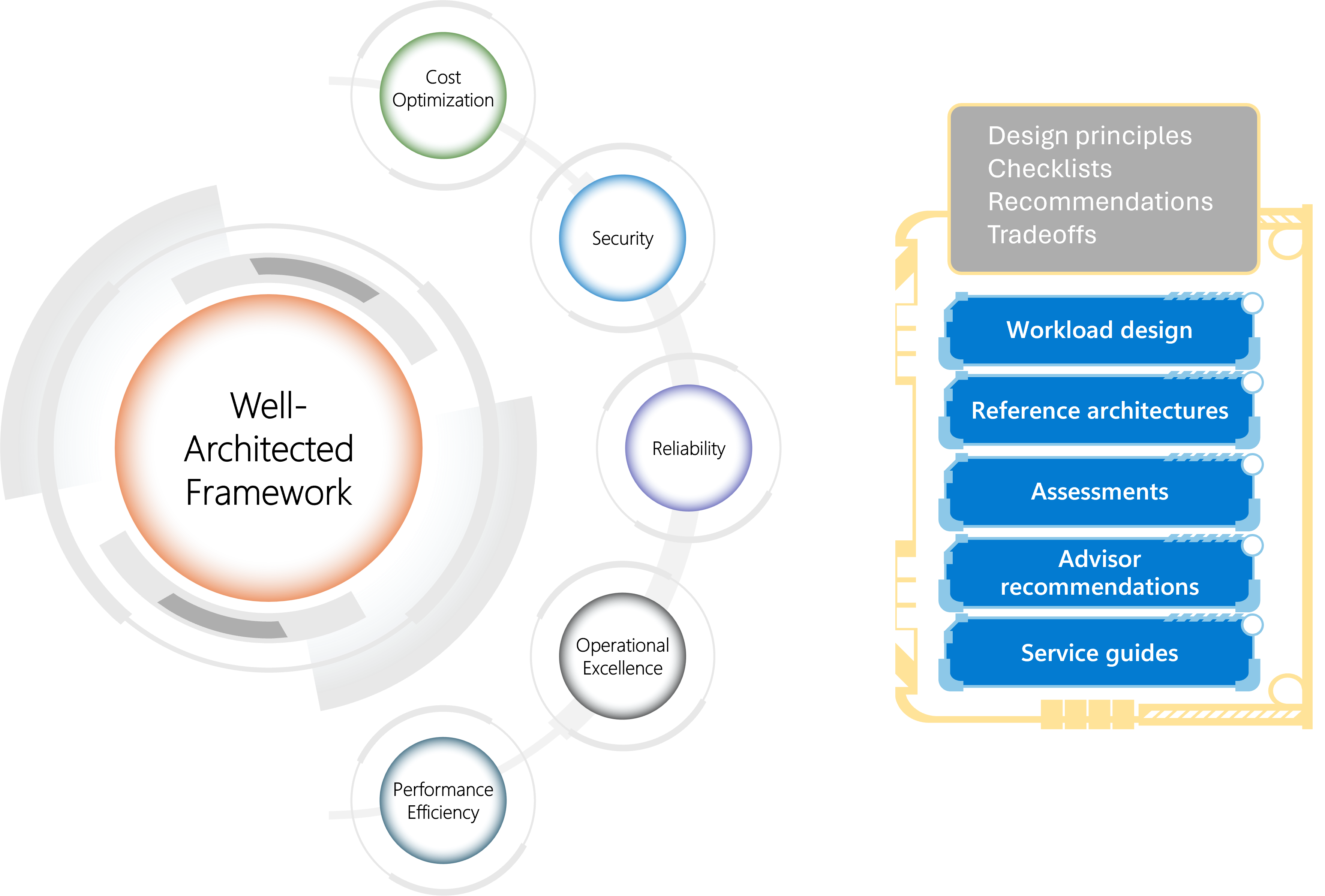
The five pillars are:
- Reliability: The ability of a system to recover from failures and continue to function. This encompasses availability (uptime) and resiliency (the ability to withstand failures). Design principles here involve planning for failure, automating recovery, and defining clear business requirements (SLOs, RTOs, RPOs).
- Security: Protecting applications and data from threats. This is a foundational pillar that involves protecting confidentiality, integrity, and availability. Design principles focus on a Zero Trust approach, using identity as the primary security perimeter, and assuming breach. Much of our work in Modules 2, 3, and 11 falls squarely under this pillar.
- Cost Optimization: Managing costs to maximize the value delivered. This is not simply about being "cheap," but about achieving business goals at the lowest possible price point. Principles include adopting a consumption-based model, analyzing spending over time, and choosing the right services for the job to avoid over-provisioning.
- Operational Excellence: The operations processes that keep a system running in production. This pillar covers how you build, deploy, and operate your workload. Key principles include using Infrastructure as Code (IaC), implementing robust monitoring and observability, and practicing safe deployment strategies to enable velocity without sacrificing stability.
- Performance Efficiency: The ability of a system to adapt to changes in load. This involves scaling resources to meet demand efficiently. Design principles focus on scaling horizontally, testing performance early and often, and using PaaS and serverless offerings that have built-in scaling capabilities.
The official Microsoft Learn documentation provides the canonical definitions for these pillars and their associated design principles.
This document from Microsoft Learn is the primary source of truth for the WAF.
Please review the introductory text and then focus on the matrix. This table concisely defines each pillar, its primary concern, and links to the detailed design principles for each. You don't need to click through to each set of principles right now, but it's important to understand the high-level goal of each pillar.
The Heart of Architecture: Making Trade-offs
Understanding the five pillars individually is the first step. The real work of an architect, however, lies in balancing them. It is rarely, if ever, possible to maximize all five pillars simultaneously. Improving reliability by adding multi-region redundancy will almost certainly increase cost and operational complexity. Aggressively optimizing for cost might reduce performance or compromise on certain security monitoring features.
This is the central challenge of system design: making conscious, informed trade-offs. The Well-Architected Framework provides the language and structure to have these crucial conversations.
John Savill's video again provides a great analogy for this concept.
Using the Well-Architected Framework
This segment of the video clearly explains the natural tension that exists between the pillars.
Watch the section discussing trade-offs. His example of "right, fast, cheap—pick two" is a classic framing, and his discussion of the conflict between Reliability and Cost Optimization is a perfect illustration of the architectural balancing act.
As a senior engineer, your role is not to find a "perfect" design that aces every pillar, but to find the right design that meets the specific business requirements by making the right trade-offs. Documenting these decisions is equally critical.
A blog post on the Azure Architecture Blog provides a practical framework for exactly this kind of decision-making, framing the WAF pillars as the criteria for a decision matrix. This directly aligns with the analytical approach required for a Principal Engineer role.
ADRs, Trade-offs, and an ATAM-Lite Checklist
This article connects the WAF pillars directly to the engineering practice of making and documenting architectural decisions.
Read the introduction to understand the philosophy. Then, read the section The Five Pillars of Trade-offs, which explicitly frames the pillars as the basis for design discussions at Microsoft. Finally, review the Decision Matrix Example. This table is a powerful, concrete example of how to use the pillars to evaluate options and justify a decision.
The decision matrix shown in the article is a practical tool you can use immediately. By weighting the pillars according to business priorities and scoring potential solutions against them, you transform an abstract discussion into a data-informed decision. This process creates clarity and provides a defensible rationale for your architectural choices, often captured in an Architecture Decision Record (ADR).
Conclusion
In this lesson, we introduced the Azure Well-Architected Framework as the guiding philosophy for creating high-quality cloud solutions. It provides a common vocabulary and a structured way to think about the competing forces in system design.
Key Takeaways:
- The Azure Well-Architected Framework is a set of guiding tenets used to improve the quality of a workload.
- It is organized into five pillars: Reliability, Security, Cost Optimization, Operational Excellence, and Performance Efficiency.
- Each pillar represents a critical dimension of a system's architecture and comes with a set of established design principles.
- The core of architectural work is not to maximize all pillars, but to make conscious and informed trade-offs between them based on business requirements.
- The pillars can be used as criteria in a decision matrix to formally evaluate and document architectural choices.
We have now established the "why" and "what" of the framework. In the next lesson, we will begin to apply it. We will compare architectural patterns for multi-region high availability (active-active) vs. disaster recovery (active-passive), a classic scenario that forces us to make explicit trade-offs between Reliability, Cost Optimization, and Operational Excellence.