Welcome back to the capstone module. In our previous lesson, we established a common language for architectural discussions by exploring the five pillars of the Azure Well-Architected Framework: Reliability, Security, Cost Optimization, Operational Excellence, and Performance Efficiency. We established that the essence of architecture is making conscious trade-offs between these pillars to meet business goals.
Today, we'll put that framework into practice by tackling one of the most fundamental decisions in cloud architecture. Our goal is to compare architectural patterns for multi-region high availability (active-active) vs. disaster recovery (active-passive). This is a classic scenario that forces a direct confrontation between the pillars of Reliability and Cost Optimization, and your experience in system design will be valuable in navigating these trade-offs.
High Availability vs. Disaster Recovery
Before we compare the patterns, it's crucial to be precise with our terminology. While often used interchangeably, High Availability (HA) and Disaster Recovery (DR) address different scales of failure.
- High Availability (HA) is typically concerned with maintaining uptime within a single region by protecting against smaller-scale failures, such as a faulty server, a rack power outage, or even the failure of an entire data center within an Azure Availability Zone.
- Disaster Recovery (DR) is about ensuring business continuity in the face of a large-scale event that could take an entire Azure region offline, such as a natural disaster or widespread network failure. This requires a strategy that spans multiple geographic regions.
John Savill provides a clear distinction between these two concepts, which sets the stage for our discussion on multi-region architectures.
Disaster Recovery in Microsoft Azure
This video segment clarifies the difference between high availability, which often uses Availability Zones within a region, and disaster recovery, which requires a multi-region strategy to protect against a larger blast radius.
Please watch the clip from the beginning of this section. Focus on how he frames HA as protection against node or facility failure within a region, and DR as protection against a catastrophic, region-wide event.
The Business Drivers: RTO and RPO
The decision of which multi-region pattern to adopt is not purely technical; it's a business decision driven by two key metrics:
- Recovery Point Objective (RPO): The maximum acceptable amount of data loss, measured in time. An RPO of 15 minutes means the business can tolerate losing up to 15 minutes of data in a disaster.
- Recovery Time Objective (RTO): The maximum acceptable duration of downtime. An RTO of one hour means the service must be operational again within one hour of a disaster declaration.
A lower RTO and RPO mean higher reliability but also exponentially higher cost and complexity. Defining these objectives is the first and most critical step in designing a reliability strategy.
Disaster Recovery in Microsoft Azure
In this segment, John Savill explains how RTO and RPO are the fundamental business requirements that drive your entire DR strategy and its associated costs.
Please watch this section, which runs from 13:11 to 16:50. Pay close attention to how he contrasts a multi-million dollar solution for zero data loss with a more manageable one for a 5-10 minute RPO.
With these foundational concepts in place, let's examine the architectural patterns themselves.
The Deployment Stamp Pattern
A clean way to think about multi-region deployments is through the Deployment Stamp pattern. A stamp is a self-contained, independently deployable unit of your application, containing all the necessary components (compute, data, networking) to run. Instead of scaling individual components, you scale by deploying more stamps. Our multi-region strategies will involve deploying these stamps to different Azure regions.

Now, let's dive into how these stamps are used in each pattern.
Active-Passive: The Disaster Recovery Model
The active-passive model is primarily a disaster recovery strategy. All user traffic is directed to a single primary region. A second secondary region is kept on standby, ready to be activated if the primary region fails. This is a cost-effective approach that balances reliability with budget.
Architecture Strategies for Designing for Redundancy
The official Microsoft Learn documentation details the active-passive pattern and its common variations.
In this resource, please read the section titled "Use an active-passive architecture design". Focus on the definitions of warm spare and cold spare and their respective advantages and disadvantages regarding RTO and cost.
As the documentation explains:
- Warm Spare (Hot Standby): The secondary region has a scaled-down version of the infrastructure running. In a failover, it must be scaled up to handle the full production load. This offers a relatively low RTO.
- Cold Spare (Cold Standby): The secondary region's infrastructure is provisioned but deallocated (e.g., VMs are stopped). In a failover, resources must be started and then scaled. This has the lowest cost but the highest RTO.
Key Architectural Components:
- Traffic Routing: A global load balancer like Azure Front Door or Azure Traffic Manager is configured with priority-based routing. All traffic is sent to the primary region (Priority 1). The secondary region is set to a lower priority (Priority 2), and traffic only flows there if the primary becomes unhealthy.
- Data Replication: Data must be replicated from the primary to the secondary region. This is almost always asynchronous replication due to the latency between regions. Services like Azure SQL Database failover groups or Azure Storage with RA-GRS (Read-Access Geo-Redundant Storage) are designed for this.
WAF Trade-offs: The active-passive pattern heavily prioritizes Cost Optimization. It sacrifices a zero-downtime RTO to achieve significant savings, as the secondary region is not running at full capacity. The trade-off is a lower grade on the Reliability pillar compared to active-active.
Active-Active: The High Availability Model
The active-active model is the gold standard for high availability. Both regions are live and actively serving production traffic simultaneously. If one region fails, the global load balancer automatically redirects all traffic to the remaining healthy region(s) with minimal or no user-facing disruption.
Architecture Strategies for Designing for Redundancy
This section of the Microsoft Learn documentation covers the active-active pattern and its variations.
Please read the section titled "Achieve zero downtime through active-active redundancy". Pay attention to the distinction between the at capacity and overprovisioned models.
The active-active patterns include:
- Active-Active at Capacity: Both regions run at a certain utilization (e.g., 50%) and are designed to autoscale to handle 100% of the traffic if the other region fails. This is more cost-efficient.
- Active-Active Overprovisioned: Both regions are always provisioned to handle 100% of the total traffic. This offers the fastest failover with no performance degradation but is the most expensive option.
Key Architectural Components:
- Traffic Routing: Azure Front Door or Traffic Manager is configured with latency-based or weighted routing to distribute traffic across both active regions, often sending users to the region with the lowest latency.
- Data Replication: This is the most complex part of an active-active design. Since both regions can accept writes, you must have a strategy for data synchronization and conflict resolution.
- Globally Distributed Databases: A service like Azure Cosmos DB is purpose-built for this, offering multi-region write capabilities with configurable consistency models.
- Relational Databases: This is more challenging. A common pattern is to have a single primary write database in one region, with read replicas in other regions. Applications in the secondary regions can serve reads locally but must send write operations across the network to the primary region, which introduces latency.
This data-tier complexity is a critical consideration that will resonate with your software engineering background. An application must be architected to handle this, which is a non-trivial task.
Disaster Recovery in Microsoft Azure
This video segment dives into the architectural implications of an active-active model, focusing specifically on the challenges presented by the data tier.
Watch the clip from 46:20 to 52:27. John Savill clearly explains why the single-write-master nature of most relational databases makes a true active-active pattern difficult to implement and how it affects application design.
WAF Trade-offs: The active-active pattern maximizes Reliability, providing near-zero RTO and RPO. It also enhances Performance Efficiency for a global user base. However, this comes at a steep price in Cost Optimization (running at least 2x the infrastructure) and Operational Excellence (managing deployments, monitoring, and complex data synchronization across live environments).
At a Glance: Active-Passive vs. Active-Active
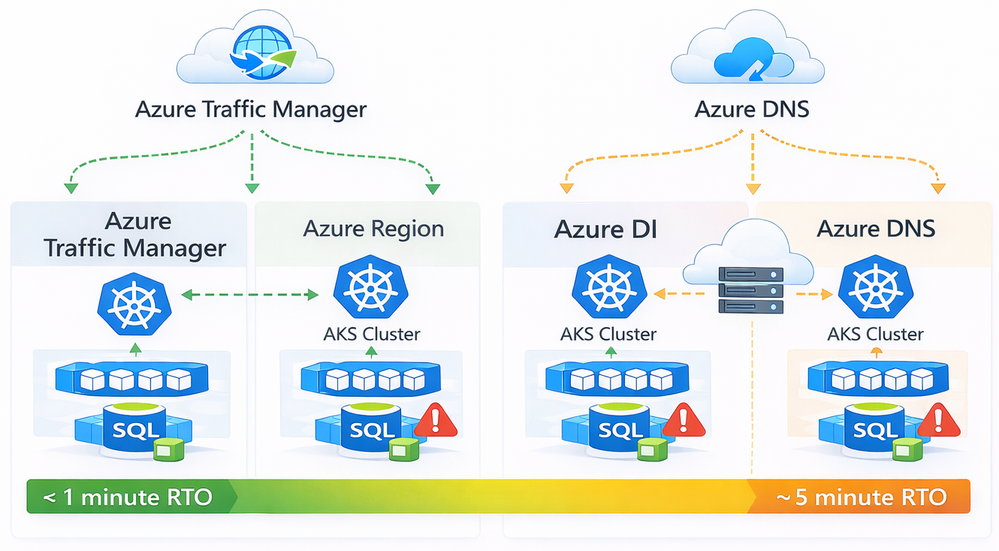
The following table and image summarize the core differences.
| Feature | Active-Passive (Disaster Recovery) | Active-Active (High Availability) |
|---|---|---|
| Primary Goal | Survive a region failure (Business Continuity) | Prevent downtime from a region failure (Continuous Availability) |
| RTO | Minutes to hours | Seconds to minutes (near-zero) |
| RPO | Seconds to minutes (due to async replication) | Seconds (or zero with synchronous replication/conflict resolution) |
| Cost | Lower (secondary region is idle or scaled down) | High (running at least two full production environments) |
| Complexity | Moderate (failover process needs to be tested) | High (data synchronization, conflict resolution, complex deployments) |
| Traffic Routing | Priority-based (failover) | Latency-based or Weighted (load distribution) |
| Typical Use Case | Enterprise apps that can tolerate some downtime (e.g., internal HR system) | Mission-critical apps that cannot go down (e.g., e-commerce storefront) |
Conclusion
In this lesson, we moved from the theory of the Well-Architected Framework to its practical application in designing for reliability. You learned to distinguish between high availability and disaster recovery and to use the business metrics of RTO and RPO to guide your architectural choices.
Key Takeaways:
- Active-Passive is a disaster recovery pattern focused on cost-effective business continuity. It uses a standby region and accepts a higher RTO and RPO.
- Active-Active is a high availability pattern focused on continuous uptime. It runs multiple live regions but comes with significantly higher cost and complexity, especially around data management.
- The choice between them is a classic architectural trade-off, primarily balancing the Reliability pillar against the Cost Optimization and Operational Excellence pillars.
- Key Azure services like Azure Front Door, Traffic Manager, Azure SQL failover groups, and Azure Cosmos DB are the building blocks for these multi-region patterns.
You now have a solid framework for evaluating and discussing multi-region strategies. In our next lesson, we will build directly on this by taking a closer look at the specific services involved. We will select appropriate Azure services for global traffic routing and data replication to implement a multi-region architecture, turning these patterns into more concrete designs.