Welcome back. In our previous lesson, we established a clear decision framework for an application's identity, choosing between service principals and managed identities. We focused on the who—the security principal making an access request. Now, we will expand on this by examining the context of that request: the when, where, and how.
This lesson addresses a cornerstone of modern security architecture: the Zero Trust model. Our objective is to explain how Microsoft Entra's Conditional Access policies serve as the primary engine for implementing Zero Trust principles in the Azure ecosystem. For an architect, understanding this relationship is not just about security; it's about designing systems that are both secure and dynamically responsive to the realities of a distributed, mobile, and threat-filled world.
The Zero Trust Paradigm Shift
For decades, enterprise security was built like a medieval castle: a strong perimeter (the corporate network firewall) with a trusted interior. If you were inside the network, you were generally trusted. This model is no longer tenable. Your applications are in the cloud, your users work from anywhere on a variety of devices, and data is constantly in motion. The perimeter has dissolved.
Zero Trust is an architectural strategy that addresses this new reality. It operates on a simple but profound premise: never trust, always verify. Instead of trusting a user or device simply because it's on a "trusted" network, we treat every access request as if it originates from an untrusted network.
To understand this shift, the following video provides an excellent conceptual overview of Zero Trust, breaking it down into its three core tenets.
Understanding and Getting Started with ZERO TRUST
This video from John Savill's Technical Training explains the evolution from perimeter-based security to the Zero Trust model.
Watch the introductory segment from the beginning. Focus on his explanation of the three guiding principles: Verify Explicitly: Always authenticate and authorize based on all available data points. Use Least Privilege Access: Grant just-in-time and just-enough-access. Assume Breach: Minimize blast radius and segment access. Assume attackers are already inside.
These principles transform security from a static set of rules into a dynamic, context-aware process. The question then becomes: what is the mechanism that enforces these principles? In the Microsoft ecosystem, the answer is Conditional Access.
Conditional Access: The Zero Trust Policy Engine
Conditional Access is the control plane that translates the Zero Trust strategy into enforceable policy. It acts as a dynamic gatekeeper for every authentication request to your Azure tenant, evaluating a rich set of signals to make a real-time decision.
At its core, a Conditional Access policy is a simple if-then statement, a logical structure you're very familiar with from software engineering.
- If a set of conditions (signals) is met...
- Then enforce a set of controls (decisions).
The following diagram provides a powerful architectural overview of Microsoft's Zero Trust implementation. Notice how Microsoft Entra Conditional Access is positioned centrally as the "Evaluation & Enforcement" engine, taking input from various sources and applying policy across the entire digital estate.
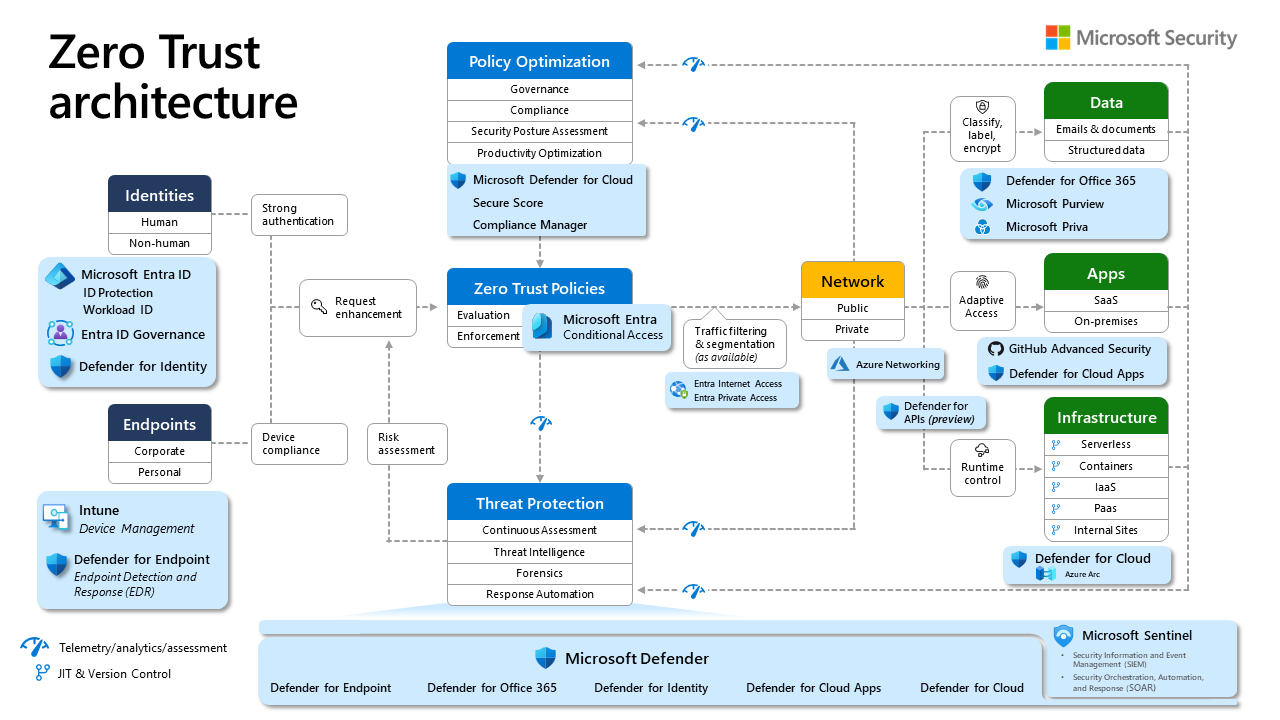
This central role is what makes Conditional Access so powerful. It doesn't matter if the user is an employee, the identity is a service principal, or the resource is a SaaS app; every access token request must pass through this policy engine.
Deconstructing a Conditional Access Policy
Let's dissect the if-then logic into its constituent parts: Signals (the "if" conditions) and Controls (the "then" decisions).
Microsoft Entra Conditional Access: Zero Trust Policy Engine
This official Microsoft documentation provides a concise and authoritative overview of Conditional Access, breaking down its components.
As you read, focus on these sections: The overview, which frames Conditional Access as Microsoft's Zero Trust policy engine. The lists under "Common signals" and "Common decisions". These detail the "if" and "then" parts of the policy logic. The examples under "Commonly applied policies" to see how these components are combined to solve real-world security challenges.
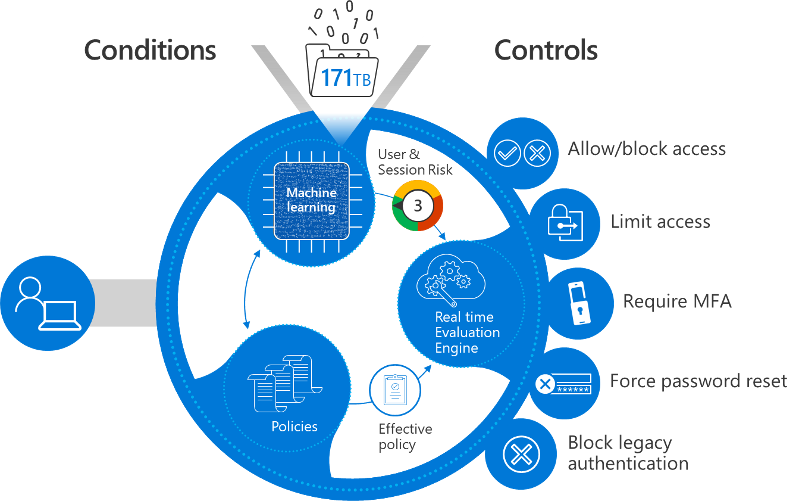
The diagram below visualizes this process, showing how a vast amount of data is funneled into a policy engine to make a decision.
Signals: The "If" Conditions
Signals are the contextual data points that Conditional Access uses to evaluate an access request. An architect needs to think about which signals are available and relevant. The most important ones include:
- User or Workload Identity: Who or what is making the request? Is it a member of a specific group (e.g., "Database Admins")? Is it a workload identity (service principal/managed identity)? Crucially, what is the calculated risk associated with this identity? Microsoft Entra ID Protection provides real-time user and sign-in risk scores based on threat intelligence (e.g., leaked credentials, sign-in from an anonymous IP).
- Device: What is the request originating from? Is the device managed by the organization (via Microsoft Intune)? Is it marked as compliant with security policies (e.g., encrypted, up-to-date OS)? Is it a known and trusted device?
- Location: Where is the request coming from? Is it from a trusted corporate network IP address? Or is it from a country where your organization does not operate?
- Application: What resource is being accessed? You can apply different policies for accessing a low-sensitivity internal web app versus managing the Azure portal itself.
- Client App: Is the user using a modern browser or an approved client application? Or are they attempting to use a legacy protocol like IMAP or SMTP, which can't handle MFA and are common attack vectors?
Controls: The "Then" Decisions
Based on the signals, the policy engine makes a decision. This isn't just a binary allow/deny. The real power lies in the granular controls:
- Block access: The most restrictive control. Used for high-risk scenarios (e.g., a high-risk user signing in from an untrusted location).
- Grant access with requirements: This is the most common and flexible outcome. Access is granted, but only after the user or device satisfies certain conditions:
- Require Multi-Factor Authentication (MFA): The most common control to mitigate credential theft.
- Require device to be marked as compliant: Ensures that only healthy, managed devices can access sensitive data.
- Require approved client app / app protection policy: Restricts access to specific applications and can enforce data protection rules on mobile devices (e.g., preventing copy/paste to unmanaged apps).
- Require password reset: A powerful, automated remediation for a user identity deemed to be at risk.
- Grant access with session controls: Even after authentication, access can be limited. For example, you can allow a user on an unmanaged device to view a document in SharePoint Online but block the ability to download or print it. This is a direct implementation of the least privilege principle.
Architectural Logic: When Policies Collide
In a large enterprise, you will have dozens of Conditional Access policies. A single sign-in can match the conditions for multiple policies simultaneously. As an architect, you must understand the logic of how these are resolved.
The following video explains this critical system behavior.
What happens when multiple conditional access policies apply?
This video, also by John Savill, dives into the architectural logic of what happens when multiple Conditional Access policies apply to a single access request.
Pay close attention to these key segments: The core rule explained from this timestamp. It describes how the controls from all matching policies are logically ANDed together. The exception to the rule, explained from "the deny just wins". This highlights the overriding power of a Block policy. The final recap, which concisely summarizes the resolution logic.
Here are the two non-negotiable rules of Conditional Access policy evaluation:
- The controls of all matching "Grant" policies are cumulative (
AND). If a user's sign-in matches Policy A (which requires MFA) and Policy B (which requires a compliant device), the user must satisfy both requirements to gain access. - A single matching "Block" policy always wins. If any applicable policy has a
Blockcontrol, the user is denied access, regardless of what other "Grant" policies might apply. This makesBlockpolicies extremely powerful and requires careful planning.
Tying It All Together: CA as the Engine of Zero Trust
Now, let's explicitly map the features of Conditional Access back to the three Zero Trust principles:
- Verify Explicitly: This is the very essence of Conditional Access. It does not trust based on a single factor like network location. Instead, it explicitly verifies every access request against a rich set of signals—user risk, device health, location, application sensitivity, and more—before granting an access token.
- Use Least Privilege: Conditional Access moves beyond simple allow/deny. With session controls, it can grant limited, context-appropriate access. Allowing a user to view a file but not download it from an untrusted device is a perfect example of granting the minimum necessary privilege for that specific situation.
- Assume Breach: Conditional Access is not static. Through its integration with real-time risk detection engines like Microsoft Entra ID Protection and Microsoft Defender, it can dynamically respond to threats. If a user's credentials appear on the dark web, their risk level increases, and a CA policy can automatically trigger an MFA prompt or block their next sign-in, mitigating the potential breach in real time.
Identity, the first pillar of a Zero Trust security architecture | Microsoft Learn
This Microsoft documentation provides further detail on how Conditional Access policies are a foundational pillar of a Zero Trust deployment.
Read the section titled "Conditional Access policies" for a summary of how these policies function as the primary access gating mechanism.
Conclusion
In this lesson, we have framed Conditional Access as the central nervous system of a Zero Trust security architecture in Azure. You should now understand that it is far more than a simple MFA enforcement tool; it is a dynamic, context-aware policy engine that allows you to design sophisticated and resilient access control systems.
Your key takeaways are:
- Zero Trust is a security strategy based on the principles of Verify Explicitly, Use Least Privilege, and Assume Breach.
- Conditional Access is the Microsoft Entra service that implements this strategy, acting as a "policy engine" for every authentication request.
- Policies are built on an
if-thenlogic, evaluating a rich set of Signals (like user risk, device compliance, and location) to enforce Controls (like blocking access, requiring MFA, or limiting sessions). - Architecturally, it's critical to understand that when multiple policies apply, their "Grant" controls are cumulative (
ANDlogic), and a single "Block" control always supersedes all others.
We've now covered the who (identity) and the when/where/why (conditional access). In our next and final lesson for this module, we will examine the how by looking at the underlying protocols like OAuth 2.0 and OpenID Connect, which applications use to programmatically request and manage the access tokens governed by these powerful policies.