Hello! Welcome to your next lesson in the Academic Vocabulary Foundations module.
In our last session, we focused on choosing the right words by distinguishing between formal and informal language. Today, we'll take that a step further. Instead of just choosing a different word, you'll learn how to change the form of a single word to use it in different ways. This is a powerful skill that dramatically increases your vocabulary flexibility.
Today's learning outcome is to form word families (noun, verb, adjective, adverb forms) correctly. Mastering this will help you write more complex sentences and understand academic texts better, which is essential for achieving a high band score in the IELTS exam.
1. What are Word Families and Why are They Important for IELTS?
A "word family" is a group of words that share a common root but have different forms to function as different parts of speech (like a noun, verb, adjective, or adverb). For example, the verb create is the root of a family that includes creation (noun), creative (adjective), and creatively (adverb).
Understanding these families is critical for the IELTS for two main reasons:
- Lexical Resource (Vocabulary Score): It shows the examiner you have a flexible and sophisticated command of vocabulary. Instead of repeating the same word, you can use different forms to express your ideas more precisely.
- Reading and Listening: It helps you understand texts and lectures where different forms of a word are used. It also helps you predict the type of word needed to fill a gap in tasks like summary or sentence completion.
Let's start by reading an article from IDP, an official co-owner of the IELTS test, which explains this concept perfectly.
IELTS Vocabulary: How to Choose the Right Word Form
This article, 'IELTS Vocabulary: How to Choose the Right Word Form', explains why this skill is vital for all four parts of the IELTS test.
Please read from the beginning of the article down to the section titled 'Common Mistakes and How to Avoid Them'. Focus on the definitions of noun, verb, adjective, and adverb, and see how the word 'create' is used in its different forms.
As the article mentions, this skill is also the foundation of the Academic Word List (AWL), which is a list of the most frequent academic words used in universities. Each item on the list is a word family, not just a single word.
IELTS - Academic Word List - Sub list 1 - Part 1
This short text introduces the concept of the Academic Word List (AWL) and how it's built around word families.
Read the first three paragraphs only. Notice how the example 'available' is presented with its related forms 'availability' and 'unavailable'.
2. How to Form Word Families: Suffixes
The most common way to change a word's form is by adding or changing its ending, known as a suffix. Learning to recognize these suffixes is the key to mastering word families.
For example:
- Adding -ion often creates a noun (
motivate->motivation). - Adding -al often creates an adjective (
nature->natural). - Adding -ly often creates an adverb (
creative->creatively).
Let's watch a video that demonstrates these changes with clear examples.
Ways to Develop Your Vocabulary (Noun, Verb, Adjective, Adverb)
The video 'Ways to Develop Your Vocabulary' will walk you through several examples of word families, explaining the changes and suffixes used.
Watch the video in parts, focusing on the suffixes used: 00:30 - 02:46: Pay attention to how 'create' is changed using -ive, -ly, and -ion. 04:16 - 05:46: See how 'happy' is changed using -ly and -ness, and note that it doesn't have a verb form. 07:19 - 08:33: Observe how 'sad' is changed using -en (to make a verb), -ness, and -ly.
Common Suffixes
The IDP article you read earlier contains a very useful table of common suffixes. It’s a great idea to save or bookmark this for future reference.
IELTS Vocabulary: How to Choose the Right Word Form
Let's go back to the IDP article and look closely at the suffix tables.
Find the section 'Tips for Choosing the Right Word Form' and study the two tables that list common suffixes for nouns, verbs, adjectives, and adverbs.
To give you more practice with these, here is a short video that focuses on some other very common academic suffixes.
English. Word formation. Suffixes ant, ent, ance, ence, ment. Adverbs with -ly
This video focuses on suffixes like '-ant', '-ent', '-ance', and '-ence', which are common in formal academic words.
Watch from 03:15 to 05:50. Notice how verbs like 'differ' and 'develop' are turned into nouns ('difference', 'development') and adjectives ('different').
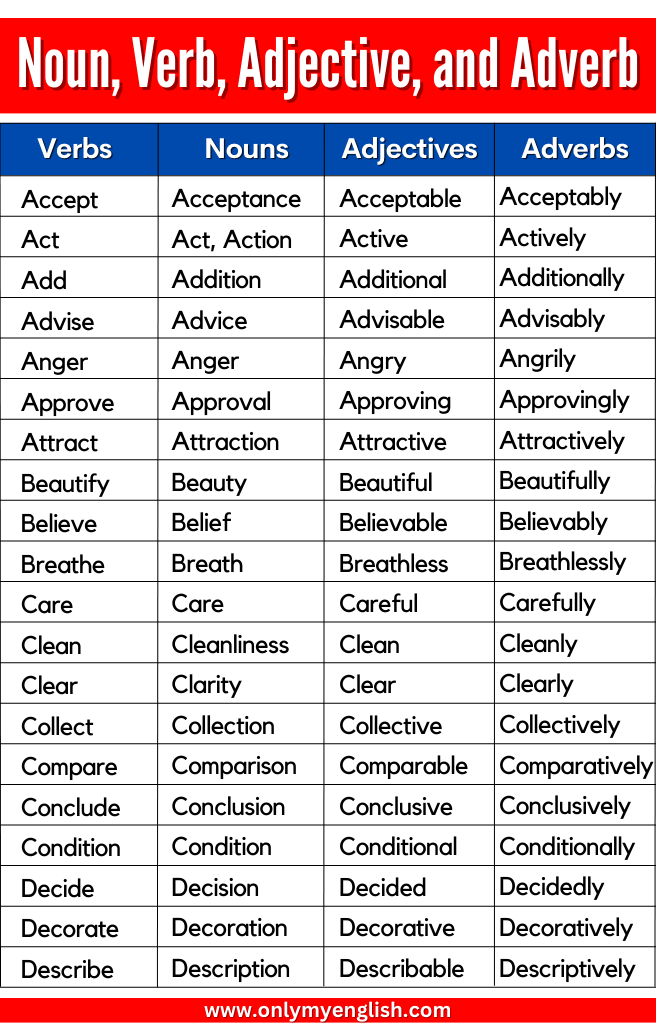
As you can see, by learning just a few suffixes, you can unlock many different forms of a word. The image below provides an excellent summary of word families for many common verbs.
3. Word Families in a Dental Context
Let's apply this to vocabulary relevant to your field of dentistry and general health. Seeing these words in context will help you remember them.
1. Benefit (noun) / Beneficial (adjective)
- "Fluoride provides a significant benefit to dental health." (noun)
- "Regular brushing is beneficial for preventing gum disease." (adjective)
2. Consist (verb) / Consistent (adjective) / Consistency (noun)
- "A healthy dental routine should consist of brushing and flossing." (verb)
- "To see results, you must be consistent with your oral hygiene." (adjective)
- "The consistency of the dental impression material is crucial for an accurate mold." (noun)
3. Approach (noun/verb) / Approachable (adjective)
- "The dentist's gentle approach calmed the nervous patient." (noun)
- "It's important for a pediatric dentist to be warm and approachable." (adjective)
4. Practice Activity
Now it's your turn. Complete the table below by filling in the missing forms for each word family. The first one is done for you. Try to do it from memory first, then you can use the resources from this lesson to help you.
| Verb | Noun | Adjective | Adverb |
|---|---|---|---|
| analyze | analysis | analytical | analytically |
| create | ? | creative | ? |
| ? | prevention | preventable / preventive | preventively |
| benefit | benefit | ? | - |
| ? | economy | economic / economical | economically |
| theorize | ? | theoretical | ? |
Take about 10 minutes to complete the table in a notebook.
Suggested Answers
Here are the completed word families. Check them against your answers.
| Verb | Noun | Adjective | Adverb |
|---|---|---|---|
| analyze | analysis | analytical | analytically |
| create | creation / creativity | creative | creatively |
| prevent | prevention | preventable / preventive | preventively |
| benefit | benefit | beneficial | - |
| economize | economy | economic / economical | economically |
| theorize | theory | theoretical | theoretically |
Conclusion
Excellent work! Today you've learned a fundamental skill for expanding your academic vocabulary. By understanding how word families work, you can express yourself with greater precision and flexibility, which is key to a higher IELTS score.
Key Takeaways:
- Word families are groups of words with the same root but different forms (noun, verb, adjective, adverb).
- Changing a word's form, usually with a suffix (like
-tion,-ment,-ive,-ly), allows you to use it in different grammatical positions. - This skill is essential for showing vocabulary range in the IELTS Writing and Speaking tests and for understanding academic materials in the Reading and Listening tests.
In our next lesson, we will learn how to use a monolingual learner's dictionary to identify word forms, collocations, and nuances of meaning. This will be the perfect tool to help you discover and confirm word families for any new vocabulary you encounter.