Hello! Welcome to your final lesson in the "Academic Vocabulary Foundations" module.
In our last session, you did a great job learning how to form word families by changing a word's form (like from a verb to a noun). Today, we'll build directly on that by learning how to use a powerful tool that helps you discover all of this information for any word you encounter: the monolingual learner's dictionary.
Today's learning outcome is to use a monolingual learner's dictionary to identify word forms, collocations, and nuances of meaning. Mastering this tool is like getting a superpower for your vocabulary studies. It will help you learn words more deeply, use them more accurately, and is an essential skill for reaching your IELTS goal.
1. What is a Learner's Dictionary?
You might be used to a bilingual dictionary (e.g., Arabic-English). A monolingual learner's dictionary is different. It's English-English, but it's specially designed for students like you.
Key features include:
- Simple definitions: The meanings of words are explained using a small number of common English words.
- Example sentences: You can see how the word is used in a real context.
- Grammar information: It tells you if a word is a noun, verb, etc., and what grammatical patterns to use with it.
- Collocations: It shows you which words naturally go together.
To get a quick overview of these features, please read the first few sections of this handout from the University of North Carolina Writing Center.
Vocabulary Building: Learner's Dictionaries
This handout, 'Vocabulary Building: Learner's Dictionaries,' provides a clear introduction to what a learner's dictionary is and what information it contains.
Read the introduction and the short sections on 'Features,' 'Pronunciation,' and 'Frequency.' Don't worry about understanding every detail; just get a general idea of the features.
As the text mentions, some of the best online learner's dictionaries are the Longman Dictionary of Contemporary English and the Oxford Advanced Learner's Dictionary. We'll be looking at examples from both.
Here is a simple visual guide to a dictionary entry. It shows you where to find the basic information.
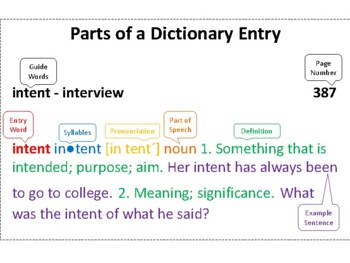
2. Identifying Word Forms and Grammar
In the last lesson, you practiced changing words like create to creation (noun) and creative (adjective). A learner's dictionary is the perfect place to find these different forms and learn the grammar rules for using them.
Let's watch a video that demonstrates this with the word advice.
IELTS Writing Task 2 VOCABULARY | Collocations
In this clip from 'IELTS Writing Task 2 VOCABULARY | Collocations' by Fastrack IELTS, the presenter uses the Longman dictionary to explore the word 'advice'.
Watch the section from 07:21 to 08:35. Pay close attention to: The difference between the noun 'advice' and the verb 'advise'. The grammar rule that 'advice' is uncountable (you can't say 'an advice' or 'advices'). The phrase 'a piece of advice'.
This is a fantastic example of how a dictionary helps you avoid common mistakes. As a dental student, you might need to give advice to patients. Knowing that you "give a piece of advice" but "advise a patient" is a crucial grammatical distinction.
This concept of "word grammar"—the specific rules that belong to an individual word—is essential for accurate writing.
How to use a learner's dictionary of academic English | British Council
This article from the British Council explains the importance of 'word grammar' and 'collocation' for academic writing.
Please read the short subsection titled 'Word grammar'. It starts with 'Language learners sometimes think...'. Notice the examples like 'expect to do something' but 'anticipate doing something'.
3. Finding and Using Collocations
Collocations are pairs or groups of words that are often used together by native speakers. Using them makes your English sound much more natural and will improve your "Lexical Resource" score in the IELTS exam.
For example, in a dental context, we say "dental hygiene" and "prevent decay". We wouldn't say "tooth hygiene" or "stop decay"—they just don't sound right.
A learner's dictionary is the best tool for finding these natural combinations.
IELTS Writing Task 2 VOCABULARY | Collocations
Let's return to the Fastrack IELTS video. The first part explains why collocations are so important, and a later section demonstrates how to find them.
Please watch these two clips: 00:00 - 01:51: This explains what collocations are and why they are vital for a high IELTS score. 05:26 - 07:21: Watch the demonstration of finding collocations for the word 'mistake' (e.g., 'make a mistake', not 'do a mistake').
A great tip from the video presenter is that when you're looking for collocations, it's often best to look up the noun in the pair. If you want to know which verb goes with "a survey," looking up the noun "survey" will show you collocations like carry out a survey or conduct a survey.
4. Understanding Nuances of Meaning
"Nuance" refers to the small, subtle differences in meaning, formality, or context. Is a word formal or informal? Is it used in science, law, or general conversation? A learner's dictionary answers these questions.
Formality
Some words are perfect for academic writing, while others are better for speaking with friends.
IELTS Writing Task 2 VOCABULARY | Collocations
This part of the Fastrack IELTS video shows how the dictionary marks formal words, using 'obtain' and 'get' as an example.
Watch from 09:42 to 10:44. Notice how 'obtain' is marked as formal and is better for writing, while 'get' is more common in everyday English.
Context
Words can also have very specific meanings in academic or professional fields. For example, in dentistry, a crown is a type of dental restoration, which is a very different meaning from the crown a king wears.
Let's read a short section that explains this perfectly.
How to use a learner's dictionary of academic English | British Council
This section of the British Council article uses the word 'neglect' to show how a word's meaning can change depending on the context (general English vs. science).
Read the paragraph that starts with 'Precision matters in academic writing...'. It explains the two different meanings of 'neglect'.
Some dictionaries, like the Oxford Advanced Learner's Dictionary, even have special symbols to show you words that are common in academic texts.
A Deep Dive into the Oxford English Dictionary
This video, 'A Deep Dive into the Oxford English Dictionary,' shows how academic words are marked.
Watch from 06:57 to 07:44. Notice the 'OPAL W' and 'OPAL S' icons, which indicate that a word is important for academic writing and speaking.
5. Practice Activity
Now it's your turn to be a vocabulary detective!
- Go to an online learner's dictionary, like the Longman Dictionary or the Oxford Learner's Dictionaries.
- Look up the word
diagnose. - Try to find the following information:
- What is the noun form of this word?
- Find a collocation: which verb is often used with the noun form (e.g., ____ a diagnosis)?
- Find a collocation: what often follows the verb
diagnose(e.g., diagnose a ____)? - Read the example sentences.
Take about 5-10 minutes to explore the entry for this word.
Suggested Findings
Here is what you likely found:
- Noun form:
diagnosis. Notice the different pronunciation and spelling. - Collocation (verb + noun): You
make a diagnosisorconfirm a diagnosis. - Collocation (verb + noun): You
diagnose a disease,diagnose an illness, ordiagnose a condition.
By spending just a few minutes with a dictionary, you have learned a whole family of words and phrases, not just one isolated word.
Conclusion
Great work today! You have learned how to use one of the most valuable tools for any English language learner. Making a habit of using a learner's dictionary will dramatically speed up your progress toward your IELTS goal.
Key Takeaways:
- A monolingual learner's dictionary is designed for students and provides simple definitions, examples, and grammar information.
- You can use it to find a word's family members (noun, verb, adjective forms), confirming what we learned in the last lesson.
- It is the best tool for finding collocations—natural word partners that make your English sound more fluent.
- It helps you understand nuances like formality (formal vs. informal) and context-specific meanings.
This lesson concludes our module on Academic Vocabulary Foundations. You've built a strong base, and now it's time to apply these skills.
In our next lesson, we will begin a new module: Core Listening Comprehension Skills. The first lesson will be on how to identify the main idea in a short academic talk or conversation. You will start practicing the skills needed for Section 1 of the IELTS Listening test.