Hello! Welcome to your next lesson on building a strong academic vocabulary for your IELTS exam.
In our last lesson, we explored how words form natural partnerships called collocations. We saw that using phrases like provide evidence or play a crucial role makes your English sound more fluent and academic. Today, we'll build on this by looking at the type of words you choose. Our goal is to learn how to distinguish between formal and informal vocabulary choices.
Knowing when to use formal language is essential for the IELTS, especially in the Writing and Speaking tests. Using informal words or phrases can lower your score, as the exam requires an academic tone. This lesson will give you the tools to choose your words carefully and confidently.
1. What Makes English Formal or Informal?
First, let's establish the difference. Formal English is the language of academia, professional communication, and official settings. Informal English is what we use with friends and family in relaxed, casual situations.
To begin, let's get a clear overview of this distinction from a trusted source.
A Guide to Formal vs informal English for IELTS Writing | TakeIELTS
The British Council, one of the creators of the IELTS test, provides a clear introduction to this topic. Please read the first few paragraphs of their article, 'A Guide to Formal vs informal English for IELTS Writing'.
Read the text from the beginning down to just before the heading 'Nine common mistakes in formal vs informal English'. Focus on understanding why this distinction is so important for the IELTS test.
As the article states, using the wrong register is one of the most common mistakes in the IELTS Writing test. The following image provides a helpful visual summary of the key differences between the two styles.
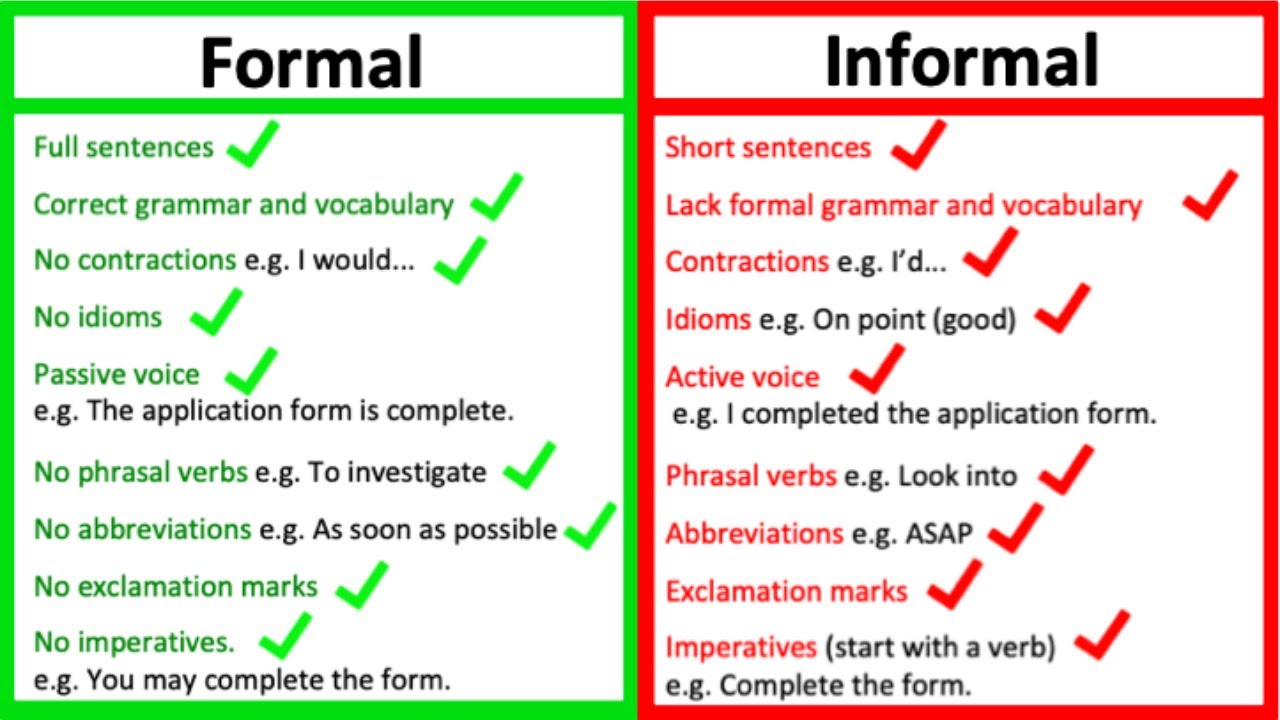
2. Choosing the Right Words: Building a Formal Vocabulary
The most noticeable difference between formal and informal English is vocabulary. Many common, everyday words have more formal equivalents that are better suited for academic writing and speaking.
The following video uses a story-based approach to introduce some of these word pairs. It's an effective way to see them in context.
Formal VS Informal English Vocabulary
Let's watch 'Formal VS Informal English Vocabulary' by POC English. The presenter rewrites three short stories, replacing informal words with more academic ones. We will watch it in segments.
First, watch from the beginning (00:00) to 05:02. Pay close attention to how the informal words in the first story are replaced with their formal equivalents. Notice the examples provided for each new word.
Here is a summary of the vocabulary from the first part of the video:
| Informal | Formal |
|---|---|
| rich | affluent |
| let (go) | allow (to go) |
| funny | amusing |
| and (to start) | additionally |
| okay | acceptable |
| say sorry | apologize |
Now, let's continue with the video to learn more useful words.
Formal VS Informal English Vocabulary
Let's watch the next part of the video, which covers words you might use when describing a project or a situation.
Watch from 05:02 to 07:55. This section introduces another set of useful formal words.
And here are the words from that segment:
| Informal | Formal |
|---|---|
| co-worker | colleague |
| hard | complex, difficult |
| worried | concerned |
| finish | complete |
| help | assist (verb), assistance (noun) |
| about | regarding, concerning |
Finally, the last part of the video introduces vocabulary that is especially useful for IELTS Writing Task 1 (describing data) and Task 2 (discussing issues).
Formal VS Informal English Vocabulary
This final segment includes words like 'demonstrate,' which is perfect for describing charts and graphs.
Watch from 08:29 to the end (12:07). Notice how the word 'demonstrate' is specifically recommended for the IELTS exam.
This last set of words is very important for academic contexts:
| Informal | Formal | Example in Dentistry Context |
|---|---|---|
| eat | consume | "Children who consume sugary drinks frequently have a higher risk of caries." |
| cheap | economical | "Public health programs can be an economical way to promote dental hygiene." |
| expensive | costly | "Advanced dental treatments can be costly for patients." |
| show | demonstrate | "The research demonstrates a link between smoking and gum disease." |
| go down / go up | decrease / increase | "The prevalence of tooth decay began to decrease with the use of fluoride." |
| talk about | discuss | "In this essay, I will discuss the main causes of periodontal disease." |
3. Beyond Vocabulary: Other Features of Formal English
While choosing the right words is crucial, other features also define a formal academic style. These include sentence structure, grammar, and avoiding certain informal habits.
The next video from BBC Learning English clearly explains four of these key features.
Formal English and informal English - BBC English Masterclass
This video, 'Formal English and informal English,' provides excellent examples of how to make your writing more formal by changing more than just single words.
Watch the entire video (00:00 - 03:52). It's short and very clear. Pay attention to the four features the presenter identifies for making an email more formal.
The video highlighted four key areas:
- Vocabulary Choice: Avoiding phrasal verbs like
find outin favor of single verbs likeenquire. - Abbreviations and Contractions: Writing the full forms, e.g.,
currentlyinstead ofat the mo, andI aminstead ofI'm. - Passive Structures: Using the passive voice (
I was promoted) can sound more formal and objective than the active voice (they promoted me). - Sentence Complexity: Combining short, simple sentences into longer, more complex ones using linking words.
To solidify your understanding, the British Council article you looked at earlier provides a great checklist of common mistakes to avoid.
A Guide to Formal vs informal English for IELTS Writing | TakeIELTS
Let's return to the article 'A Guide to Formal vs informal English for IELTS Writing' and read the main checklist.
Read the section titled 'Nine common mistakes in formal vs informal English'. This list provides clear examples for each point and is an excellent guide for your own writing.
4. Put It Into Practice
Now it's your turn to apply what you've learned. The best way to master this skill is by actively transforming informal language into formal language.
Activity: Rewrite the Sentences
Rewrite the following informal sentences to make them suitable for an academic essay. Try to use the formal vocabulary and grammatical structures we've covered today.
- Lots of people think that getting rid of baby teeth isn't a big deal.
- The research was about why some people get gum disease.
- It's really important for dentists to tell their patients what to do.
- The new machine is good for finding problems early.
- The number of kids with cavities went down after the program started.
Take about 10 minutes to write your new sentences in a notebook. Then, compare them with the suggestions below.
Suggested Answers
Here are some possible ways to rewrite the sentences. Your answers might be different, but they should follow the same principles of formal language.
-
Informal: Lots of people think that getting rid of baby teeth isn't a big deal.
- Formal: It is a common misconception that the loss of primary teeth is an insignificant event. (Uses more formal vocabulary like
common misconception,primary teeth,insignificant).
- Formal: It is a common misconception that the loss of primary teeth is an insignificant event. (Uses more formal vocabulary like
-
Informal: The research was about why some people get gum disease.
- Formal: The research concerned the factors that contribute to the development of periodontal disease. (Uses
concerned,factors,contribute,periodontal disease).
- Formal: The research concerned the factors that contribute to the development of periodontal disease. (Uses
-
Informal: It's really important for dentists to tell their patients what to do.
- Formal: It is crucial for dentists to provide clear instructions to their patients. (Uses
crucial,provide clear instructions).
- Formal: It is crucial for dentists to provide clear instructions to their patients. (Uses
-
Informal: The new machine is good for finding problems early.
- Formal: The new equipment is beneficial for the early detection of pathologies. (Uses
equipment,beneficial,detection,pathologies).
- Formal: The new equipment is beneficial for the early detection of pathologies. (Uses
-
Informal: The number of kids with cavities went down after the program started.
- Formal: The number of children with dental caries decreased following the implementation of the program. (Uses formal vocabulary and a more complex sentence structure).
Conclusion
Great job today! You have learned to identify the key differences between formal and informal English and, most importantly, how to apply these rules to make your own language more academic.
Key Takeaways:
- For the IELTS exam, always use a formal register in your Writing tasks and maintain a formal tone in the Speaking test.
- Avoid informal vocabulary (
thing,good,a lot), slang, contractions (don't,it's), and informal phrasal verbs. - Instead, use precise, academic words (
factor,beneficial,a considerable amount), full words, and more formal verbs (investigate,postpone). - Using more complex sentences and the passive voice where appropriate can also make your language more formal.
In our next lesson, we will continue to build your vocabulary skills by learning how to form word families (noun, verb, adjective, adverb forms) correctly. This will give you the flexibility to use a core vocabulary word in many different grammatical situations.