Hello! Welcome to the next phase of your IELTS preparation. In the previous module, you mastered the skills for Writing Task 1, including how to assess a response like an examiner. Now, we're moving on to IELTS Writing Task 2.
This part of the test is an academic essay. It's longer than Task 1 (at least 250 words) and is worth more towards your final Writing score, so it's very important.
Today's lesson is the essential first step to success in Task 2. Our learning outcome is to analyze essay prompts to identify the task type and requirements. Just like with Task 1, understanding exactly what the question is asking you to do is the most critical skill. If you misunderstand the question, you cannot get a high score, no matter how good your grammar or vocabulary is.
By the end of this lesson, you will be able to look at any Task 2 question, quickly identify what kind of essay you need to write, and understand exactly what points you must cover.
1. The Importance of Answering the Question
In IELTS Writing Task 2, your score for Task Response depends entirely on how well you answer the question. Many students lose marks here simply because they rush and don't fully analyze the prompt. Let's start by understanding why taking a few minutes to analyze the question is so important.
Writing Task 2 Tips for IELTS — Analyze the Question
This article by Lar Ryan, an experienced IELTS tutor, explains why question analysis is the most important step in Task 2. It highlights common mistakes students make.
Please read the first part of the article, from the beginning down to the heading 'What to Expect in Task 2 Questions'. Pay attention to the two main reasons why candidates misread the question.
As the article explains, rushing is a major cause of misunderstanding. Spending 2-4 minutes at the start to understand the question is not wasted time; it's an investment that ensures your entire essay is relevant and on-topic.
2. The Main Types of IELTS Essays
Most IELTS Task 2 questions fall into one of about five categories. If you can learn to recognize these categories, you will immediately know how to structure your essay.
This next video provides an excellent overview of the five main essay types. It uses the topic of Artificial Intelligence (AI) for all its examples, which you might find interesting.
The Complete Guide to 5 IELTS Essay Types (+Band 9 Examples)
Watch this guide from Fastrack IELTS to learn about the five key essay types. The presenter clearly explains how to identify each one from the wording of the question.
Watch from 00:59 to 06:03. The video will cover: Opinion Essay (Agree/Disagree) Two Views and Your Opinion (Discussion) Advantages and Disadvantages Two Direct Questions Problem and Solution Focus on the key phrases that help you identify each type (e.g., 'To what extent do you agree or disagree?', 'Discuss both these views...').
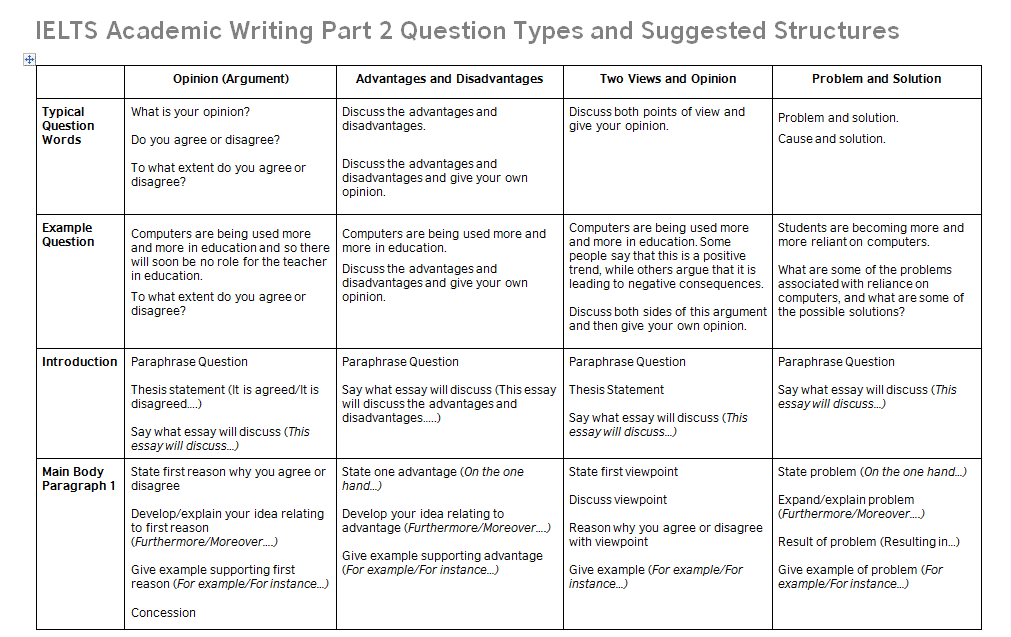
To help you remember these types, here is a summary table that shows the different question types and gives you a hint about how to structure your essay for each one.
3. A Step-by-Step Method for Analysis
Now that you know the different essay types, how do you break down a question on test day? Having a clear method is key. Let's look at a simple, effective process for analyzing any prompt.
Writing Task 2 Tips for IELTS — Analyze the Question
Let's return to the article by Lar Ryan. It provides a simple 5-step strategy for analyzing any Task 2 question. This will give you a clear process to follow every time you practice.
Please read the section titled 'The Stages of Question Analysis'. It outlines a 5-step process: Read the question Circle unknown words Identify key information Write the question in your own words Compare
This 5-step method helps you slow down and make sure you haven't missed anything. Let's see how an expert teacher applies this kind of thinking to a real IELTS question.
How to Plan an IELTS Writing Task 2 Essay
In this video from E2 IELTS, the presenter, Jay, shows you how to analyze and plan for a 'Discuss both views and give your own opinion' essay. This is a great practical demonstration of the analysis stage.
Watch from 01:16 to 05:19. Notice how Jay: Reads the question carefully more than once. Identifies the different parts he needs to address ('fixed punishments' vs. 'individual circumstances'). Identifies that he must also give his own opinion. Starts to plan ideas for each part of the question.
This process of breaking the question down into its parts is exactly what you need to do to ensure a high score for Task Response.
4. Practice Time
Let's put what you've learned into practice.
Activity 1: Quick Identification (5 minutes)
Look at the image below. It contains three different IELTS essay questions. Can you match each question to its type? Use the categories you learned from the video (Opinion, Discussion, Two-Part Question, etc.).

Answers:
- Question 1: "Some people think that children should have their own mobile phones..." This is an Opinion essay (or "Agree/Disagree"). The key phrase is "Do you agree or disagree?".
- Question 2: "Some people argue that it is more important to have a pleasant home..." This is a Discussion essay. The key phrase is "Discuss both views and give your opinion."
- Question 3: "Many people who leave school..." This is a Two-Part Question. It asks two direct questions: "Why is this the case?" and "Do you think this is a positive or negative trend?".
Activity 2: Deeper Analysis (10 minutes)
Now, let's try a more detailed analysis on a few more questions. For each question below, identify:
a) The general topic.
b) The specific task (e.g., agree/disagree, discuss two views, etc.).
c) If your opinion is required.
Question A:
In some countries, most people prefer to rent their homes rather than buying them. What are the advantages and disadvantages of renting a home?
Question B:
Some people believe that it’s better to live in the countryside. Others argue that living in the city is superior. Discuss both these views and give your own opinion.
Question C:
There are some who feel that extreme violence in movies should be banned as it can lead to criminal behaviour. To what extent do you agree or disagree?
Analysis:
Question A:
- a) Topic: Renting vs. buying a home.
- b) Task: Describe the advantages and disadvantages. This is a plural question ("advantages" and "disadvantages"), so you must provide at least two of each.
- c) Opinion: Not directly required. You are asked to present both sides, not to say whether renting is better or worse.
Question B:
- a) Topic: Living in the countryside vs. the city.
- b) Task: Discuss both views. You must explain why some people prefer the countryside AND why some people prefer the city.
- c) Opinion: Yes, it is explicitly required ("...and give your own opinion").
Question C:
- a) Topic: Banning extreme violence in movies.
- b) Task: Agree or disagree with the statement.
- c) Opinion: Yes, this is an opinion essay. You must state your position clearly. The phrase "To what extent" means you should say how much you agree (e.g., completely agree, partially agree).
Conclusion
Excellent work today! You've taken the first and most important step in mastering IELTS Writing Task 2. By learning to analyze the question prompt correctly, you ensure that your entire essay is focused and relevant.
Key Takeaways:
- Always analyze before you write. Spending a few minutes to understand the question saves you from losing marks in Task Response.
- Identify the question type. Most questions fall into a few categories: Opinion, Discussion, Advantages/Disadvantages, Problem/Solution, or Two-Part Questions.
- Break the question down. Identify the general topic, the specific task, and all the parts you must address. Check if your personal opinion is required.
In our next lesson, we will move on to the second step of the planning process: "Generate and organize relevant ideas into a logical essay outline." You'll learn how to brainstorm ideas that directly answer the question you've just analyzed.