Hello! Welcome to your next lesson on IELTS Writing Task 2.
In our last session, we focused on the crucial first step: analyzing the essay prompt. You learned how to identify the question type and understand exactly what the examiner wants you to do.
Today, we'll build directly on that skill. Now that you can understand the question, what do you write about? This lesson will teach you how to generate and organize relevant ideas into a logical essay outline. This 5-10 minute planning stage is your secret weapon for writing a high-scoring essay under pressure. A good plan acts as a map, guiding you from your introduction to your conclusion without getting lost.
1. Why You Must Plan Your Essay
Before we learn how to generate ideas, let's quickly review why it's so important. Some students worry that planning takes too much time, but the opposite is true. A few minutes spent planning saves you much more time during the writing process.
IELTS Essay: How To Plan a Task 2 IELTS Jacky
This article from IELTS Jacky clearly explains the main benefits of creating a plan before you start writing.
Please read the section titled '4 Reasons Why You Must Plan Your IELTS Essay'. Pay attention to how planning affects your time, relevance, structure, and grammar.
As the article points out, planning helps you write faster, stay on topic, create a logical structure, and even make fewer grammatical mistakes because you can focus on your language instead of worrying about what to say next.
2. How to Think of Good Ideas (Without Panicking)
A common fear for students is seeing the question and thinking, "I have nothing to say!" The good news is that IELTS topics are usually about everyday subjects like education, technology, the environment, and society. You don't need to be an expert.
So, what makes an idea "good" for an IELTS essay? It's not about being unique or complex. A good idea has three qualities:
- It's relevant: It directly answers the question.
- You can develop it: You can explain it and give an example.
- You can think of it quickly.
Let's watch a video that introduces some effective and low-stress techniques for generating these kinds of ideas.
Generate Band 9 IELTS Ideas After Doing This
This video from IELTS Advantage explains why you shouldn't worry about difficult topics and introduces simple methods for generating ideas.
Please watch two short sections: 03:28 to 04:55: This part explains the three key features of a 'good idea' for an IELTS essay. 08:58 to 11:15: This introduces the 'Coffee Shop Method', a simple technique to help you think of natural, relevant ideas by imagining you're talking to a friend. Focus on understanding why simple, developable ideas are better than complex ones.
The Coffee Shop Method is an excellent tool. Instead of thinking "I'm in an exam," imagine a friend asks you the essay question over coffee. The simple, direct answers you would give in that conversation are often the best ideas for your essay.
3. From Ideas to a "Skeleton" Outline
Once you have a couple of ideas, you need to organize them. A standard IELTS essay has four paragraphs: an introduction, two main body paragraphs, and a conclusion. Each main body paragraph will focus on one main idea.
Let's see this process in action. We'll watch how two students, guided by a teacher, take a question, generate ideas, select the best ones, and start building a plan.
From Band 6.5 to 9 in ONE Writing Lesson
This video from IELTS Advantage demonstrates the practical steps of generating, selecting, and structuring ideas for an essay.
Please watch from 03:17 to 12:25. The video is a bit long, so focus on these key stages: Idea Generation (03:17 - 05:28): Notice how they come up with several simple ideas related to the question. Idea Selection (06:17 - 10:02): Pay close attention to why they choose two ideas. The key is finding ideas that are relevant and easy to write about. Structure Planning (10:02 - 12:25): See how they assign one main idea to each of the two body paragraphs. This forms the basic 'skeleton' of the essay.
This video shows the entire thinking process. The most important steps are:
- Generate a few simple ideas.
- Choose the two easiest ones to explain and support with examples.
- Assign one idea to Body Paragraph 1 and the other to Body Paragraph 2.
4. Developing Your Ideas: The PEEL Method
To get a high score, you can't just state your idea. You must develop it. A great way to structure your body paragraphs is using the PEEL method:
- Point: State your main idea in a topic sentence.
- Explanation: Explain what you mean in more detail. Ask yourself "Why?" or "How?".
- Example: Give a specific example to support your point.
- Link: (Optional but good) Link the idea back to the main question.
Let's apply this to a sample question:
Some people argue that living in a big city is better, while others believe that life in the countryside is more satisfying. Discuss both views and give your own opinion.
- Idea for Body Paragraph 1: Cities offer more career opportunities.
- (P) Point: One of the primary advantages of living in a major city is the greater availability of professional opportunities.
- (E) Explanation: This is because large urban centers are hubs for various industries, attracting numerous national and international companies, which creates a higher demand for skilled workers.
- (E) Example: For instance, someone working in finance or technology would find far more job vacancies in a metropolis like London or Dubai than in a small rural town.
This structure ensures your paragraph is well-developed and easy for the examiner to follow.
This image provides a clear template for a four-paragraph essay, which is the structure we will use.

5. Practice Time
Now it's your turn to create an essay outline. Read the following question:
Parents should not pressure their children to choose a particular profession. Young people should have the freedom to choose a career path they like.
To what extent do you agree or disagree?
Your Task (10 minutes):
Create a simple outline for a four-paragraph essay that answers this question.
- Decide your opinion: Do you agree, disagree, or partially agree?
- Generate two main ideas to support your opinion. Use the "Coffee Shop" method.
- Organize them into a plan like the one below. For each body paragraph, write down your main idea, a brief explanation, and a possible example.
Your Outline:
- Introduction: (Just state your opinion here - e.g., "I mostly agree.")
- Body Paragraph 1:
- Point (Main Idea):
- Explanation (Why?):
- Example:
- Body Paragraph 2:
- Point (Main Idea):
- Explanation (Why?):
- Example:
- Conclusion: (Just write "Summarize points and restate opinion.")
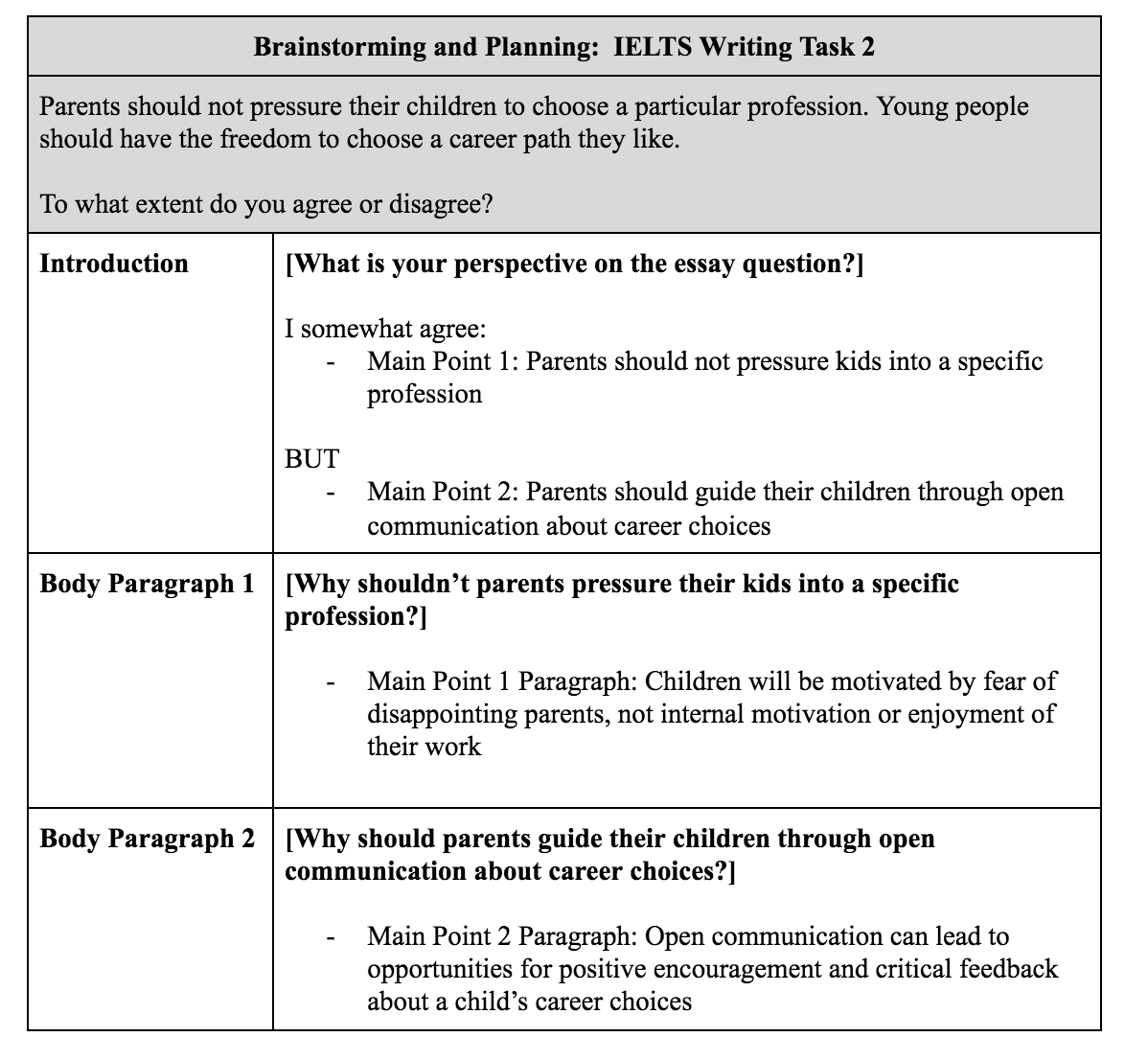
Sample Outline:
Here is an example of what a completed outline could look like. Compare it with yours. Don't worry if your ideas are different—what matters is that they are relevant and organized.
Conclusion
Fantastic work! You have now learned the complete planning process for IELTS Writing Task 2. You know how to analyze the question, generate relevant ideas, and organize them into a logical outline. This plan is the foundation for a clear, coherent, and high-scoring essay.
Key Takeaways:
- Planning is an investment that saves time and improves your score.
- Use simple techniques like the "Coffee Shop Method" to generate ideas quickly.
- A "good" idea is one that is relevant and easy to explain.
- Organize your essay into a four-paragraph structure.
- Develop each main idea in your body paragraphs with an Explanation and an Example (PEEL).
In our next lesson, we will start writing the essay itself. We will focus on the first paragraph and learn how to write clear introductions with a thesis statement.