Hello! Welcome to your next lesson on IELTS Writing Task 1.
In our last lesson, you did an excellent job of putting everything together to write a complete Task 1 response. You learned the essential four-paragraph structure and practiced writing each section. Today, we're going to switch roles. Instead of being the writer, you will learn to think like an IELTS examiner.
This lesson focuses on a crucial skill for hitting your target score: understanding how your writing is graded. Our goal is to assess a Task 1 response using the public band descriptors for Task Achievement and Coherence & Cohesion. By the end of this lesson, you will understand what examiners look for in these two key areas and be able to spot strengths and weaknesses in a sample essay. This will help you to review your own writing more effectively.
1. What Are Band Descriptors?
To understand how to improve your score, you first need to know how it's calculated. Examiners don't just give a score based on a general feeling; they use a detailed marking guide called the band descriptors.
There are four areas that are assessed:
- Task Achievement (TA)
- Coherence and Cohesion (CC)
- Lexical Resource (LR) (Vocabulary)
- Grammatical Range and Accuracy (GRA) (Grammar)
Your final score for Task 1 is the average of your scores in these four areas. In this lesson, we will focus on the first two: Task Achievement and Coherence and Cohesion.
To start, let's get a clear overview of what these descriptors are and why they are so important.
IELTS Task 1 Band Descriptors Explained Simply
This article from Learn English Weekly provides a simple, clear introduction to the band descriptors. It will help you understand their purpose and give you a foundation for today's lesson.
Please read the following sections: Start with the 'Introduction to IELTS Task 1 Band Descriptors' and continue to 'What Are IELTS Task 1 Band Descriptors?' Read the section on 'Task Achievement: The Core of Task 1 Scoring'. Read the section 'Coherence and Cohesion: How Your Writing Feels to Read'. Focus on understanding the main purpose of each criterion.
2. The Official Criteria: Band 6 vs. Band 7+
Now that you have a general idea, let's look at the official public band descriptors that examiners use. This table shows what is required to get a Band 6, 7, 8, or 9. Your goal is a Band 7, so pay close attention to the differences between the columns.
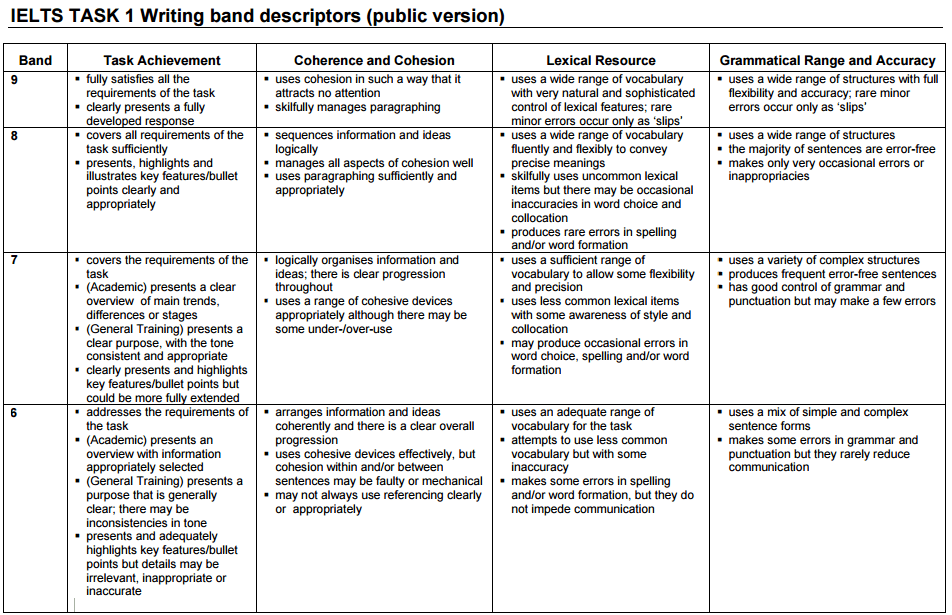
You'll see phrases like "presents a clear overview" for Band 7 Task Achievement, while a lower band might have an unclear one. For Coherence and Cohesion, a Band 7 "logically organises information," while a Band 6 just "arranges" it.
These differences may seem small, but they are critical. Let's break down what they mean in practice.
3. Understanding Task Achievement (TA)
Task Achievement is about how well you answer the question. For Task 1, this means:
- You answer all parts of the question. You must describe the visual information given.
- You write a clear overview. This is a summary of the main trends or features. As you've learned, this is essential for scoring Band 6 or higher.
- You select and report key features accurately. You must use specific data from the chart to support your points.
This video does an excellent job of showing the difference between a Band 6 and a Band 8 performance in Task Achievement.
IELTS Task 1 Writing - Transform Band 6 to Band 8
This video from IELTS Advantage clearly explains what an examiner is looking for in Task Achievement. It compares a weaker overview with a much stronger one.
Watch from 00:40 to 06:56. Pay close attention to the mistakes the Band 6 student makes, such as: Including inaccurate information (e.g., using outside knowledge like 'EU'). Making claims that are not 100% clear from the data. Being too general or vague (e.g., 'Ireland was also the lowest').
Key takeaway for Task Achievement: Accuracy is everything. You must present a clear, accurate overview of the main points and support them with correct data. Avoid making guesses or bringing in your own knowledge.
4. Understanding Coherence and Cohesion (CC)
Coherence and Cohesion is about how well you organize your essay and connect your ideas. It's what makes your writing easy to read and understand. For Task 1, this means:
- You organize your ideas logically. This often means grouping similar information together.
- You use paragraphs effectively. Each paragraph should have a clear purpose.
- You use linking words appropriately. Words like 'however', 'in contrast', or 'similarly' should be used correctly and not too often.
Let's return to the same video to see how this applies.
IELTS Task 1 Writing - Transform Band 6 to Band 8
Now, let's look at what the examiner says about organizing your report for a high Coherence & Cohesion score.
Watch from 09:50 to 16:14. Focus on these points: The difference between 'arranging' information and 'logically organizing' it. Why you must select key features, not just describe everything. How to group information logically in your two detail paragraphs. The correct and incorrect use of cohesive devices (linking words).
Key takeaway for Coherence & Cohesion: Your main job is to help the reader understand the data easily. Do this by grouping similar information together into logical paragraphs.
5. Your Turn: Be the Examiner
Now it's time to apply what you've learned. You will read a candidate's response to a Task 1 question and assess it for Task Achievement and Coherence & Cohesion.
Your Task (15 minutes):
- First, carefully read the candidate's response in the resource below.
- Then, using the band descriptors and the key points from the videos, think about these questions:
- Task Achievement: Is there a clear overview? Does it accurately summarize the main features? Are the details in the body paragraphs accurate?
- Coherence & Cohesion: Is the information grouped logically? Are the paragraphs easy to follow? Are there any issues with linking words?
- Write down one or two points for each criterion.
- Finally, read the examiner's feedback in the same resource to see how your assessment compares.
IELTS Writing Task 1 report sample 3104 – Band 6.0
This resource from IELTS Juice provides a full Task 1 question, a candidate's response, and a detailed assessment. It's a perfect opportunity to practice your new evaluation skills.
First, read the 'Candidate’s Response' (section 0). Assess it based on the questions above. After making your own notes, scroll down and read the examiner's 'Feedback' under the 'IELTS Writing Band Descriptors' heading (section 1). Pay special attention to the comments on Task Achievement (TA) and Coherence and Cohesion (CC).
Did you spot the main issues?
The examiner noted that for Task Achievement, the response "incorrectly describes trends" for two categories. This is a major accuracy problem that limits the score. For Coherence & Cohesion, the structure was clear, but some phrases were "less common" and could be more formal. These are exactly the kinds of details that separate a Band 6 from a Band 7.
Conclusion
Fantastic work today! Learning to think like an examiner is a powerful skill that will transform your approach to IELTS writing. You can now use this knowledge to assess your own practice essays and identify exactly where you need to improve.
Key Takeaways:
- Task Achievement (TA): To score high, you need a clear, accurate overview and details that are correctly reported from the chart. Select the most important features; don't describe everything.
- Coherence & Cohesion (CC): To score high, you must logically organize your information into paragraphs that are easy for the reader to follow. Group similar trends or data points together.
In the next module, we will move on to the second part of the IELTS Writing test: Writing Task 2. You will learn how to analyze essay questions and start planning your response.