Hello! Welcome to your next lesson in our IELTS Listening module.
In our last session, we developed a powerful strategy for multiple-choice questions: eliminating distractors. We focused on skills like predicting answers, identifying keywords, and noticing synonyms. Today, we will apply and build upon those very same skills to master two other common question types.
This lesson will show you how to complete sentence and summary completion tasks by listening for specific information. These two question types are very similar. They test your ability to listen for specific details—like names, numbers, or key facts—and write them down accurately.
A Quick Recap: Your Core Listening Skills
Remember the core skills from our last lesson? They are your foundation here as well:
- Prediction: Using the time before the audio plays to read the questions and predict the type of word or information needed for the gap (e.g., a noun, a date, a place).
- Keyword Identification: Highlighting the key words in the sentences that will help you locate the answer in the audio.
- Listening for Synonyms & Paraphrasing: Understanding that the audio will use different words to express the same idea you see written on the paper.
Let's begin with the first task type: sentence completion.
1. Mastering Sentence Completion
In a sentence completion task, you are given a set of sentences with one or more gaps. Your job is to fill those gaps with the exact words you hear in the recording, making sure the completed sentence is grammatically correct.
Listening: Unit 5: Sentence Completion
To start, let's watch a short video from IELTSx IELTS for Academic Entry that clearly explains what a sentence completion task is and the most important rules to follow.
Please watch from the beginning (00:09) until 02:05. Pay close attention to the three crucial rules mentioned: You must write the exact words you hear. The sentences on the paper will be paraphrased. Spelling must be correct.
A Step-by-Step Strategy
Now that you know the rules, let's establish a clear strategy. The process is very similar to what we've practiced before.

The following video segment breaks down this strategy perfectly.
Listening: Unit 5: Sentence Completion
Let's continue with the same video. This next part outlines a fantastic, practical approach to sentence completion tasks.
Please watch from 01:49 to 04:46. The speaker will guide you through the strategy and highlight the critical role of grammar in finding the correct answer.
Let's consolidate that into a 4-step process:
- Read and Predict: Before the audio starts, read the instructions to check the word limit (e.g., "NO MORE THAN TWO WORDS"). Then, read each sentence and predict the type of word that fits the gap (e.g., is it a noun, a verb, a number?). The words around the gap are your biggest clues.
- Listen for Keywords and Synonyms: As you listen, focus on the keywords you identified in the sentence. The audio will use synonyms for these keywords to guide you to the answer.
- Write the Exact Word(s): When you hear the information that fills the gap, write down the exact word or words from the audio. Do not change the word form (e.g., from singular to plural).
- Check for Grammar: After you write your answer, quickly read the full sentence. Does it make grammatical sense? If not, you might have misheard the word or chosen the wrong one. For example, if the sentence requires a plural noun, but you heard a singular one, you may need to reconsider.
Sentence Completion Practice
Let's put this into practice. The following exercise is from Part 4 of the IELTS test, which is a lecture. This is the most difficult section, so don't worry if you find it challenging. It's excellent practice.
IELTS Listening Sentence Completion Strategies Practice
This webpage from IELTS Buddy provides a short lecture about the hospitality market and a set of sentence completion questions. We will use it to practice our strategy.
On the page, scroll down to the heading 'Sentence Completion Strategies Practice'. First, read the instructions ('Write ONE WORD ONLY') and the six sentences. For each gap, try to predict the type of word needed. For example, for question 1, 'cater specifically for (1) ______ travelers,' the missing word is likely an adjective describing the travelers. Next, play the audio recording and fill in the gaps as you listen. After you finish, click the 'Show / hide answers' link to check your answers and read the transcript. Notice the synonyms used (e.g., 'stylish' in the question vs. 'sleek' in the audio).
2. Tackling Summary Completion
Summary completion is very similar to sentence completion. Instead of separate sentences, you are given a short paragraph that summarises the main points of the audio recording. This paragraph has several gaps for you to fill.
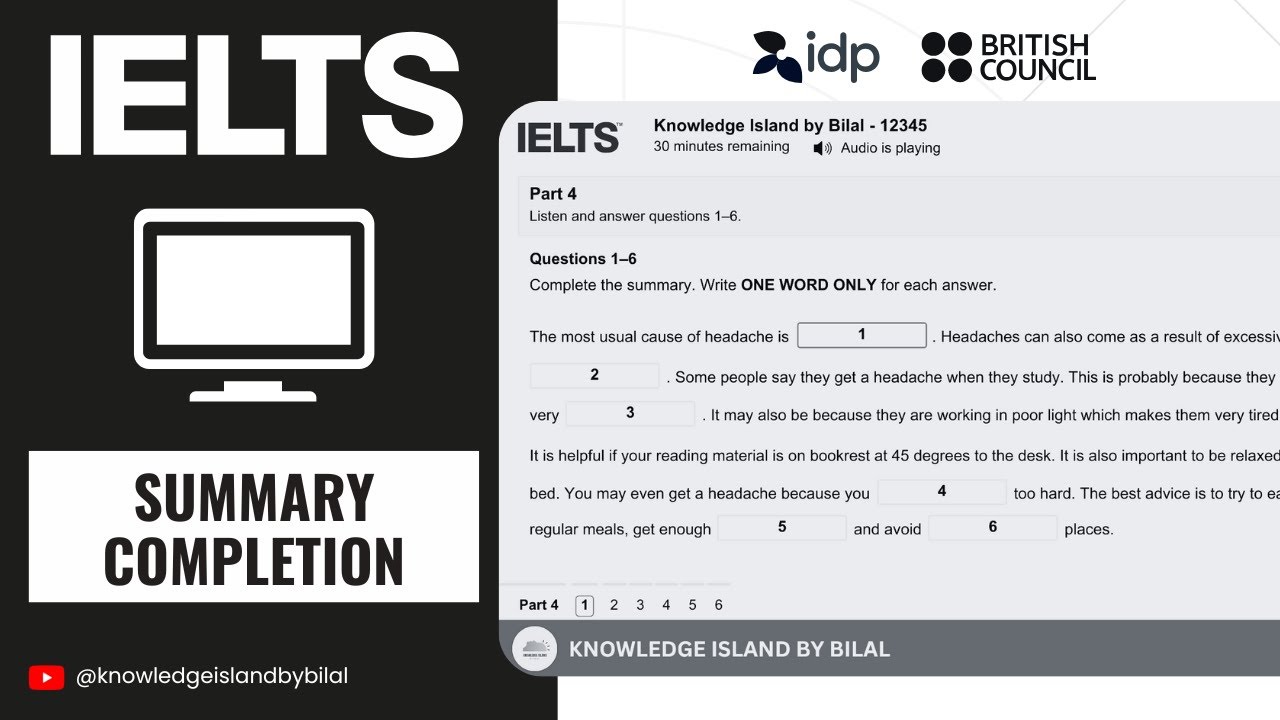
IELTS Listening – Summary Completion Questions
To understand this task type, let's watch a video from IELTS Jacky. She explains the format and provides an excellent set of strategies.
Please watch the video from the beginning (00:00) until 07:13. As you watch, pay attention to: The Strategy (01:35): Notice how similar it is to sentence completion (predicting, keywords, synonyms). Problem Vocabulary (05:21): The speaker highlights types of information that can be tricky, like numbers and dates. Distractors (06:17): This connects directly to our last lesson. The audio might mention an incorrect answer before correcting it (e.g., using words like 'but' or 'however').
The core strategy remains the same: Predict -> Listen -> Write -> Check. The main difference is that you are filling in a connected paragraph, which can sometimes make it easier to follow the flow of information.
Summary Completion Practice
Let's use the same video for a guided practice session. The presenter will play a recording about the Sydney Opera House and then walk you through each answer, explaining the keywords and synonyms.
IELTS Listening – Summary Completion Questions
Now, let's try the practice question in the video.
Continue watching from 07:13 to the end (12:53). First, the speaker will show you the questions and play the audio. Try to answer the questions on your own. Then, the speaker will explain each answer one by one. This is a great opportunity to see how synonyms and paraphrasing were used to point to the correct answer.
Pro Tips: Understanding the Finer Rules
Sometimes, the most confusing part of these tasks isn't the listening itself, but the specific rules about what is considered a correct answer.
IELTS Listening Summary Completion: Practice & Tips
The website IELTS Liz has a fantastic page with practice questions. The comments section is particularly useful, as students ask the teacher, Liz, about very specific situations. Reading her answers can clarify common points of confusion.
Please scroll down to the 'Comments' section of the webpage. Read the following exchanges between students and Liz to understand some tricky rules: '9 direct' vs. '9': Find the first comment from a user named 'Hey Liz...' and her reply. This explains why you shouldn't add extra, unnecessary words, even if you hear them. '9 bomb hits' vs. '9 bombs hit': Find the comment from 'e2d1...' asking about this. Liz's answer is a great mini-lesson on how nouns can act as adjectives. '50,000' vs. '50 thousand': Find the comment from 'can we write 50 thousand...'. Liz's reply gives practical advice on writing numbers.
Conclusion
Well done. Today you've learned the strategies for two very important IELTS Listening question types. While they look slightly different, the underlying skills for sentence and summary completion are identical. It all comes down to careful preparation before you listen and focused attention to detail while you listen.
Key Takeaways:
- The Strategy is Key: Always use your preparation time to read the questions, check the word limit, and predict the type of information needed for the gaps.
- Listen for Synonyms, Write the Exact Words: The question will paraphrase the audio, but your answer must be the exact words you hear.
- Grammar and Spelling are Crucial: Your answer must fit the gap grammatically, and spelling must be correct to get the mark.
- Don't Add Unnecessary Words: If the instruction is "ONE WORD ONLY" and the answer is a number like '9', do not write extra words like 'direct' even if you hear them in the audio.
In our next lesson, we will move on to matching and classification tasks. You'll see once again how the foundational skills of identifying keywords and listening for paraphrased information will be essential to your success.