Hello! Welcome back to your course on preparing for the IELTS exam.
In our last lesson, we focused on sentence and summary completion, strengthening your ability to listen for specific words and details. You practiced predicting answers, identifying keywords, and listening for synonyms—skills that are essential across the entire Listening test.
Today, we will adapt those skills for a new challenge. Our goal is to match information in classification and matching tasks. These questions require you to listen to a conversation or talk and connect two sets of information, such as matching a person to an opinion, a place to a feature, or a cause to an effect.
1. Understanding Matching Questions
Matching tasks can appear in a couple of different formats, but the core challenge is the same: connecting items from one list to items in another.
First, let's watch a video that introduces the two main types of matching questions you'll see in the IELTS test and outlines a five-step strategy to solve them.
IELTS Listening: How to Answer Matching Questions!
This video from E2 IELTS clearly explains the two types of matching questions and provides a universal strategy for both.
Please watch from the beginning (00:00) until 02:26. Pay close attention to: The two different formats of matching questions. The five-step strategy for approaching them.
As the video explained, the strategy builds on what you already know:
- Read the instructions: Check if you can use an option more than once.
- Read the questions: Understand what you need to match.
- Highlight keywords: Pinpoint the key ideas in both lists.
- Think of synonyms: The audio will use different words for the same ideas.
- Listen while looking: Keep your eyes on the options as you listen.

The most important things to remember are:
- The numbered questions (the first list) will be discussed in order in the audio.
- The lettered options (the second list) will be mentioned in a random order.
To reinforce this strategy, let's review it in a written format. This resource from IELTS Jacky provides excellent, detailed tips.
IELTS Listening Matching Questions – How to Answer
This article, 'IELTS Listening Matching Questions – How to Answer', gives a clear, text-based explanation of the strategy.
Please read the 'Strategy & Tips' section. Focus on points 2 ('Answer order'), 3 ('Synonyms and paraphrasing'), and 4 ('Watch out for distractors'). This will help solidify the concepts from the video.
2. A Worked Example: Applying the Strategy
Now that you have the strategy, let's see it in action. We'll return to the E2 IELTS video and watch the presenter solve a practice question step-by-step. This is where you'll see how synonyms, antonyms (opposites), and distractors are used to test your understanding.
IELTS Listening: How to Answer Matching Questions!
Let's continue with the E2 IELTS video. This next segment applies the five-step strategy to a practice question about wedding venues.
Watch from 02:26 to 11:23. Observe how the speaker correctly identifies the answers by listening for meaning, not just exact words. Notice: Question 1: The audio uses 'gluten-free' as a specific example of 'dietary requirements'. Question 2: The audio uses 'used to' and 'not available at the moment' to distract you from an incorrect answer. Question 3: The audio uses an antonym ('closed over winter, spring, and autumn') to give you the answer ('only available in the summer').
This example shows why simply hearing a keyword is not enough. You must listen to the full context to understand if the information is being confirmed, denied, or changed.
3. Classification Tasks: A Common Variation
A common type of matching question is a classification task. Here, you are asked to classify a list of items into a few categories. Often, these categories are people, opinions, or types.
For example, you might listen to two students, Martin and Kate, planning a project and have to decide for each task:
- A Martin will do it
- B Kate will do it
- C They will do it together
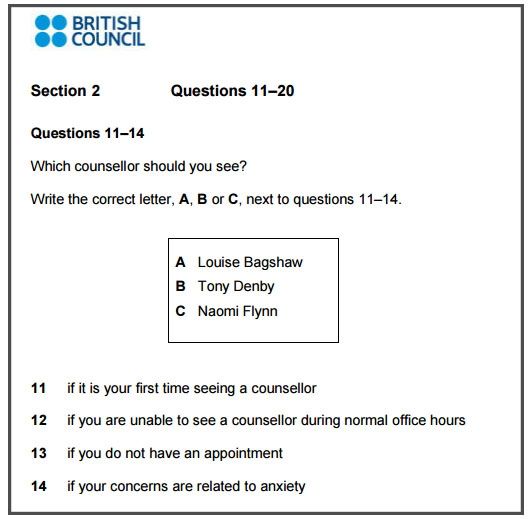
The key challenge in these tasks is that the speakers often discuss, negotiate, and change their minds. It's crucial not to choose an answer too early.
IELTS Listening Tips | Classification | Asad Yaqu b
This video from Asad Yaqub focuses specifically on classification tasks. He gives an essential tip: wait for the speakers to agree before you choose your answer.
Please watch from the start (00:18) until 09:14. Pay special attention to the 'Step-by-step guide' (starting at 03:48). The speaker breaks down a conversation between two students, showing how they go back and forth before reaching a final decision. This demonstrates why you must wait for confirmation.
The most important takeaway from this video is to wait for confirmation. Don't select an answer just because one person suggests it. Wait until the other person agrees or a final decision is clearly stated.
Conclusion
Excellent work today. You have learned a systematic approach to tackle matching and classification questions, which are common in the IELTS Listening test. By building on your existing skills, you are now better prepared to handle these complex tasks.
Key Takeaways:
- Know the Format: In matching tasks, the questions are in order, but the options are not. You may need to use some options more than once.
- Apply the Core Strategy: Always use the preparation time to analyze the question, highlight keywords in both lists, and think about possible synonyms.
- Listen for Meaning, Not Words: The audio will use paraphrasing, specific examples, and even antonyms to convey information. Don't just listen for a keyword.
- Beware of Distractors and Negotiations: Speakers may mention an option but then reject it, or they might discuss who should do a task before agreeing. Always wait for the final, confirmed answer.
In our next lesson, we will focus on another type of question that requires visual interpretation: labeling maps, plans, and diagrams. You'll learn how to follow spoken directions and use spatial language to locate answers.