Hello! Welcome to your next lesson on mastering the IELTS Listening section.
In our last lesson, we focused on using the time before the audio starts to predict answers. Today, we'll build directly on that skill to tackle one of the most challenging question types: multiple choice.
This lesson is designed to help you answer multiple choice questions by eliminating distractors. You’ll learn to identify the common tricks the test uses to mislead you and develop a systematic strategy to confidently choose the correct answer by first identifying the incorrect ones.
A Quick Recap: The Power of Prediction
Remember how we learned to use the 30-second pause to analyze questions? This is your first and most important step for multiple choice questions. By reading the question and the options (A, B, C) beforehand, you activate the relevant vocabulary and prepare your mind for the topic. This preparation is your best defence against distractors.
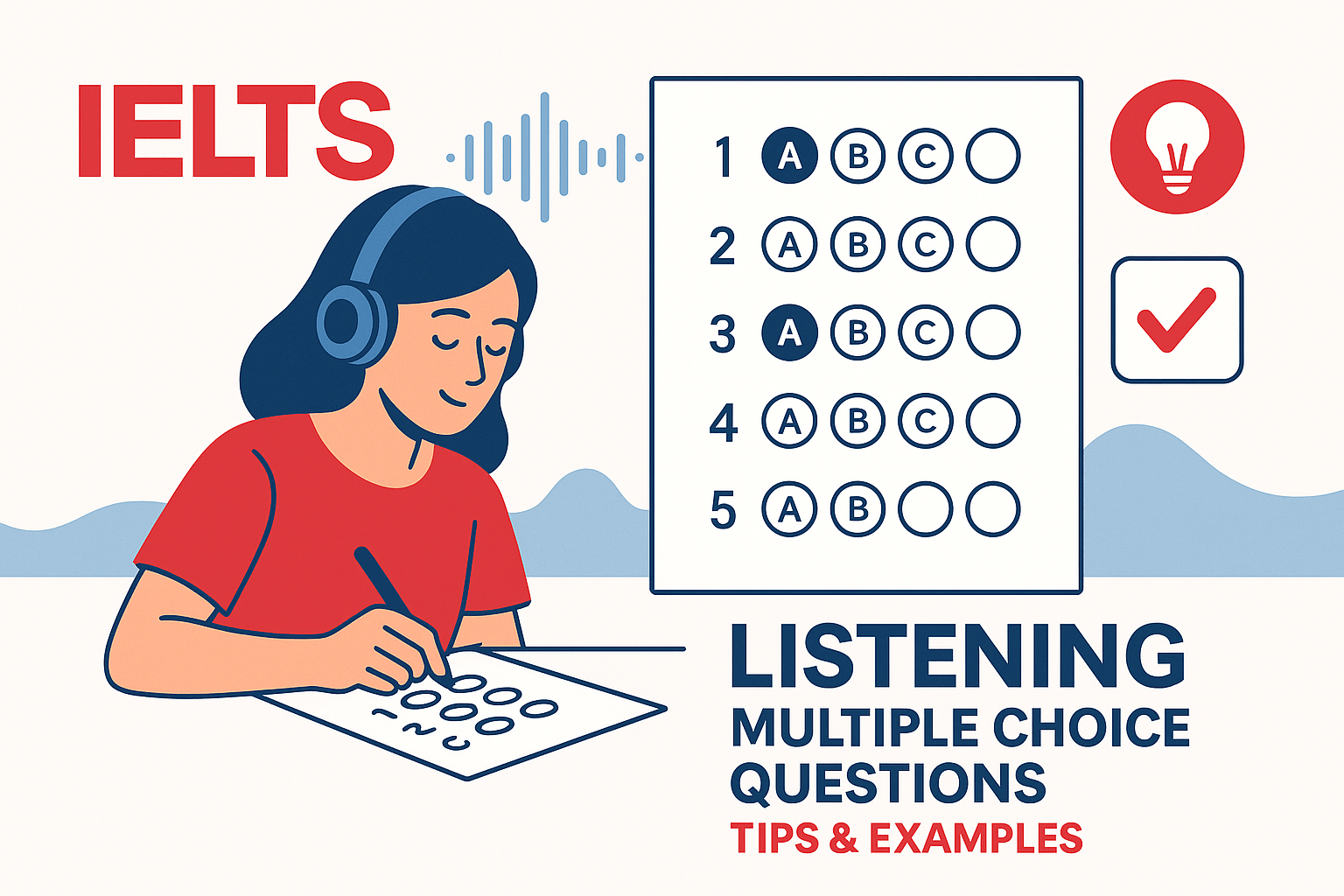
1. Understanding the Enemy: What Are Distractors?
In the IELTS Listening test, you will often hear words or phrases related to all the multiple-choice options (A, B, and C). This is done on purpose. The incorrect options that are mentioned are called distractors. Their job is to "distract" you from the correct answer and test whether you are listening for deep meaning or just spotting individual words.
To begin, let's establish a crucial mindset for avoiding these traps.
Understanding distractors in IELTS Listening
This article, 'Understanding distractors in IELTS Listening,' explains why you must rely only on the information you hear, not your own knowledge or intuition. This is a fundamental rule for the entire IELTS test.
Please read the beginning of the article, from the start down to the heading 'IELTS Exam Distractor Types'. Pay close attention to the explanation of 'bottom-up' versus 'top-down' processing.
The key takeaway here is to switch off your "top-down" processing. Even as a dental student, if you hear a question about healthcare, you must answer based only on what the speaker says, not what you know to be true from your studies.
2. The Main Types of Distractors
Distractors come in several predictable forms. Once you learn to recognize them, they lose their power. The following video provides an excellent breakdown of the most common types.
IELTS Listening: Don't Make These 4 Mistakes!
In this video from E2 IELTS, the presenter clearly explains and demonstrates the four most common types of distractors you will face.
Watch the video from 03:00 to 12:17. As you watch, take a note of the different distractor types explained: Already Mentioned Words (starts at 03:00) Synonyms (starts at 05:29) Negatives (starts at 07:52) Similar Sounding Words (starts at 01:43, you can watch this after) Special Distractor (starts at 10:29)
Let's consolidate what you've just learned. Here are the key distractors to watch out for:
- Mentioned-Then-Rejected: This is the most common type. A speaker mentions an option but then corrects themselves, changes their mind, or someone else disagrees with them. Listen for signal words like but, however, though, actually, or I was going to... but then....
- Synonyms & Paraphrasing: Often, a distractor option will use the exact word you hear, but in the wrong context. The correct answer will often use a synonym or paraphrase the idea. For example, the speaker says the price was "very reasonable," and the correct option is "good value for money."
- Negatives: The speaker will state that something is not the case, but the option will present it as if it is. The negation can be subtle, using words like
avoid,never, or prefixes likeun-,in-,dis-. For example, the audio says an activity is "unsuitable for beginners," and a distractor option says it's "for beginners." - Similar-Sounding Words: A simpler trap, but it can catch you if you're not focused. For example, mishearing
seventeenforseventyorplaneforplain.
3. A Strategy for Eliminating Distractors
Knowing the types of distractors is half the battle. Now, you need a strategy to deal with them in real time. The most effective method is elimination. Instead of trying to find the one correct answer, you should actively listen for evidence that proves the other two options are wrong.
New Strategy For IELTS Listening Multiple Choice
This video from IELTS Advantage provides a fantastic, practical strategy for tackling multiple-choice questions, focusing on how to analyze the options and listen effectively.
Please watch the following segments: Keywords and Differences (02:25 - 04:09): Focus on the tip about understanding the difference between the options. Qualification Statements (05:29 - 07:10): This section reinforces the importance of listening for words like 'but' and 'however'. Step-by-Step Strategy (07:10 - 11:12): Pay attention to the advice to listen to the whole section before choosing an answer and to make an educated guess if you're unsure.
Let's combine these ideas into a clear, three-step process.
Step 1: Before Listening - Analyze and Differentiate
- Read the question to understand what it's asking.
- Read options A, B, and C and underline keywords.
- Most importantly, think about what makes the options different from each other. For example, if two options are about "usefulness," one might be about "useful variations" and the other might compare its usefulness to "other appliances." This subtle difference is often where the answer lies.
Step 2: While Listening - Listen to Eliminate
- Your goal is not to find the right answer immediately. Your goal is to cross out the wrong ones.
- When you hear a speaker mention an option, don't circle it. Listen carefully. Do they follow it with "but..."? Does the information actually contradict the option? If so, you've found a distractor. Cross it out.
- Listen to the entire conversation related to that question before making a final decision.
Step 3: After Listening - Choose and Move On
- After eliminating one or two options, the correct answer should be clear.
- If you are still unsure, make an educated guess. You don't lose marks for wrong answers in IELTS, so never leave a multiple-choice question blank.
IELTS Listening Test: Top Strategies for Multiple-Choice Questions
To add a few final tips from an official IELTS source, let's look at this article from IDP.
Read the four short sections titled 'Be mindful of distractors', 'Pay attention to tone', 'Eliminate the wrong answers', and 'Answer all the questions'.
The tip about tone of voice is particularly useful. If a speaker sounds hesitant or negative when mentioning an option (e.g., "Well, we could take the bus..."), it's likely a distractor.
4. Practice in Action
Let's apply this strategy to a classic example.
Question:
Type of delivery chosen:
A. Plane
B. Train
C. Truck
Audio Transcript:
Speaker 1: Sure, so you can elect to have your goods sent by plane, which is the quickest and safest but also the most expensive. Or you can choose to have them sent by train, which is safe and less expensive. And finally, you can send your things by truck, which is less safe but much cheaper.
Speaker 2: Ah, yes, sending by truck can take far too long. I’m in a bit of a rush, so I’ll go for the fastest option, please…
Your Task:
Based on the elimination strategy, which is the correct answer and why are the other two incorrect?
Analysis:
- Option C (Truck): Speaker 2 mentions "truck," but immediately rejects it ("can take far too long"). This is a classic Mentioned-Then-Rejected distractor. We can eliminate C.
- Option B (Train): Speaker 1 mentions "train," but Speaker 2 never considers it or chooses it. This is another distractor. We can eliminate B.
- Option A (Plane): Speaker 2 says they'll take the "fastest option." Earlier, Speaker 1 defined "plane" as the "quickest." This is a synonym link. By eliminating B and C, A is confirmed as the correct answer.
Conclusion
Great job today. Mastering multiple-choice questions is about shifting your mindset from "finding the right answer" to "eliminating the wrong ones." By understanding how distractors work and using a clear strategy, you can approach these questions with much more confidence.
Key Takeaways:
- Distractors are deliberate traps. They are incorrect options mentioned in the audio to test your comprehension.
- The best strategy is elimination. Listen for evidence to cross out incorrect answers.
- Listen for signal words. Words like but, however, and actually often introduce a distractor or a correction.
- Pay attention to synonyms and paraphrasing. The correct answer rarely uses the exact same words as the audio.
- Never leave an answer blank. If you're unsure, eliminate the options you know are wrong and make an educated guess.
In our next lesson, we will look at another common question type: completing sentence and summary completion tasks. You'll find that the skills we practiced today—identifying keywords, listening for specific information, and recognizing synonyms—are directly applicable to that task as well.