Hello! Welcome to the fifth lesson in our module on Pronunciation and Fluency.
In our last lesson, we worked on creating a natural speech rhythm by using thought groups and pauses. We learned that breaking sentences into logical chunks makes you easier to understand and sound more fluent.
Today, we will shift our focus from the rhythm of sentences to the precision of individual sounds. As a native Arabic speaker, you might find some English sounds more challenging than others because they don't exist in your first language. This lesson is designed to help you with one of the most common challenges: how to pronounce the /p/ vs /b/ distinction clearly. Mastering this will significantly improve your clarity and help you avoid misunderstandings, which is essential for a high score in the IELTS Speaking test.
1. The Core Difference: Voiced vs. Voiceless
The sounds /p/ and /b/ are a consonant pair. This means they are produced in exactly the same way with your mouth: your lips come together, block the air, and then release it.
The only difference is what your vocal cords are doing.
- The /p/ sound is voiceless. It's just a puff of air. There is no vibration in your throat.
- The /b/ sound is voiced. Your vocal cords vibrate to produce the sound.
Let's explore two simple physical tricks to help you feel this difference.
Technique 1: The Paper Trick
A puff of air comes out for the /p/ sound, but not for the /b/ sound. You can see this effect with a piece of paper.
English Pronunciation - P vs B
This video from Easy ENGLISH with James will show you a great trick using a piece of paper to check your pronunciation.
Watch from 01:23 to 02:57. Pay close attention to how the paper moves for the /p/ sound but stays still for the /b/ sound. Try this yourself with a small piece of paper or even your hand in front of your mouth.
Technique 2: The Hand-on-Throat Trick
Since the /b/ sound is voiced, you can feel the vibration of your vocal cords in your throat. For the voiceless /p/, you won't feel anything.
MiniPod: P vs B Pronunciation Practice
This article from SBS Learn English explains the 'hand on throat' technique, which is another excellent way to feel the difference between the two sounds.
Read the section that begins with 'Now, let’s work on how to pronounce these sounds' and ends just before 'Who is with us today?'. As you read, place your hand on your throat and say the example words ('pin', 'pack', 'pet' vs. 'bin', 'back', 'bet') to feel the vibration for /b/ and the lack of vibration for /p/.
By using both the paper trick and the hand-on-throat trick, you get both visual and physical feedback to confirm you are making the sounds correctly.
2. A Special Technique for Arabic Speakers
Modern Standard Arabic has a /b/ sound but not a /p/ sound. This is why many Arabic speakers naturally substitute /b/ when they see the letter 'p'. The good news is that you are already physically able to make the /p/ sound. The key is to "turn off" the vocal cord vibration that you use for /b/.
Here is a very effective technique for doing just that.
How to pronounce P vs B (WITHOUT confusing them) | American English Pronunciation
The speaker in this video, Hadar, offers a brilliant tip specifically for Arabic speakers: whispering a /b/ sound to produce a /p/ sound.
Watch from 03:08 to 04:38. Follow her instructions: start by saying a word you know, like 'bay'. Then, whisper the same word. Notice how the whispered 'b' sound becomes a 'p' sound. This is a fantastic way to train your muscles to produce /p/ correctly.
This 'whisper' technique is powerful because it uses a sound you are already comfortable with (/b/) to create the new sound (/p/).
3. Practice with Minimal Pairs
Minimal pairs are pairs of words that differ by only one sound. Practicing them is one of the best ways to train your ear to hear the difference and your mouth to produce it.
Look at the images below. Say each pair of words out loud. Use the hand-on-throat or paper trick to check your pronunciation.

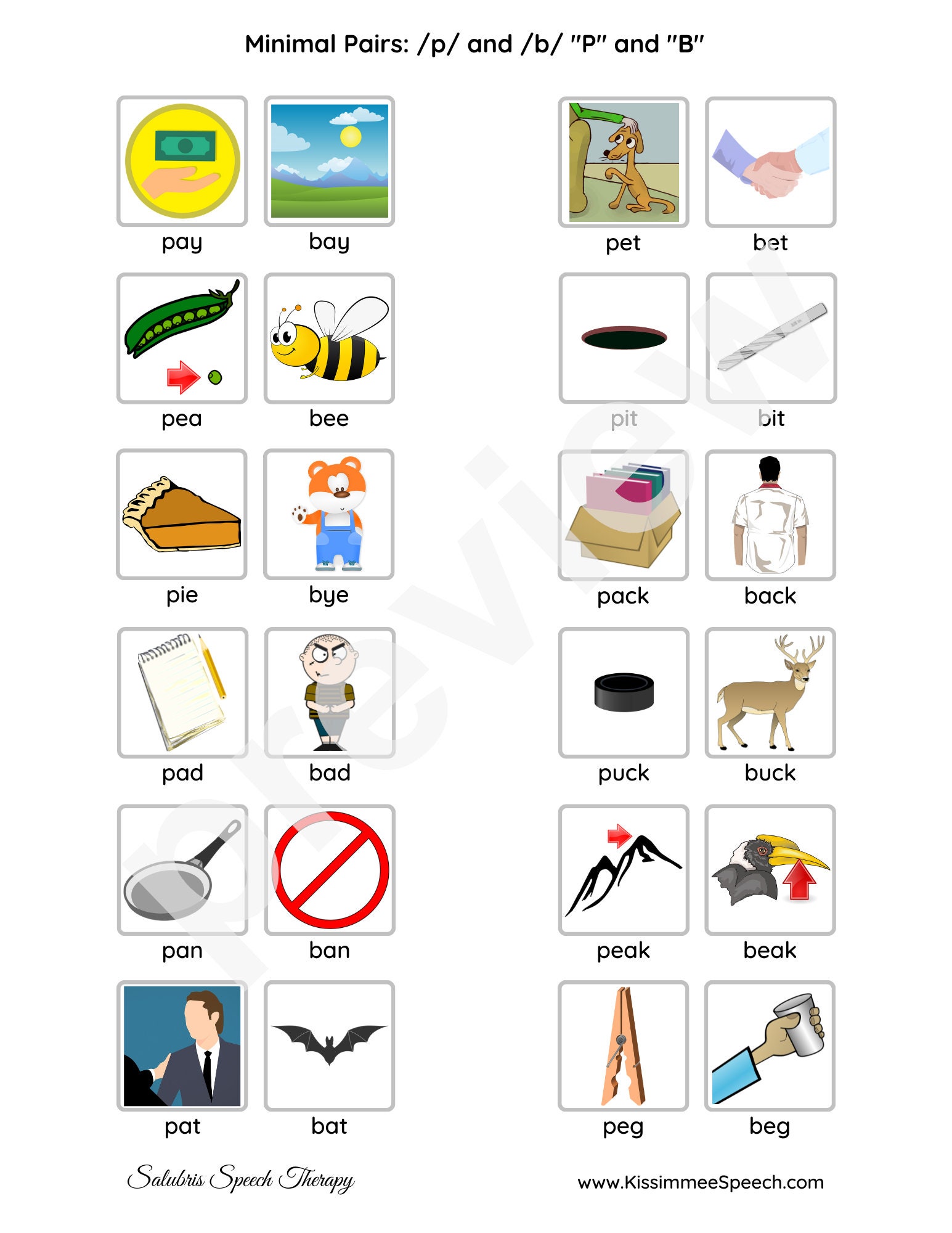
Here is a list of minimal pairs to practice. Say them out loud, focusing on the strong puff of air for /p/ and the vibration for /b/.
- pack / back
- pay / bay
- peach / beach
- pig / big
- pull / bull
- rope / robe
- cap / cab
4. Practice in Context
Now that you can produce the sounds in individual words, let's practice them in longer phrases and sentences. This will help you use them more automatically in conversation.
Activity 1: Alliteration and Tongue Twisters
Alliteration (using the same sound at the beginning of words) and tongue twisters are a fun way to challenge your pronunciation muscles.
English Pronunciation - P vs B
Let's return to the video from Easy ENGLISH with James. This time, we will use his tongue twister examples for focused practice.
Watch from 05:37 to 08:57. The video presents two tongue twisters. First, practice the /p/ tongue twister slowly: 'Peter Piper picked a peck of pickled peppers.' Then, practice the /b/ tongue twister: 'The big bad baby boss built a bigger better business.' Repeat them several times. Try to say them faster as you get more confident.
Activity 2: Self-Recording
A common English phrase that uses both sounds is "Happy birthday". This is perfect for practice.
MiniPod: P vs B Pronunciation Practice
Let's revisit the SBS article, which has a great practical tip.
Find the section near the end where Janice says, 'Why don’t you try recording yourself and your friends singing the happy birthday song...'. Try this yourself. Say 'Happy birthday, Peter!' out loud. Record your voice using your phone and listen back. Can you hear the voiceless /p/ in 'happy' and 'Peter' and the voiced /b/ in 'birthday'?
Conclusion
Excellent work today! You have tackled a key pronunciation point that will make your English much clearer.
Key Takeaways:
- The /p/ sound is voiceless (a puff of air, no vibration).
- The /b/ sound is voiced (your vocal cords vibrate).
- You can use the paper trick to see the air for /p/ and the hand-on-throat trick to feel the vibration for /b/.
- For Arabic speakers, a great technique is to whisper the /b/ sound to produce a clean /p/.
- Practice with minimal pairs and tongue twisters to build muscle memory.
In our next lesson, we'll continue building your pronunciation skills by focusing on another important sound that can be tricky for some learners: how to pronounce the /v/ sound accurately.