Hello! Welcome to your next lesson in the "Pronunciation and Fluency" module.
In our last lesson, we focused on distinguishing between the voiceless /p/ and the voiced /b/ sounds. The key takeaway was the concept of voicing—whether your vocal cords vibrate or not. This is a fundamental concept in English pronunciation, and we are going to build directly on it today.
This lesson addresses another sound that is often challenging for native Arabic speakers: how to pronounce the /v/ sound accurately. Mastering this sound will make your speech significantly clearer and more precise, which is crucial for achieving a high score in the IELTS Speaking test.
1. How to Produce the /v/ Sound
The /v/ sound is a voiced consonant. Let's break down the mechanics of how to make it. It's very similar to another sound you already know, the /f/ sound, but with one key difference.
- Place your top teeth gently on your bottom lip.
- Push air through the small gap.
- Turn on your voice: Vibrate your vocal cords.
You should feel a slight buzzing or vibration on your lip and in your throat. You can use the "hand-on-throat" trick we learned in the last lesson. Place your fingers on your throat and say a long "vvvvvvv" sound. You should feel a clear vibration.
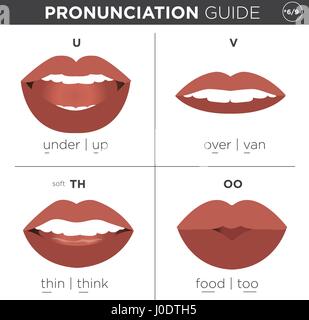
Now, let's see and hear it in action.
English Pronunciation | The Letter V
This video from Easy ENGLISH with James gives a clear demonstration of how to form the /v/ sound.
Watch from 00:40 to 01:07. Pay close attention to the speaker's mouth position. Try to imitate the sound he makes. Remember, the contact between your teeth and lip should be light.
2. Common Confusions for Arabic Speakers
Because the /v/ sound does not exist in Modern Standard Arabic, speakers often substitute it with sounds that are more familiar. Let's tackle the two most common substitutions.
2.1. The /v/ vs. /f/ Distinction
This is the most common challenge. The good news is that you already have the correct mouth position for /v/, because it's the same as for the /f/ sound, which exists in Arabic. The only difference is voicing.
- /f/ is voiceless: No vibration (just air). Think fan, fine, feel.
- /v/ is voiced: Vibration. Think van, vine, very.
This distinction is exactly the same as the /p/ (voiceless) vs. /b/ (voiced) pair from our last lesson.
American English Pronunciation for Arabic Speakers
This article, 'American English Pronunciation for Arabic Speakers', explains exactly why this is a challenge and what is missing.
Read the section titled 'Arabic Challenge #5: The F/V and P/B Consonants'. The text directly explains that Arabic speakers may substitute /f/ for /v/ and that the solution is to 'turn on' your vocal cords.
Now, let's practice telling these sounds apart with some minimal pairs.
English Pronunciation | The Letter V
Let's return to the 'English Pronunciation | The Letter V' video. It has an excellent section on practicing minimal pairs for /f/ and /v/.
Watch from 05:56 to 07:24. Listen carefully to each pair (e.g., 'very'/'fairy', 'van'/'fan'). Repeat each word after the speaker. Use the hand-on-throat trick to confirm you are voicing the /v/ sound.
2.2. The /v/ vs. /b/ Distinction
Another potential confusion is between /v/ and /b/. While both are voiced, the mouth position is completely different.
- For /b/, your lips press together and then release (e.g., boat, berry).
- For /v/, your top teeth touch your bottom lip (e.g., vote, very).
Mistaking these sounds can lead to misunderstandings. For example, "ban" is very different from "van".
This video from Pronunciation with Emma clearly demonstrates the physical difference between producing the /b/ and /v/ sounds.
Watch from 00:12 to 02:01. Observe Emma's mouth shape for each sound. She gives a very important tip: for /v/, your teeth rest just inside your bottom lip, not on the outside. Practice the minimal pairs she provides, like 'bent'/'vent' and 'vowel'/'bowel'.
3. Practice in Different Word Positions
Like many consonants, the /v/ sound can appear at the beginning, middle, or end of a word. It's important to practice it in all three positions.

Your Task:
Read the words from the image above out loud. Pay attention to producing a clear, voiced /v/ sound in each position.
- Beginning: voice, visit, view, very, vote
- Middle: never, seven, river, level, over
- End: love, live, give, save, move (Note: The final 'e' is silent in these words).
To hear these words pronounced correctly, you can refer back to the video "English Pronunciation | The Letter V". The speaker covers words with 'v' at the beginning (01:07-02:17), in the middle (02:17-03:49), and at the end (03:49-05:03).
4. Practice in Sentences
Now let's put it all together. Tongue twisters are an excellent way to train your mouth muscles for speed and accuracy.
English Pronunciation | The Letter V
Let's use the tongue twisters from the 'English Pronunciation | The Letter V' video for a final challenge.
First, go to the time stamp 05:03 and practice the tongue twister that only uses the /v/ sound. Say it slowly at first, then try to speed up. Next, go to 07:24 to practice the tongue twister that mixes /v/ and /f/ sounds. This is a fantastic exercise for mastering the voiced/voiceless distinction.
Self-Recording Activity:
To check your progress, record yourself saying the following sentences. Some of them include words that might be relevant to your studies in dentistry.
- It is very important to give good advice.
- We will review the patient's records before their visit.
- There are several preventive measures available.
- She lives in a village near the river.
Listen back to your recording. Can you clearly hear the buzzing, voiced /v/ sound? Does it sound different from your /f/ and /b/ sounds?
Conclusion
Fantastic effort today! By focusing on the details of voicing and mouth position, you've taken another big step toward clear and confident English pronunciation.
Key Takeaways:
- To make the /v/ sound, place your top teeth on your bottom lip and vibrate your vocal cords.
- The /v/ sound is voiced, while its partner sound /f/ is voiceless. The only difference is the vibration in your throat.
- The /v/ sound is made with teeth on lip, while the /b/ sound is made with lips together.
- Practice pronouncing /v/ at the beginning, middle, and end of words to build fluency.
In our next lesson, we will move on to another important aspect of clear speech: pronouncing initial and final consonant clusters clearly. We'll learn how to say words like 'strategy' and 'worlds' without missing any sounds, a skill that is essential for sounding fluent and natural.