Hello! Welcome to the fourth lesson in our module on Pronunciation and Fluency.
In our last lesson, we focused on intonation, the 'music' of English, learning how to use rising and falling tones to sound more natural and engaged. We learned that statements usually have a falling tone, while questions to confirm information often have a rising tone.
Today, we will build on that by looking at speech rhythm. The goal of this lesson is to learn how to use thought groups and pauses to create natural speech rhythm. This means breaking down your sentences into small, logical chunks of meaning. Mastering this skill is crucial for fluency in the IELTS Speaking test, as it helps the examiner follow your ideas easily and makes you sound much more confident and clear.
1. What are Thought Groups?
Imagine trying to read a long sentence with no punctuation. It would be difficult and confusing. The same is true for spoken English. If you speak without any breaks, your speech can sound rushed and robotic. If you pause in the wrong places, you can confuse your listener.
Thought groups (also called 'chunks') are small groups of words that belong together and express a single idea. We use short pauses between these groups to give the listener time to process the information and to give ourselves time to breathe and think.
Let's watch a video that introduces this concept very clearly.
How to Best Group Words & Pause for Natural-Sounding English
This video from Speak Confident English provides an excellent introduction to thought groups. It demonstrates the difference between robotic, rushed, and natural speech.
Please watch the first part of the video, from the beginning until 03:18. Pay attention to how the speaker defines a thought group as a 'small package of meaning' and how she breaks down the example sentence.
As the video explained, breaking a sentence into thought groups makes the meaning much clearer.
- Sentence: The old woman who lives next door is an actress from Italy.
- Thought Groups: The old woman // who lives next door // is an actress // from Italy.
Each chunk provides one clear piece of information. This not only helps your listener understand but also makes your speech flow smoothly.
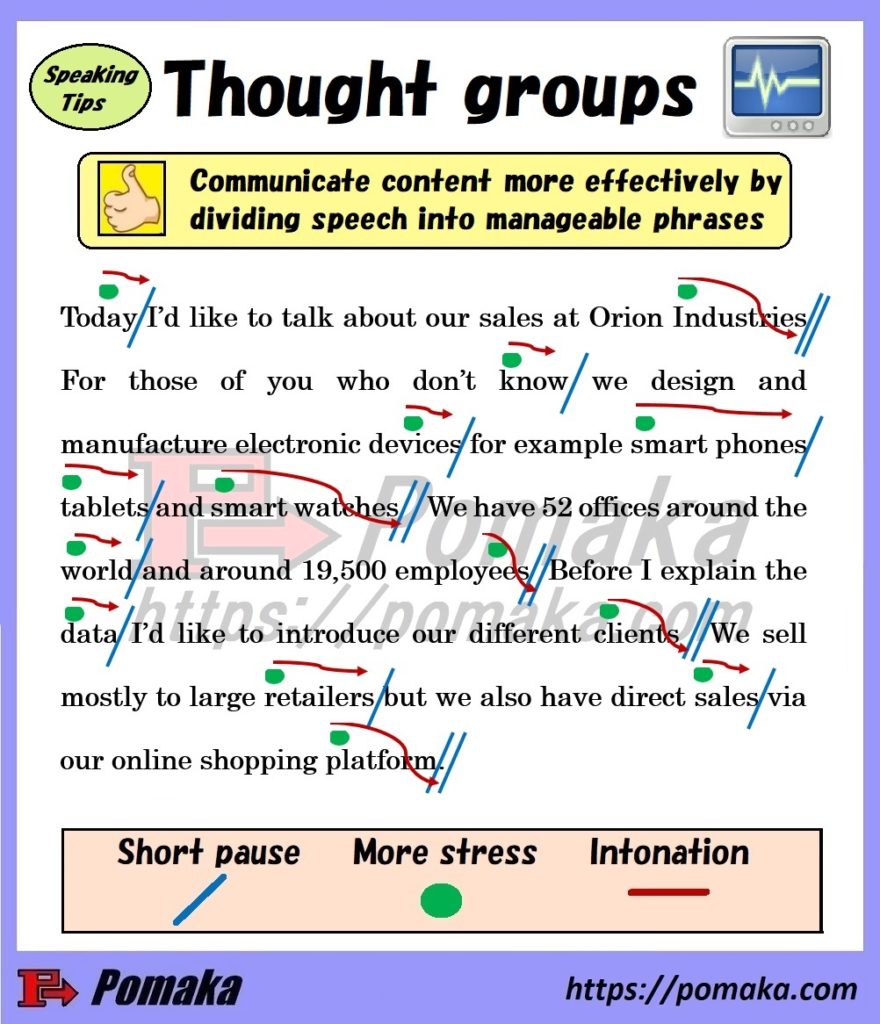
The image below provides a great visual summary of how pauses, stress, and intonation work together within thought groups. Notice the marks for pauses (/), stressed words (green dots), and intonation (red arrows). This connects what we learned today with our previous lessons on stress and intonation.
2. How to Find Thought Groups
So, how do you know where to pause? While there's some flexibility, there are common patterns that native speakers follow. Understanding these patterns is the key to developing a natural rhythm.
Let's watch the next section of the same video, which outlines six very useful patterns for identifying thought groups.
How to Best Group Words & Pause for Natural-Sounding English
This part of the video will give you six clear, practical rules for grouping words together. This is the most important part of our lesson, so listen carefully.
Watch from 03:18 to 10:54. The speaker explains six patterns for creating thought groups. Try to say the example sentences out loud along with her.
To summarize, here are the key patterns from the video:
- Keep articles and pronouns with their nouns:
The book// is on the shelf. (Don't pause between "The" and "book".) - Keep infinitives together: She needs //
to finishthe report. (Don't pause between "to" and "finish".) - Start a new thought group with conjunctions: I like coffee, //
butmy sister prefers tea. - Separate time and location information:
Yesterday morning// I went to the park. - Set apart transition words:
First of all,// we need to make a plan. - Create separate groups for extra information (often starting with who, which, that): My aunt, //
who lives in Paris,// is visiting soon.
For the IELTS test, it's also helpful to think about pausing from the listener's perspective. The following article provides a concise list of situations where pausing is particularly effective.
This article from FutureLearn is specifically about the IELTS test. It gives you a simple list of when to use pauses to make your answers clearer for the examiner.
Read the text under the heading 'Using pausing effectively', down to the end of the bulleted list. Focus on the five situations where you can use pausing.
This confirms some of the patterns we've already seen and adds a few more, such as pausing when giving a list or after giving important information.
3. Practice Activities
Now it's time to put this into practice. Remember, developing a natural rhythm takes time and repetition.
Activity 1: Guided Reading
The article "Using pausing effectively" includes a sample answer from an IELTS candidate with pauses marked by //. Your task is to read this text aloud, making sure to take a short, clean pause at every // mark.
Let's return to the article from FutureLearn. This time, you'll use the provided script to practice your pausing.
Find the section titled 'Practice'. Read the text provided out loud. The symbol // shows you exactly where to pause. Try to record yourself and listen back. Do you sound more natural and clear?
Activity 2: Shadowing Practice
Shadowing is an excellent technique where you listen to a native speaker and repeat what they say immediately, copying their rhythm and pauses.
Let's use the video from Speak Confident English for this.
How to Best Group Words & Pause for Natural-Sounding English
This section of the video provides perfect examples for shadowing. The speaker models sentences for common situations.
Watch the video from 11:48 to 13:00. The speaker will give three example sentences for different situations (a meeting, weekend plans, explaining a delay). Listen to each sentence, then pause the video and repeat it, trying to copy her pauses exactly.
Activity 3: Independent Practice
Finally, here are a few sentences related to your field of study, dentistry. Read them aloud and decide where you should pause. Mark the pauses with a slash (/). Record yourself and listen to see if your pauses help to clarify the meaning.
- Preventive dentistry is the practice of caring for your teeth to keep them healthy.
- Although brushing is important, you should also floss every day to remove plaque.
- The dental student, who was in her final year, prepared carefully for the clinical exam.
Here are my suggested pauses for you to compare:
- Preventive dentistry // is the practice of caring for your teeth // to keep them healthy.
- Although brushing is important, // you should also floss every day // to remove plaque.
- The dental student, // who was in her final year, // prepared carefully // for the clinical exam.
Conclusion
Great work today! You have learned a fundamental skill for spoken fluency that will make a big difference in your IELTS Speaking test.
Key Takeaways:
- Thought groups are small chunks of words that express a single idea.
- We use short pauses between thought groups to create a natural rhythm, help the listener understand, and give ourselves time to think.
- You can identify where to pause by looking for grammatical and logical units, such as prepositional phrases, clauses, conjunctions, and transition words.
- Practicing with guided texts and shadowing are effective ways to improve your use of thought groups.
In our next lesson, we will zoom in from the rhythm of sentences to the pronunciation of individual sounds. We'll start with a sound that can be challenging for Arabic speakers: pronouncing the /p/ vs /b/ distinction clearly.