Hello! Welcome back to your personalized SEO course.
In our last lesson, we focused on using AI to uncover high-value keyword gaps by analyzing your competitors. You now have a framework for finding what keywords to target. Today, we'll address the crucial next question: understanding the why behind those searches.
This lesson directly tackles the learning outcome: Use AI models to classify search intent at scale and inform content strategy. We'll explore how AI not only helps us understand the classic search intent categories but also uncovers more complex, "layered" intents that are becoming common in the age of conversational search. You will learn practical methods, from no-code automation to more advanced scripting concepts, to apply this analysis to thousands of keywords and use the insights to build a smarter content strategy.
1. The Four Core Categories of Search Intent
Before diving into AI applications, let's establish a firm understanding of the traditional search intent model. Every search query has an underlying goal. As an SEO specialist, you know that matching your content to this goal is non-negotiable for ranking well.
Generally, we classify intent into four main types:
- Informational: The user is looking for information. They want to learn something, find an answer to a question, or understand a topic.
- Examples: "how to brew coffee," "what is SEO," "symptoms of vitamin D deficiency."
- Navigational: The user wants to find a specific website or page. They already know their destination.
- Examples: "semrush login," "youtube," "ThatWare homepage."
- Commercial Investigation: The user is in the consideration phase. They intend to make a purchase or take an action soon and are comparing options or doing research.
- Examples: "best gaming laptops 2026," "semrush vs ahrefs," "iphone 18 review."
- Transactional: The user is ready to act now. They want to buy, download, or sign up.
- Examples: "buy macbook air m4," "ahrefs trial," "hire seo specialist."
An AI tool like ChatGPT can easily categorize keywords into these buckets.
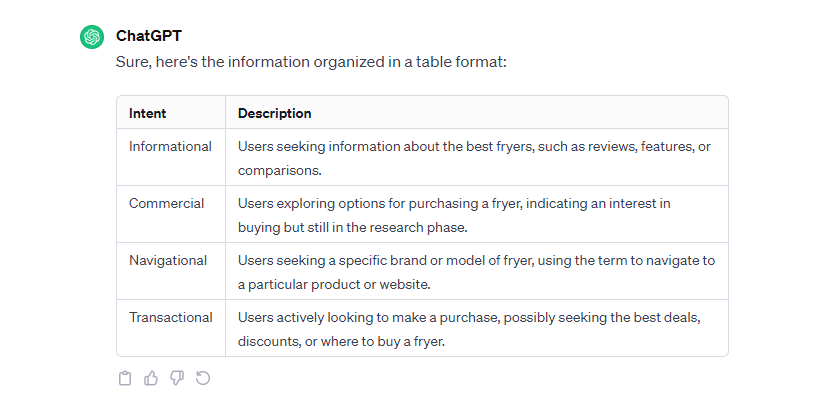
Test your understanding!
You are developing a content strategy for a website that sells project management software. You have the following three keywords from your gap analysis. How would you classify their primary intent, and what type of content would you create for each?
- "how to manage a remote team effectively"
- "monday.com vs asana"
- "project management software for small business pricing"
Show answer
-
"how to manage a remote team effectively"
- Intent: Informational. The user is looking for knowledge and tips.
- Content: A comprehensive blog post or a detailed guide. This content should genuinely help the user solve their problem, with a soft mention of your software as a potential solution.
-
"monday.com vs asana"
- Intent: Commercial Investigation. The user is actively comparing competitor products.
- Content: A dedicated comparison page or an in-depth review article. This content should be objective but highlight the strengths of your software where it outperforms the competition. Feature tables, use-case examples, and testimonials are effective here.
-
"project management software for small business pricing"
- Intent: Transactional (with a commercial element). The user is close to making a decision and cost is a key factor.
- Content: This query should lead directly to your pricing page, which should be clearly optimized for small businesses. The page should detail different tiers, features included, and have clear calls-to-action (CTAs) like "Start Free Trial" or "Buy Now."
2. The Rise of "Layered Intent" in Conversational Search
The traditional four categories are a great model, but AI-driven search is making user queries more complex. People are starting to use natural language and pack multiple needs into a single, conversational query.
This is where the concept of layered intent comes in. A single query might contain informational, commercial, and transactional signals all at once. The following video introduces this idea perfectly and shows how you can use AI to uncover these modern, complex queries.
The AI Keyword Research Hack No One Talks About
In 'The AI Keyword Research Hack No One Talks About,' the creator from Rank Math SEO explains the shift from simple keywords to conversational queries with layered intent. This is a key concept for future-proofing your SEO strategy.
Please watch from the beginning to 01:38 to understand the concept of layered intent. Then, watch from 02:20 to 05:44 to see a practical demonstration of using ChatGPT to generate these conversational queries for your product or service. Pay attention to the 'common denominator' prompt structure.
As the video shows, you can prompt an AI to think about a customer's core problems (the "common denominator") and then generate realistic, conversational queries that contain multiple layers of intent. This moves you beyond one-dimensional keywords and closer to how real people will search in an AI-first world.
3. Scaling Intent Classification with AI
Manually classifying intent for hundreds or thousands of keywords is not feasible. This is where AI models truly shine. Let's explore two practical methods for automating this process at scale.
Method 1: The No-Code Automation Workflow
For many SEO tasks, you don't need to write code. You can connect tools you already use, like Google Sheets and ChatGPT, through an automation platform like Zapier or Make.com.
The article "10 Semantic SEO Automation Workflows" highlights this approach. It proposes a workflow where adding a new keyword to a Google Sheet automatically triggers ChatGPT to classify its intent and write the result back into the sheet.
10 Semantic SEO Automation Workflows to Scale Topic ...
This article from Appy Pie Automate provides a great overview of practical SEO automation. We're interested in one specific use case that directly applies to our goal.
Please read Use Case #3, 'ChatGPT + Google Sheets — Intent-Based Content Mapping,' and look at the corresponding row in the 'Semantic SEO Automation Comparison Table.' This demonstrates a simple yet powerful workflow for classifying intent at scale.
This method is powerful because it's accessible and easily scalable. You create a list of keywords from your gap analysis, set up the automation once, and let the AI do the tedious work of classification. More sophisticated tools build this capability directly into their UI, allowing for fine-tuning of the AI model and the prompts used.

Method 2: The Power User Approach with Python
For maximum control and customization, you can use Python scripts to interact with AI models. While this requires some technical setup, understanding the concept is valuable as it represents the cutting edge of SEO automation.
An article by ThatWare, "Keyword Density Analysis and Search Intent Mapping," demonstrates two ways to do this in Python:
- Rule-Based Classification: A simple script that checks for keywords like "buy," "how to," or "compare" to assign an intent. It's fast but limited.
- AI Model Classification: A more advanced script that uses a powerful NLP model (from HuggingFace Transformers) to understand the context and meaning of the query, not just its words. This is a true AI approach.
Keyword Density Analysis and Search Intent Mapping
Let's explore the technical side of intent classification. This article provides actual Python code for automating this process.
Please read 'Part 2: Search Intent Mapping Using Python' and 'Mapping Keyword Density to Intent.' You don't need to understand every line of code. Focus on the concept of using a BERT-based classifier for intent prediction and the workflow for merging this data to find content gaps.
The key takeaway is that AI provides a spectrum of solutions. Whether through a user-friendly automation platform or a custom script, you can now process massive keyword lists and enrich them with accurate intent data almost instantly.
Summary and Next Steps
Fantastic work! You've now moved from simply finding keywords to deeply understanding the user's goal behind them.
Key Takeaways:
- Search intent is the foundation of a successful content strategy and is typically broken down into Informational, Navigational, Commercial, and Transactional categories.
- The rise of AI and conversational search has introduced "layered intent," where a single query can contain multiple user goals.
- You can use AI tools like ChatGPT to uncover these complex, conversational queries.
- To classify intent at scale, you can use either no-code automation (e.g., Google Sheets + ChatGPT) for accessibility or Python scripting with NLP models for maximum power and customization.
- The ultimate goal is to analyze the distribution of intent across your keyword set to identify strategic gaps in your content plan.
In our next lesson, we will build directly on this foundation. Now that we have a list of keywords classified by intent, we will use GPT-4 to generate semantic keyword clusters and topical variations for content planning. This will help us organize our keywords into logical content pieces and build topical authority effectively.