Hello! Welcome back to your personalized SEO course.
In our last lesson, we focused on using AI to classify search intent at scale, giving you a deep understanding of why users are searching for specific terms. Now that you have a list of keywords and their corresponding intents, the next logical step is to organize them into a coherent content plan.
This lesson addresses the learning outcome: Use GPT-4 to generate semantic keyword clusters and topical variations for content planning. We will move from a flat list of keywords to a structured, hierarchical content strategy. You'll learn how to use GPT-4 with precise prompts to group keywords for individual articles and to build entire topic silos, a crucial step for establishing topical authority and dominating your niche in 2026.
1. From Keyword Lists to Content Silos: Topic vs. Keyword Clustering
Before we start prompting, it's vital to understand two related but distinct concepts: Topic Clustering and Keyword Clustering. As an experienced SEO, you've likely encountered these ideas, but AI radically changes how we execute them.
The following video provides an excellent and concise distinction between these two strategies.
How to Rank for More Keywords with Keyword Clusters
In this clip from 'How to Rank for More Keywords with Keyword Clusters' by Rank Math SEO, the presenter clearly distinguishes between topic clustering (for site structure) and keyword clustering (for a single piece of content).
Please watch from 01:48 to 03:09. Pay close attention to how they differentiate the two concepts.
To summarize and build on the video's explanation:
-
Topic Clustering (or Topical Maps): This is a macro-level strategy for organizing your site's architecture. You group multiple, related pages around a central "pillar" topic. This creates a content silo, signaling to search engines that you have comprehensive expertise on a subject.
- Example: A pillar page on "AI in Marketing" linked to and from cluster pages like "AI for Email Marketing," "Using AI for SEO," and "AI-Powered Analytics."
-
Keyword Clustering: This is a micro-level tactic for optimizing a single piece of content. You group a set of keywords that share the exact same search intent. The goal is to create one comprehensive article that can rank for all these variations simultaneously.
- Example: The keywords "how to make cold brew," "cold brew coffee recipe," and "DIY cold brew at home" all have the same informational intent and can be targeted by a single, in-depth guide.
Mastering both is key to an effective AI-driven SEO strategy. It allows you to build topical authority while ensuring each individual piece of content is laser-focused on user intent, efficiently capturing traffic from dozens of related queries.
2. The Foundation: Engineering Effective Prompts
To get high-quality clusters and maps from GPT-4, you need to master prompt engineering. A vague prompt yields a vague result. A structured prompt yields a structured, actionable result.
A great mental model for this is the five-step formula.
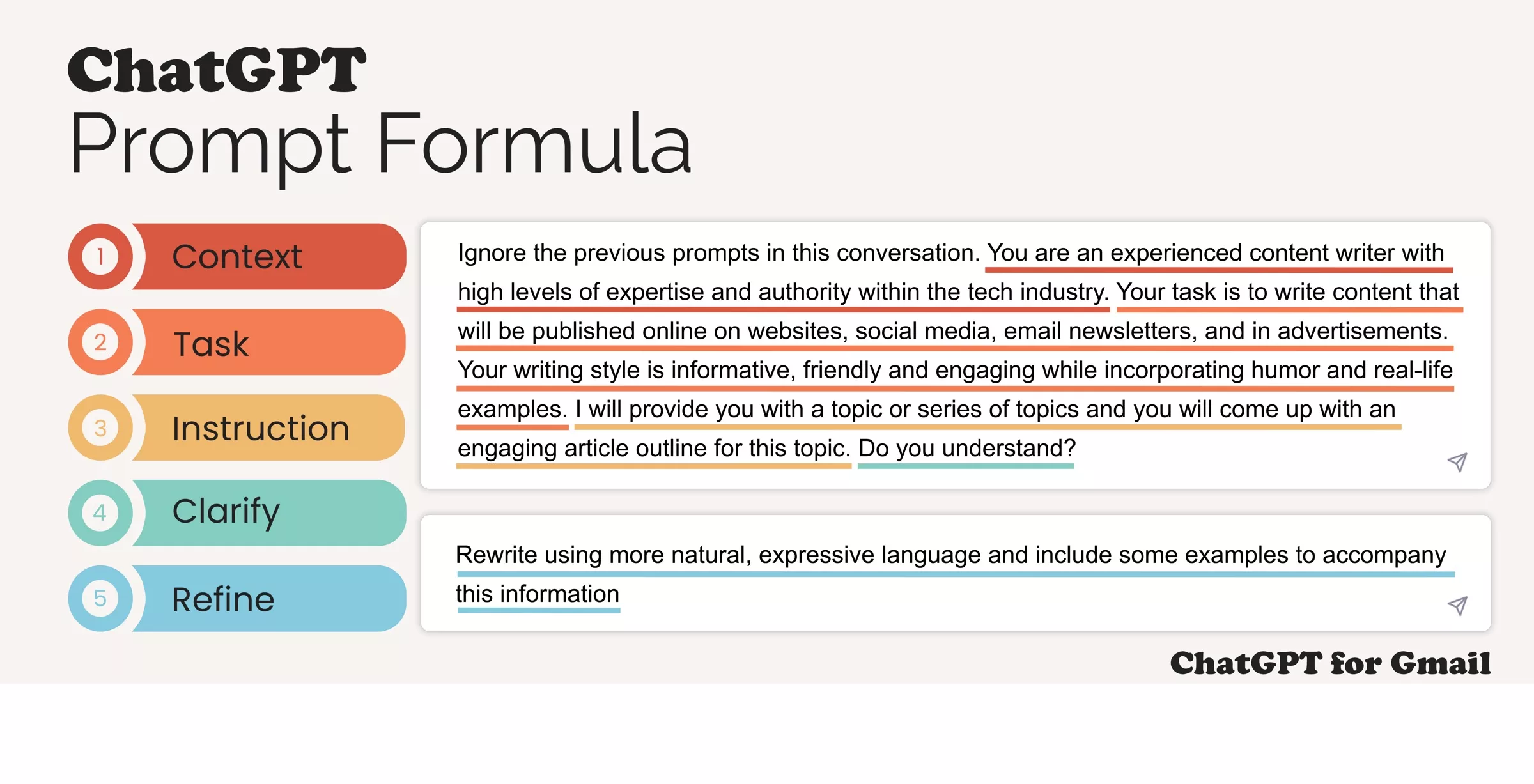
We will use this formula to build our prompts for generating topical maps and keyword clusters.
3. Building Your Content Blueprint: Generating Topical Maps
A topical map is your website's architectural blueprint. It helps you plan content systematically to build authority and avoid keyword cannibalization. Instead of manually brainstorming, you can use GPT-4 to generate a comprehensive map in minutes.
The video below demonstrates several methods for this. We'll focus on the prompt-based approach that works with the free or paid version of ChatGPT.
How to Create Topical Maps with ChatGPT (FREE!)
The video 'How to Create Topical Maps with ChatGPT (FREE!)' by Julian Goldie SEO offers several practical workflows. We'll focus on the prompt strategies that provide a structured content plan.
First, watch from 05:49 to 07:05 to see a direct prompt for generating a topical map. Then, watch from 07:05 to 09:14 for a more advanced, two-part method that first creates categories and then expands them with numerous variations.
Let's synthesize this into a powerful, reusable prompt based on the "Prompt Formula":
[CONTEXT] Act as an expert SEO content strategist with deep knowledge of the [YOUR NICHE] niche. My goal is to establish topical authority and create a comprehensive content hub.

[TASK] Create a detailed and semantically optimized topical map that will serve as the content blueprint for my website.

[INSTRUCTIONS]
1. Identify 5 core pillar topics that are fundamental to the [YOUR NICHE] niche.
2. For each pillar topic, generate 10-15 semantically related cluster topics (subtopics) that a user would need to understand the pillar topic fully. These cluster topics should cover a range of search intents (informational, commercial, etc.).
3. The cluster topics should be logical and progress from foundational concepts to more advanced ones.

[CLARIFY] Present the output as a hierarchical list. Each pillar topic should be a main heading, with the corresponding cluster topics listed as a bulleted or numbered list underneath it.
By simply replacing [YOUR NICHE], you have a robust prompt to generate a full content plan for any vertical. This plan ensures you cover a topic comprehensively, which is a massive signal for E-E-A-T (Experience, Expertise, Authoritativeness, and Trustworthiness).
4. Optimizing a Single Page: Generating Keyword Clusters
Now let's zoom in from the site-level blueprint to the page-level details. Once you've decided on a cluster topic to write about (e.g., "AI-Powered Analytics" from our earlier example), you need to identify all the keyword variations to target within that single article.
This is where keyword clustering shines. The following resource offers excellent, specific prompts for this task.
Prompt Engineering for SEO & Keyword Search Tools
The article 'Prompt Engineering for SEO' provides several excellent prompts for keyword research. We will focus on the one for creating clusters.
Read the section 'Prompt Examples That Generate SEO Keywords.' Pay special attention to the prompt: 'Create a keyword cluster for [topic] including informational, navigational, and transactional search terms with estimated search volumes.' This shows how to ask for clusters grouped by intent.
Building on that, here is a highly effective prompt to generate keyword clusters from a list you might have from Ahrefs, SEMrush, or your own brainstorming.
[CONTEXT] You are an expert SEO analyst. I have a list of keywords related to the topic "[YOUR TOPIC, e.g., 'meditation for beginners']".

[TASK] Group these keywords into tight, semantically-related clusters based on shared user search intent. Each cluster should be targetable by a single, comprehensive piece of content.

[INSTRUCTIONS]
1. Analyze the following keyword list: [PASTE YOUR KEYWORD LIST HERE].
2. For each cluster you identify, choose a "Primary Keyword" that best represents the core intent of the group. This should generally be the term with the highest search volume or the most representative phrase.
3. List the "Secondary Keywords" (synonyms, long-tail variations, questions) that belong to that same cluster.

[CLARIFY] Format the output clearly. For each cluster, use the following structure:
**Cluster X: [Theme of the Cluster]**
- **Primary Keyword:** [Primary Keyword]
- **Secondary Keywords:**
  - [keyword 1]
  - [keyword 2]
  - [keyword 3]
When you use a detailed prompt like this, GPT-4 can produce a highly structured and actionable output, similar to this example:

5. Expanding Your Horizons: Generating Topical Variations
The final piece of the puzzle is using AI not just to organize what you already know, but to discover what you don't. GPT-4 excels at brainstorming "topical variations"—semantically related ideas and user questions that traditional keyword tools often miss because their search volume is low or emerging.
How to Find Hidden Topics Using GPT and Search Console
The article 'How to Find Hidden Topics Using GPT and Search Console' discusses the concept of 'topic mining'—using GPT to find themes and entities, not just keywords.
Please read the section 'Using GPT for Semantic Clustering and Idea Expansion.' Focus on the prompt examples that show how to expand a single query and cluster queries by intent to uncover deeper layers.
Here's a prompt designed specifically for this kind of creative expansion:
[CONTEXT] Act as a creative content strategist and SEO expert. I want to uncover hidden content opportunities around the central theme of "[YOUR THEME, e.g., 'sustainable fashion']".

[TASK] Generate a list of unique topical variations and long-tail keywords that go beyond the obvious suggestions from standard keyword research tools.

[INSTRUCTIONS]
1. Brainstorm sub-topics related to "[YOUR THEME]".
2. Think about different user personas (e.g., budget-conscious students, ethical professionals, parents) and the unique questions they might ask.
3. Generate variations that cover different angles: technical aspects, ethical debates, practical how-to guides, and future trends.

[CLARIFY] Please provide a list of at least 20 unique topical variations. For each one, briefly state the likely user intent (e.g., 'Informational - seeking comparison', 'Commercial - looking for alternatives').
This approach helps you build content that answers questions your competitors haven't even thought of yet, positioning you as a forward-thinking authority.
Test your understanding!
Imagine you are the SEO strategist for a company that sells AI-powered music creation software. Your primary topic is "AI music generation."
- Write a prompt using the five-step formula to ask GPT-4 for a topical map for your blog.
- One of the cluster topics in your map is "best AI music generators." You've exported a list of 50 keywords related to this. Write a prompt to ask GPT-4 to create keyword clusters from this list.
Show answer
Here are example prompts that would effectively complete the tasks. Your wording might differ, but the structure and intent should be similar.
1. Prompt for a Topical Map:
[CONTEXT] Act as an expert SEO and content strategist for a B2C SaaS company specializing in AI music generation tools. My target audience includes musicians, producers, and content creators.

[TASK] I need a comprehensive topical map to build a content hub that establishes our brand as the leading authority in AI music.

[INSTRUCTIONS]
1.  Identify 5 essential pillar topics for the "AI music generation" space.
2.  For each pillar, generate 10-15 cluster topics that cover the subject from beginner to advanced levels. Include topics that address how-to guides, tool comparisons, creative use cases, and technical explanations.
3.  Ensure the topics logically flow into one another to guide a user's learning journey.

[CLARIFY] Please format the output with each pillar as a main heading (H2) and the cluster topics as a bulleted list below it.
2. Prompt for Keyword Clusters:
[CONTEXT] You are a data-driven SEO analyst. I'm planning an article on "best AI music generators" and have a list of keywords from my research.

[TASK] Cluster the following list of keywords into tight groups based on shared, specific search intent. The goal is to inform the structure and subheadings of a single, comprehensive review article.

[INSTRUCTIONS]
1.  Analyze this keyword list: [Here you would paste your list of 50 keywords].
2.  Group keywords that are looking for free tools, tools for specific genres (e.g., 'lo-fi'), tools for vocals, and direct comparisons (e.g., 'suno vs udio').
3.  For each cluster, identify a primary keyword and list the related secondary keywords.

[CLARIFY] Please structure the output clearly for each cluster:
**Cluster Name:** (e.g., Free AI Music Generators)
- **Primary Keyword:** ...
- **Secondary Keywords:** ...
Conclusion
You've made excellent progress today! By moving from simple lists to structured clusters and maps, you're now equipped to build a truly strategic, AI-enhanced content plan.
Key Takeaways:
- Topic Clustering (Topical Maps) is for structuring your site and building authority, while Keyword Clustering is for optimizing a single page to rank for many queries.
- Effective prompt engineering is crucial. Using a structured formula (Context, Task, Instructions, Clarify) will give you actionable outputs from GPT-4.
- You can use specific prompts to generate topical maps as a high-level content blueprint.
- You can use different prompts to group an existing keyword list into keyword clusters, informing the content of a single page.
- GPT-4 is also a powerful brainstorming partner for generating novel topical variations that put you ahead of the competition.
In our next lesson, we'll address a critical question: now that you have this beautifully structured content plan, where do you start? We will tackle the learning outcome: Combine AI analysis with competitive metrics to evaluate keyword difficulty and traffic potential. This will help you prioritize your clustered topics for the highest possible ROI.