Hello! Welcome to the first lesson of your personalized SEO course. I'm excited to get started.
Given your deep experience in traditional SEO, we're going to dive straight into the advanced, AI-focused topics you're interested in. This first module is all about revolutionizing keyword research with AI, and today, we'll tackle our first objective: applying AI-powered tools to identify high-value keyword opportunities that your competitors are capitalizing on, but you're missing.
We'll skip the basics and focus on two powerful, practical methods for conducting an AI-enhanced "gap analysis":
- Using a specialized SEO platform you're already familiar with (Semrush), but with a focus on its competitive intelligence features.
- Using a general-purpose AI tool like ChatGPT for a more qualitative, strategic analysis.
This approach will give you a repeatable framework for finding untapped keyword goldmines.

1. Why AI Changes the Gap Analysis Game
You're likely familiar with the concept of a keyword gap analysis. Traditionally, this meant exporting keyword lists from tools like Ahrefs or Semrush and comparing them in spreadsheets. Today, with search engines using AI to understand topics more deeply (through entities and semantic relationships), our approach to gap analysis must also evolve.
AI tools allow us to move beyond simple keyword comparisons to find deeper topical and intent-based gaps. They can rapidly analyze what topics competitors cover, how they structure their content, and even where they appear in AI-driven search features like Google's AI Overviews.
To set the stage, let's explore this modern context of gap analysis.
SEO gap analysis: How to find content & keyword gaps
This article from Search Engine Land, 'SEO gap analysis: How to find content & keyword gaps,' provides an excellent overview of why this process is critical in the age of AI search. It explains how to think beyond just keywords.
Please read the introduction and the sections titled 'What is a gap analysis?', 'Why gap analysis matters for SEO in 2025', and 'How doing a gap analysis helps you respond to changes.' Focus on how AI Overviews and topical authority have changed the goals of competitive analysis.
The key takeaway is that AI doesn't just make old processes faster; it enables a more intelligent, strategic analysis. We can quickly identify not just what keywords competitors rank for, but why they rank—uncovering entire topic clusters we might be neglecting.
2. Method 1: Data-Driven Gap Analysis with SEO Platforms
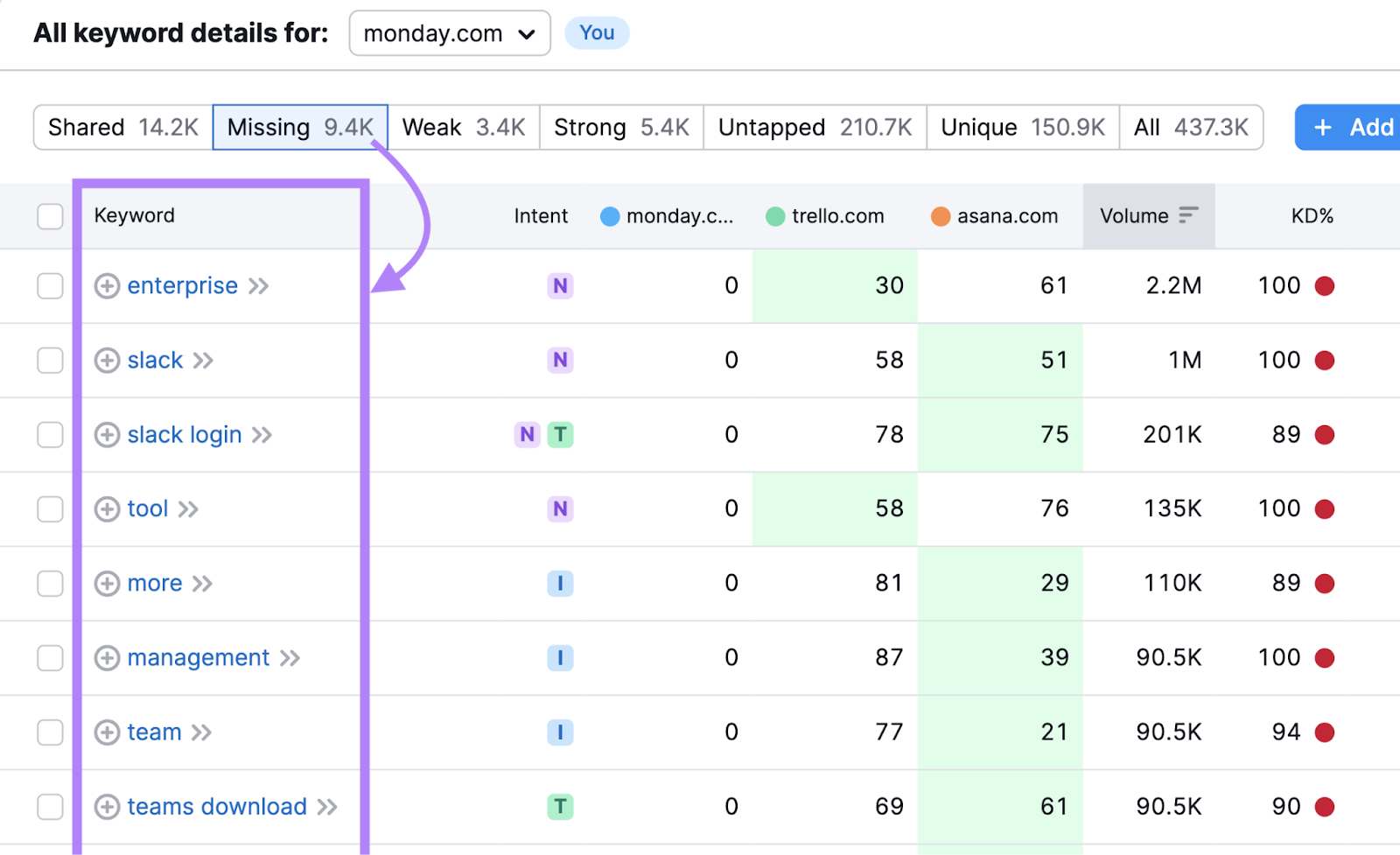
Let's start on familiar ground. You've used tools like Semrush and Ahrefs, which have powerful competitive analysis features. We'll focus on how to use Semrush's Keyword Gap tool specifically to find "missing" and "weak" keywords—two types of high-value opportunities.
- Missing Keywords: These are keywords your competitors rank for (often in the top 100), but your domain doesn't rank for at all. These are perfect for identifying new content ideas.
- Weak Keywords: These are keywords where both you and your competitors rank, but your rank is significantly lower. These are low-hanging fruit for optimizing existing content.
The following video provides a step-by-step walkthrough of this process.
Keyword Research for SEO in 2026: Step-by-Step Tutorial
This video, 'Keyword Research for SEO in 2026', demonstrates how to use Semrush's Keyword Gap tool to systematically uncover these opportunities. Pay close attention to the distinction between 'missing' and 'weak' keywords.
Please watch the sections from 08:17 to 12:47. The first part (08:17 - 11:03) covers finding 'missing' keywords. The second part (11:03 - 12:47) focuses on finding 'weak' keywords.
As the video demonstrates, this process gives you an immediate, data-driven list of keywords to target. The AI component here is the platform's ability to process massive datasets of keyword rankings across millions of domains and instantly highlight the most relevant gaps for your specific competitive landscape.
Test your understanding!
Imagine you are the SEO specialist for a website selling high-end coffee beans (mycoffeebrew.com). Your main competitor is peetscoffee.com.
Using Semrush's Keyword Gap tool, you find two opportunities:
- Missing:
peetscoffee.comranks #5 for "how to make cold brew concentrate," which has a monthly volume of 12,000. Your site doesn't rank at all. - Weak: For "best coffee for french press" (volume 8,000),
peetscoffee.comranks #8, while you rank #22.
How would you prioritize these two opportunities, and what would be your immediate next action for each one?
Show answer
This scenario presents a choice between creating new content and optimizing existing content.
-
"how to make cold brew concentrate" (Missing): This is a high-priority opportunity for creating new content. Since you don't rank at all, the goal is to build a new, comprehensive guide or video tutorial to capture this informational traffic. The high search volume makes it a valuable target. Your immediate action would be to add this topic to your content calendar for a new blog post.
-
"best coffee for french press" (Weak): This is a high-priority opportunity for content optimization. Ranking on page three (#22) means Google already sees your page as somewhat relevant. You have a foothold. The immediate action would be to analyze the existing page: improve its on-page SEO, add more depth, update information, and check if it fully matches the search intent of the top-ranking pages. A content refresh could quickly push this keyword to page one, providing a faster ROI.
Both are valuable, but the "weak" keyword often represents a quicker win.
3. Method 2: Strategic Gap Analysis with ChatGPT
While specialized tools are great for quantitative data, large language models like ChatGPT can perform a more qualitative, high-level strategic gap analysis. Using a model with web-browsing capabilities (like ChatGPT with plugins or its native browsing function), you can ask it to analyze competitor sites and identify their core content pillars.
This approach is less about finding specific long-tail keywords and more about understanding the overarching topics and themes your competitors focus on that you might be ignoring.
ChatGPT GAPs Analysis: Uncover Hidden Ranking Opportunities
The video 'ChatGPT GAPs Analysis' shows a practical example of this. The host prompts ChatGPT to compare his site against two competitors to identify broader content gaps and opportunities.
Watch the first three minutes of the video (00:00 - 03:02). Focus on the prompt structure used and the kind of strategic, topic-level output the AI provides.
This method is powerful because it mirrors how a human strategist would think, but at the speed of AI. To make this even more practical, you can use a structured prompt to guide the AI.
The article from Nightwatch provides an excellent, reusable prompt for this exact task.
How to Use AI for Keyword Research: A 6-Step Practical Guide
Let's revisit the Nightwatch article, 'How to Use AI for Keyword Research.' This time, we'll focus on its practical guide for performing a competitor gap analysis.
Please read 'Step 6: Discover Competitor Keywords and Content Gaps.' Pay close attention to the example prompt provided. This is a template you can adapt for your own projects.
The prompt structure from the article is a fantastic takeaway:
I want to analyze the keyword gap between my website and several competitors. Please identify keywords that:My domain does not rank for,But two or more of the competitors do.Prioritize keywords with high search volume and low-to-medium competition. The keywords are also categorized by search intent (informational, commercial, transactional, navigational).Here's the data:My domain: (your domain)Competitor 1: (competitor’s domain)Competitor 2: (competitor’s domain)
You can adapt this prompt to ask for broader topics instead of just keywords, combining the strengths of both methods we've discussed.
Summary and Next Steps
Congratulations on completing your first lesson! We've established a solid foundation for AI-powered keyword research.
Key Takeaways:
- AI-powered gap analysis helps you identify not just keyword gaps but also broader topical and semantic opportunities missed by traditional methods.
- Specialized SEO tools (like Semrush) are excellent for quantitative analysis, quickly identifying data-backed "missing" and "weak" keyword opportunities.
- General AI tools (like ChatGPT) excel at qualitative analysis, helping you understand high-level strategic gaps in your competitors' content pillars.
- Combining both methods gives you a comprehensive view of the competitive landscape, providing a list of both specific keywords to target and broader topics to build out.
In our next lesson, we will move to the next logical step. Once you have a list of keyword opportunities, you need to understand the 'why' behind them. We will use AI models to classify search intent at scale and inform your content strategy. This will ensure that the content you create perfectly aligns with what users are looking for.