Hello! Welcome back.
In our last lesson, we looked to the future, learning how to use AI to predict emerging keyword trends and capture demand before your competitors even see it. This completed our journey through the various methods of AI-powered keyword discovery.
Today, we'll address the final learning outcome for this module: Build a data-driven keyword gap analysis strategy to outrank competitors in specific niches. This lesson ties together everything we've learned about keyword research by focusing on a concrete, strategic process for identifying and exploiting weaknesses in your competitors' SEO strategies. We will move from discovering new opportunities to strategically capturing existing ones.
By the end of this lesson, you'll have a multi-faceted framework for keyword gap analysis that goes far beyond the basic features of SEO tools, incorporating AI-driven insights and automation.
1. What is Keyword Gap Analysis? A Data-Driven Framework
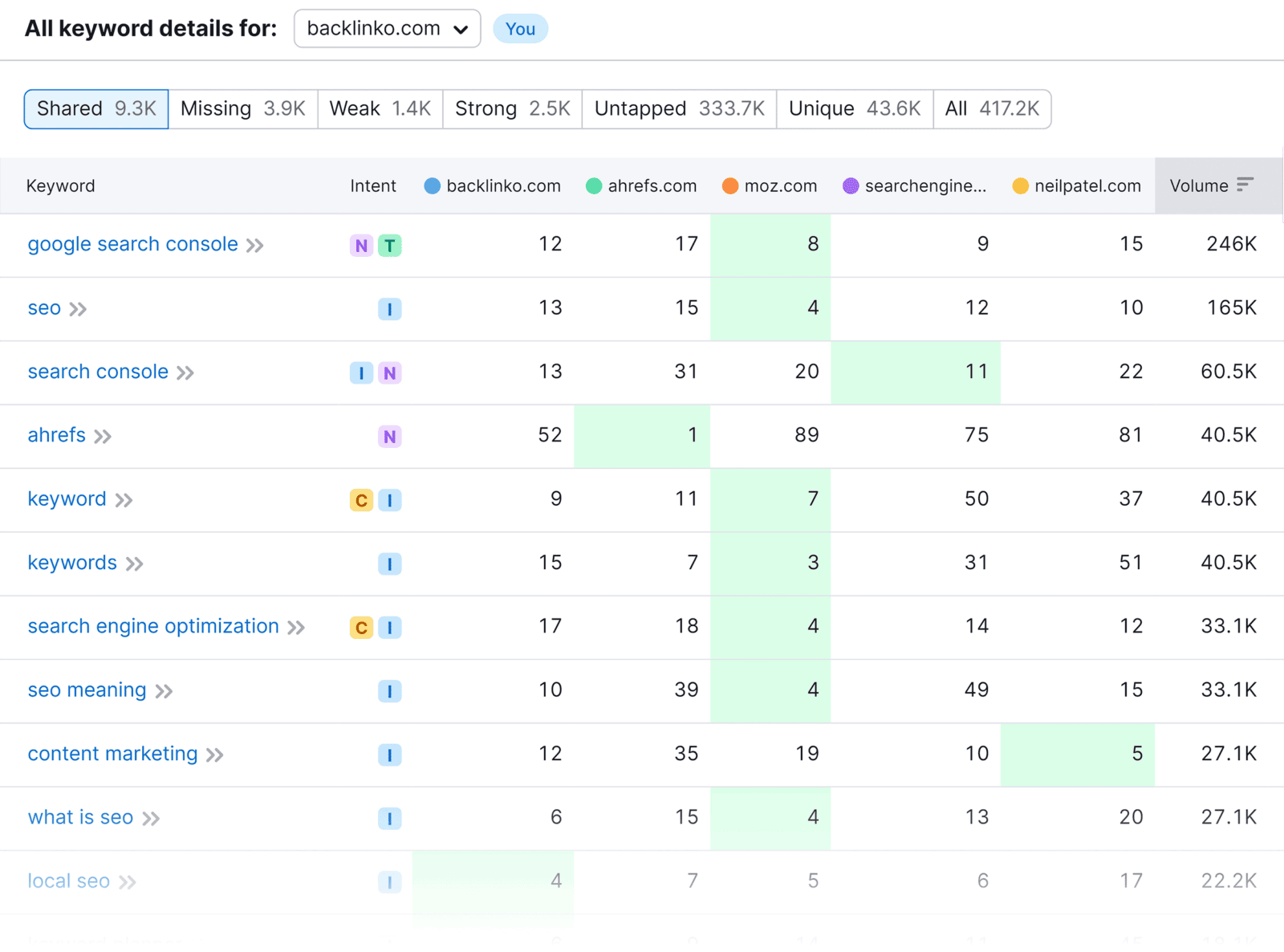
At its core, keyword gap analysis is the process of identifying valuable keywords that your competitors rank for, but you don't. Given your experience with tools like Ahrefs and SEMrush, you're likely familiar with the basic concept.
However, a modern, data-driven strategy requires more than just exporting a list of "missing" keywords. It involves a systematic process of filtering, prioritization, and opportunity scoring.
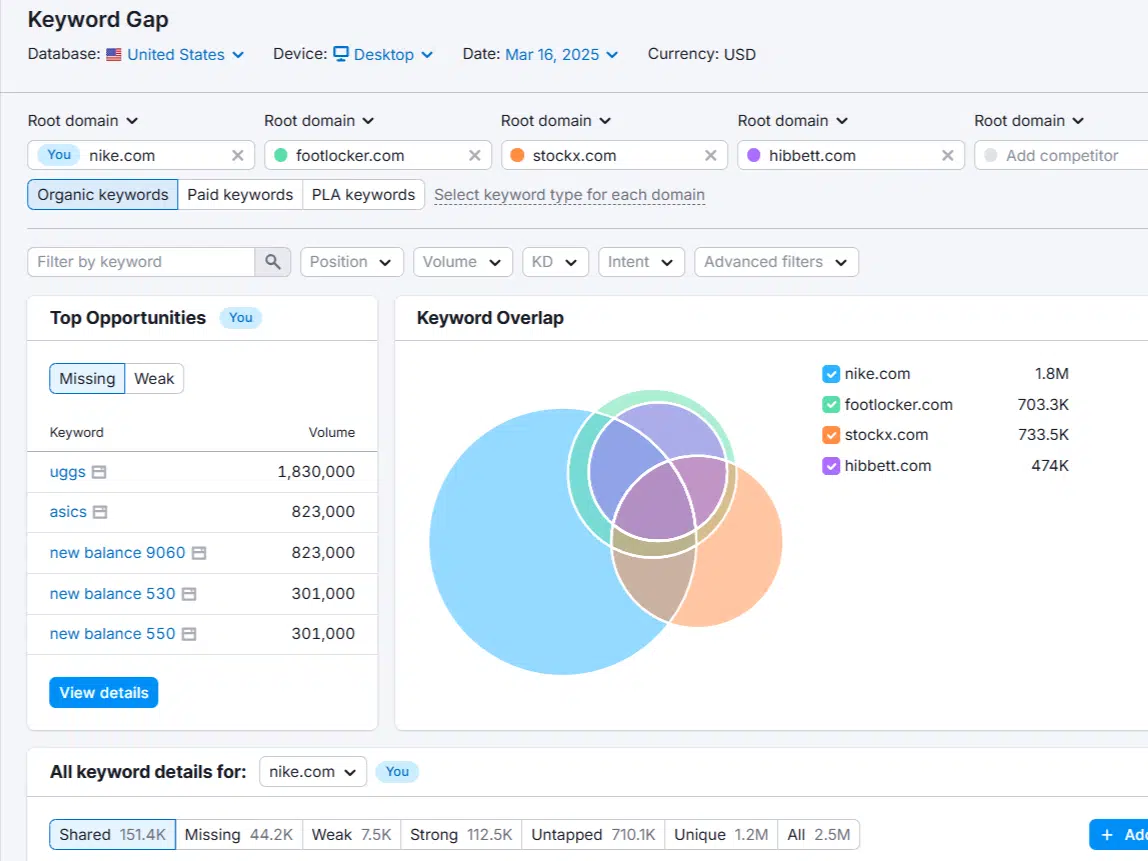
Let's refine this process with a quantitative approach.
Keyword Research That Works: AI SEO Tactics for 2025
The article 'Keyword Research That Works: AI SEO Tactics for 2025' from Passionfruit provides an excellent, advanced workflow for this. It moves beyond simple comparisons to a true opportunity analysis.
Please read the section 'Competitor Keyword Gap Exploitation'. Pay close attention to the 'Premium Gap Analysis Workflow' and the custom 'Opportunity Score' formula. This is the key to prioritizing your efforts effectively.
The Opportunity Score formula mentioned in the article is a powerful concept:
Let's break this down:
- Numerator (The Upside): It prioritizes keywords that not only have high volume but are also highly relevant to your business and likely to generate clicks.
- Denominator (The Cost): It de-prioritizes keywords that are too competitive (high KD) or would require a massive effort to create content for (e.g., a 10,000-word guide with custom graphics).
By using a formula like this, you create a data-driven priority list, ensuring you focus your resources on the gaps with the highest potential ROI.
2. Finding Untapped Niches: The "Rabbit Hole" Strategy
Standard gap analysis is great for direct competition, but what about breaking into highly competitive niches where the obvious gaps are already filled? For this, we need a more creative strategy that leverages AI to find patterns and uncover low-authority competitors who have already done the hard work for us.
The SEO Strategy to BREAK into Competitive Niches
The Ahrefs video, 'The SEO Strategy to BREAK into Competitive Niches', demonstrates a brilliant methodology for this. It's a masterclass in using AI and pattern recognition to find the side door into a competitive market.
Please watch from 02:30 to 10:36. This section covers the core of the strategy. Focus on these three key steps: Unique Seed Keywords (02:30 - 05:34): See how ChatGPT can be used to generate seed keywords your competitors likely haven't thought of. Pattern Identification (05:45 - 07:22): Learn to spot patterns in low-competition keywords to expand your list exponentially. Follow the Rabbit Hole (07:22 - 10:36): This is the crucial part. Understand how to find low-authority sites that are succeeding, and then analyze their top pages to uncover entire clusters of low-competition keywords.
This "rabbit hole" strategy is a powerful form of gap analysis. Instead of just looking at what keywords your main rivals rank for, you're identifying a gap in the overall market strategy. You find where a smaller player has succeeded and reverse-engineer their approach to build your own topical authority from the ground up.
3. The Internal Gap Analysis: Mining Your Own Search Console Data
So far, we've focused on external gaps relative to your competitors. But some of the most valuable opportunities are internal—the gaps between the topics your content could rank for and what it actually ranks for. Your Google Search Console data is a goldmine for this.
The goal here is to find queries where you have high impressions but a low click-through rate (CTR). These are topics where Google sees you as relevant, but users don't find your page compelling enough to click. This often indicates a "content gap" on your page that can be filled.
How to Find Hidden Topics Using GPT and Search Console
The article 'How to Find Hidden Topics Using GPT and Search Console' by Growthym provides a fantastic, step-by-step process for this internal analysis.
Please read the following sections to understand this workflow: 'Understanding Topic Mining with GPT': To grasp the core concept. 'Setting Up Data Sources': Learn how to prepare your GSC data for analysis. 'Using GPT for Semantic Clustering': See how to use prompts to get GPT to find topic clusters in your query data. 'Validating and Prioritizing Topics': Understand how to use GSC metrics to validate the topic clusters GPT generates. This will show you how to turn your 'almost-ranking' queries into a concrete content update strategy.
By feeding your GSC data (specifically, queries with high impressions and low CTR) into a model like GPT-4, you can ask it to identify semantic clusters and suggest subtopics you might be missing. This turns your existing, underperforming content into a high-potential asset.
4. Scaling the Strategy: Automating Competitor Analysis
As an SEO specialist, your time is valuable. Manually running gap analyses for multiple competitors is time-consuming. This is where automation and AI can provide a massive strategic advantage, aligning perfectly with your goal to master AI's impact on SEO.
Imagine a system that automatically pulls key SEO metrics for you and your competitors, and then uses an AI to provide an initial strategic analysis.
Use This Powerful SEO Competitor Analysis Automation To Out Rank Competitors
The video 'Use This Powerful SEO Competitor Analysis Automation' by Nico from AI Ranking is a hands-on tutorial that shows exactly how to build such a system. While you don't need to build it right now, watching the process will reveal what's possible.
Focus on understanding the overall workflow rather than the specific clicks in the automation tool: Building the Automation (04:29 - 12:06): Skim this section to see how Make.com is used to connect Google Sheets with the DataForSEO API to pull metrics like backlinks, traffic, and keyword rankings. Populating the Sheet (12:06 - 19:08): Briefly watch how the collected data automatically fills the Google Sheet. The AI Analysis (21:47 - 26:17): This is the most important part. Watch this section closely to see how the final data is fed into an AI with a specialized prompt to generate a deep competitive analysis with actionable recommendations.
This automated workflow elevates you from a data-gatherer to a strategist. The system handles the tedious metric collection, allowing you to focus on interpreting the AI-generated insights and making high-level decisions.
Test your understanding!
You are the SEO specialist for a project management software company (like Asana or Trello). Your primary competitors are well-established. Outline a three-pronged keyword gap analysis strategy based on the methods in this lesson.
Describe briefly:
- How you would conduct a traditional gap analysis.
- How you would apply the "rabbit hole" strategy.
- How you would perform an internal gap analysis.
Show answer
Here's a three-pronged strategy:
-
Traditional Gap Analysis:
- I would use Ahrefs' or SEMrush's Content Gap tool to compare my domain against 3-4 direct competitors (e.g., asana.com, monday.com, trello.com).
- I'd filter for keywords where at least two competitors rank in the top 10, but I rank outside the top 20.
- I would export this list and apply a weighted Opportunity Score that considers search volume, keyword difficulty, and high business relevance (e.g., keywords including terms like "template," "alternative," "pricing," "integration").
-
"Rabbit Hole" Strategy:
- Instead of targeting broad terms like "project management," I'd use ChatGPT to find unique seed keywords for niche use cases (e.g., "agile for marketing teams," "nonprofit grant tracking," "event planning timeline").
- I'd search these terms in Ahrefs and look for low-DR websites (like a niche blog or a small consulting firm) that rank on page 1.
- I would then plug that low-DR domain into Site Explorer and analyze their "Top Pages" report. This would likely reveal a cluster of related, low-competition keywords about that specific niche that my major competitors have overlooked.
-
Internal Gap Analysis:
- I'd export 6 months of Google Search Console data, focusing on queries with high impressions (>500/mo) but low CTR (<3%) that rank between positions 8-20.
- I would feed this list of queries into GPT-4 and use a prompt like: "Analyze these queries related to project management. Group them into semantic clusters and identify missing subtopics or user intents that could be added to our existing content to improve CTR."
- If GPT identifies a cluster around "team capacity planning," and I see that my page on "resource management" gets impressions for these terms, I would update that page with a dedicated section on capacity planning, including examples and a template.
Conclusion
This lesson concludes our first module, "AI-Powered Keyword Research & Intent Analysis." You have built a comprehensive toolkit that takes you from generating initial ideas with AI, to classifying intent, building semantic clusters, evaluating difficulty, predicting future trends, and now, strategically identifying and prioritizing gaps in the competitive landscape.
Key Takeaways:
- A Multi-Faceted Strategy: Effective keyword gap analysis involves looking at external competitors, untapped market niches, and your own internal data.
- Prioritize with Data: Use scoring models like the Opportunity Score to move beyond simple keyword lists and focus on high-ROI initiatives.
- Leverage AI for Creativity and Efficiency: Use LLMs to find unique seed keywords and analyze your GSC data, and use automation platforms to handle repetitive data collection.
- Find the Side Door: Don't just analyze your main rivals. The "rabbit hole" strategy of finding and reverse-engineering successful low-authority sites is a powerful way to enter competitive markets.
You are now fully equipped with a modern, AI-enhanced keyword strategy. The next step is to use this research to create content that ranks.
Our next module is AI-Driven Content Strategy & Creation. In the first lesson, we will bridge the gap between research and execution by learning how to: "Define the components of an AI-enhanced content brief, including target query, search intent, and key entities."