Hello! Welcome back to your personalized SEO course.
In our last lesson, we built a robust framework for evaluating existing keywords, combining traditional quantitative metrics with qualitative AI analysis to prioritize your efforts. You now know how to assess the current landscape and pick your battles wisely. However, in the rapidly evolving world of AI search, winning today's battles isn't enough; you need to anticipate tomorrow's.
This lesson focuses on exactly that. We'll shift from a reactive to a proactive mindset. Instead of just analyzing what people are searching for, you'll learn how to predict what they will be searching for. This is the final and most forward-looking piece of our module on AI-powered keyword research.
Our learning outcome for today is to: Identify emerging keyword trends and search patterns using AI trend prediction tools.
1. The Shift to Predictive SEO: From Reactive to Proactive
Traditional SEO often feels like you're driving by looking in the rearview mirror—you analyze historical search volume and optimize for what has already happened. Predictive SEO, in contrast, is about looking ahead through the windshield. It uses AI to forecast future search demand, allowing you to create content before a trend peaks and the competition floods in.
Predictive SEO Guide 2026 | AI-Driven Strategies for Higher ...
To understand the fundamentals of this proactive approach, let's start with the article 'Predictive SEO Guide 2026' from MD Azizur Rahman's blog. It clearly defines the concept and its importance.
Please read the sections 'What is Predictive SEO?' and 'Why Predictive SEO Is Important in 2026'. Pay close attention to the distinction between traditional and predictive SEO and why AI-driven search experiences like SGE make this shift critical.
The core difference isn't just about looking at a Google Trends graph. While that shows interest over time, modern AI prediction tools go deeper.
Using AI to Predict Keyword Trends and Search Demand
The article 'Using AI to Predict Keyword Trends and Search Demand' from Legacy Digital Marketing explains the mechanics behind this shift. It introduces the key concepts of momentum and velocity.
Now, read the sections 'What Is Predictive Keyword Research?' and 'How AI Forecasts Search Demand Using Data and NLP'. Focus on how AI tracks not just volume, but the rate of change (momentum) and how it processes various data signals like social chatter and SERP volatility.
By analyzing billions of data points—from search queries and social media discussions to news articles and academic papers—AI models can identify nascent trends before they register significant search volume. This allows you to gain a crucial first-mover advantage.
2. Identifying Emerging Search Patterns: A Practical Guide
Predicting the future of search isn't about one magic tool; it's about learning to recognize new patterns of user behavior. We'll focus on two major patterns that are defining the AI search era.
Pattern 1: The Rise of Conversational & Situational Queries
As users get more comfortable with AI assistants and generative search engines, they are moving away from short, staccato keywords ("best dog food arthritis") and toward natural, conversational questions ("what food supports senior dogs who are stiff in the morning?").
These queries are rich with intent and context, but they rarely show up in traditional keyword tools. This is where you can use AI to think like a user and uncover these valuable, low-competition phrases.
The following video from Rank Math provides an outstanding, practical workflow for finding and quantifying these queries.
The AI Keyword Research Hack No One Talks About
This video, 'The AI Keyword Research Hack No One Talks About', demonstrates a powerful method to identify and evaluate conversational queries that your competitors are likely missing.
Please watch from 00:38 to 11:53. This is the core of the video and covers a complete workflow. Pay close attention to these four key steps: Understanding the Shift (00:38 - 01:38): Grasp why conversational queries are the future. Generating Queries with ChatGPT (02:32 - 05:44): Learn the prompt structure for brainstorming situational queries based on a 'common denominator'. Reverse-Engineering with Perplexity (05:54 - 07:42): Discover how to find the underlying 'traditional' keywords that an AI might search for to answer a conversational query. Estimating Volume with Layered Intent (08:34 - 11:53): Understand the clever method for estimating the traffic potential of a zero-volume conversational query.
This method is powerful because it gives you a data-driven way to target phrases that have no official search volume, grounding your predictive strategy in the existing demand for related topics.
Pattern 2: Capturing Breakout Topics with "Zero Volume"
The second pattern involves identifying entirely new topics or keywords before they become mainstream. These are the "zero-volume" keywords that will be high-volume in six months. This is where specialized trend prediction tools shine.

These platforms go beyond search data, analyzing signals from social media, online forums, news sites, and e-commerce platforms to spot trends as they form.
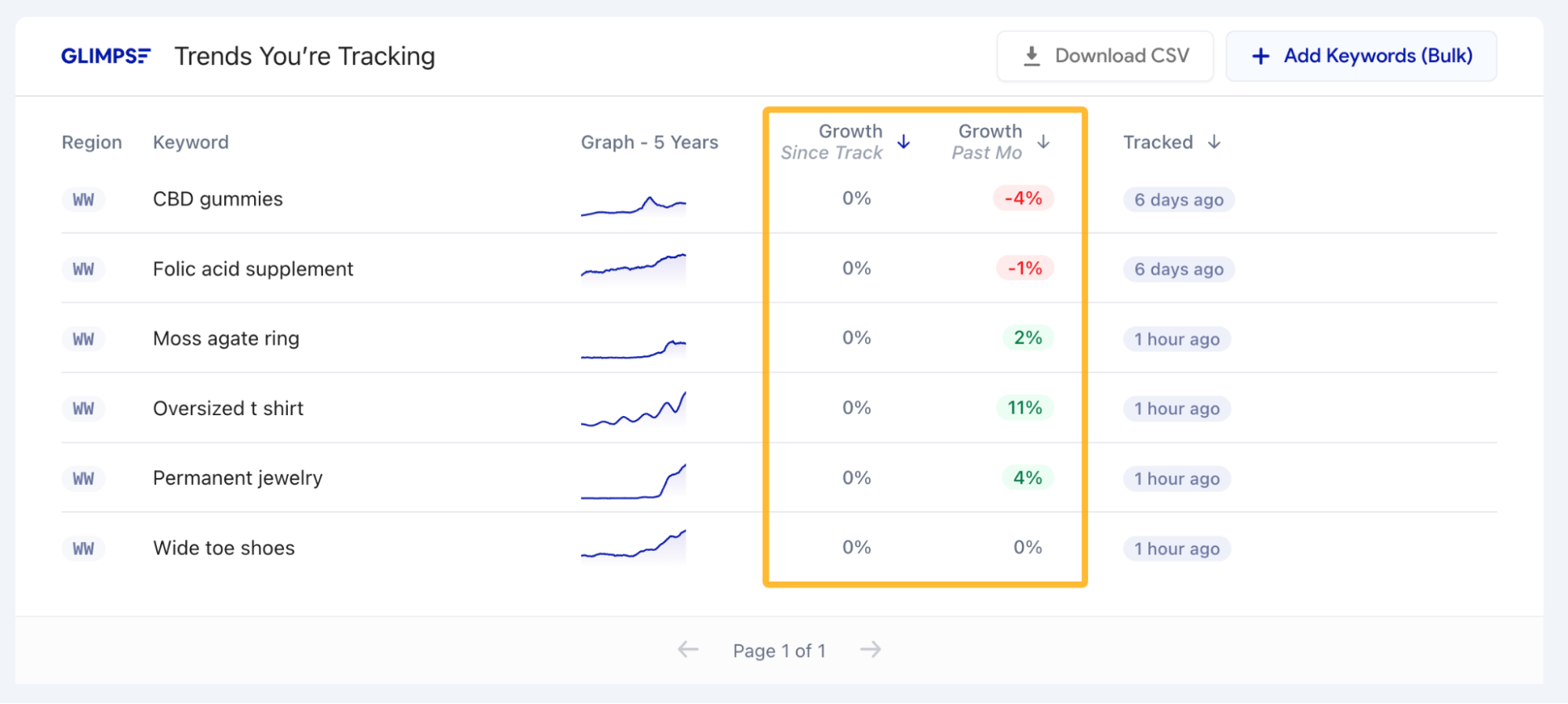
Let's walk through a structured process for using these tools.
Using AI to Predict Keyword Trends and Search Demand
The 'Using AI to Predict Keyword Trends and Search Demand' article that we looked at earlier also provides a clear, step-by-step workflow for this process, along with a list of essential tools.
Please read the sections 'Core AI Tools for Keyword Trend Prediction' and 'How to Use AI to Predict Keyword Trends (Step-by-Step)'. This will introduce you to key tools like Exploding Topics and MarketMuse and give you a repeatable framework for finding and validating breakout topics.
To summarize the workflow:
- Ideate: Start with a broad topic and use an LLM (like ChatGPT or Gemini) to brainstorm potential emerging sub-topics.
- Identify: Run these ideas through a trend discovery tool (like Google Trends, Exploding Topics, or the trend features in Semrush/Ahrefs). Look for keywords with high velocity (a steep upward curve), even if the absolute volume is still low.
- Validate & Cluster: Verify the trend by checking SERP volatility and looking for supporting discussions on social media or forums. Use AI clustering tools to group related emerging keywords and map out your content plan.
- Act: Create content early to establish topical authority before the trend fully matures.
3. A Word of Caution: Interpreting the Forecast
AI prediction tools are incredibly powerful, but they are not infallible. They provide data-driven hypotheses, not certainties. Your expertise as an SEO is to interpret their output critically.
Using AI to Predict Keyword Trends and Search Demand
To ensure you use these tools effectively, it's crucial to be aware of common mistakes. The same article provides an excellent list of pitfalls to avoid.
Read the section 'Common Mistakes in AI Keyword Forecasting'. You don't need to memorize all 15 points, but focus on the core principles: validating with multiple sources, distinguishing real trends from short spikes, and using AI to guide—not replace—your strategic judgment.
Key principles to remember:
- Always triangulate your data. Never rely on a single tool. Cross-reference a potential trend with Google Trends, SERP analysis, and social listening.
- Distinguish fads from trends. A news-driven spike might last a week, but a true trend shows sustained growth over months.
- Don't ignore "zero-volume" gems. Your traditional tools will tell you there's no demand. Your predictive tools and your analysis of conversational queries might tell a different story. Trust the velocity signal for future opportunities.
Test your understanding!
You are the SEO specialist for a company that sells sustainable, eco-friendly travel gear. You want to get ahead of the 2026 travel trends.
Using the concepts from this lesson, outline a two-pronged strategy to identify emerging keyword trends. Describe:
- How you would find emerging conversational/situational queries.
- How you would find breakout topics.
Mention the types of tools or prompts you would use for each.
Show answer
Here is a two-pronged strategy:
1. Finding Conversational & Situational Queries:
- Objective: To find long-tail, intent-rich questions that users will ask AI search engines.
- Process:
- Identify the 'Common Denominator': I'd start by identifying core problems or situations my customers face. Examples: "packing light for long trips," "finding plastic-free travel options," "dealing with airport security with eco-friendly liquids."
- Use ChatGPT for Brainstorming: I would use a prompt similar to the one in the Rank Math video: "I sell sustainable travel gear. The common denominators that trigger customer searches are [packing light, plastic-free travel, airport security]. Provide me with conversational and situational queries that real people would ask an AI assistant related to these denominators and my products."
- Estimate Opportunity: For a promising query like "how can I pack for a two-week trip to Europe with just a carry-on using eco-friendly products?", I would use Perplexity to see what traditional keywords it searches for (e.g., "best solid toiletries," "compression packing cubes," "sustainable carry-on backpack"). I'd then use Google Keyword Planner or Ahrefs to sum the volume of these underlying intents to estimate the query's traffic potential.
2. Finding Breakout Topics:
- Objective: To identify new, broader trends in sustainable travel before they become competitive.
- Process:
- Tool-Based Discovery: I would use a tool like Exploding Topics or Glimpse. I'd set up tracking for broad seed terms like "eco-tourism," "regenerative travel," "slow travel," and "digital nomad visa."
- Look for Velocity: I would monitor for topics showing high month-over-month growth, even with low absolute search volume. A hypothetical example might be "biocontributed travel" or "carbon-negative hotels."
- Validate the Trend: If I see a spike in "biocontributed travel," I would validate it by:
- Checking Google Trends for a sustained upward curve.
- Searching on Reddit (e.g., r/solotravel, r/digitalnomad) and TikTok to see if real people are discussing it.
- Analyzing the SERP volatility. High fluctuation might indicate Google is still trying to figure out the intent, presenting an opportunity to rank early with definitive content.
Conclusion
This lesson concludes our first module, "AI-Powered Keyword Research & Intent Analysis." You have progressed from using AI to generate keywords, to classifying their intent, clustering them into topics, evaluating their competitiveness, and now, to forecasting future trends. You are now equipped with a complete, forward-looking keyword strategy framework.
Key Takeaways:
- Predictive SEO is Proactive: It's about creating content for future demand, not just reacting to past data.
- Look for Momentum: AI trend prediction tools identify opportunities by tracking the velocity of topics across multiple platforms, not just static search volume.
- Master Two Patterns: Learn to uncover both long-tail conversational queries using LLMs and broad breakout topics using trend discovery tools.
- Validate Everything: AI provides powerful clues, but your expertise is required to validate those clues against real-world data and separate true trends from noise.
Now that you have a vetted, prioritized, and future-proofed list of keyword opportunities, the next logical step is to create content that can rank for them. In our next module, AI-Driven Content Strategy & Creation, we will begin by learning how to translate your keyword research into a detailed plan for your writers (or for an AI). Our first lesson will be: "Define the components of an AI-enhanced content brief."