Hello! Welcome to the final lesson in our module on Advanced SERP Feature & Voice Search Optimization.
In our last session, we focused on the practical steps of structuring content to provide direct answers for voice search, which is a key strategy for capturing featured snippets. Now that you know how to create and format this content, it's time to measure its impact.
Today's lesson addresses the learning outcome: Track and measure SERP feature performance using advanced Search Console and third-party tools. This is where you close the loop on your optimization efforts. By accurately tracking your performance, you can demonstrate the value of your work, diagnose issues, and identify new opportunities to dominate the SERPs. We'll cover this using Google Search Console as your data foundation and then explore how third-party tools like Ahrefs and Semrush provide crucial competitive and historical context.
1. Key Metrics and Essential Tools
Before diving into the tools, let's establish what we're measuring. As the article from Semai AI explains, the core metrics for tracking SERP feature performance are the same ones you're familiar with, but their interpretation requires a specific lens.
How to Monitor Featured Snippet Performance
To start, let's review the core metrics and tools involved in monitoring SERP features. This article, 'How to Monitor Featured Snippet Performance' from Semai AI, provides a concise overview.
Please read the introduction and the sections 'Key Performance Metrics for Rich Results' and 'Essential Tools for Monitoring SERP Features'. Pay close attention to the 'Practical Considerations' regarding the ambiguity of the 'average position' metric for featured snippets.
As you just read, tracking SERP features means monitoring:
- Impressions: How often your content appears in a SERP feature.
- Clicks: How often users click on your content from that feature.
- Click-Through Rate (CTR): The percentage of impressions that result in a click.
- Average Position: Your average ranking. For featured snippets, a position close to 1 (e.g., 1.1) often indicates ownership. A sudden jump from ~1 to a higher number can signal you've lost the snippet.
Your primary toolset will be a combination of Google Search Console for first-party data and third-party tools for competitive intelligence and historical analysis. Let's start with GSC.
2. Monitoring Performance in Google Search Console
Google Search Console (GSC) is your direct line to Google's data. It's the most accurate source for understanding how your site performs in search, including within rich results and other SERP features.
The following video from the Google Search Central channel is an excellent guide to the two main areas in GSC for this task: the Performance report and the specific structured data reports (formerly "Enhancements").
Monitoring Rich Results in Search Console - Google Search Console Training
This official Google training video, 'Monitoring Rich Results in Search Console,' will walk you through the key reports for tracking your SERP feature performance.
Please watch from 02:38 to 07:12. The video covers: Performance Report (02:38 - 03:50): Focus on how to use the 'Search appearance' filter to isolate performance data for rich results. Structured Data Reports (03:50 - 06:23): Understand how to find and interpret errors and warnings for specific schema types. Unparsable Data (06:23 - 07:12): Learn about this critical report for finding fundamental implementation issues.
Key Takeaways from the Video:
-
Performance Report: The
+ New > Search appearance...filter is your best friend here. You can use it to compare performance between pages that appear as rich results and those that don't. You can also filter for specific types, like "Featured snippets," "Video results," or "Product results," to see their direct impact on clicks and impressions. -
Specific Item Reports: These reports (e.g., Videos, Products, Review snippets) are your diagnostic hub. They show you:
- Errors: Critical issues that disqualify your page from appearing as a rich result. These must be fixed.
- Valid with warnings: Your page is eligible, but you could improve it by providing recommended (but not required) properties.
- Valid: Your structured data is implemented correctly.
-
Unparsable Structured Data: This report is crucial. If a page appears here, it means Google found what looks like structured data but couldn't understand it due to a syntax error. This is a complete blocker, and fixing these errors can uncover lost opportunities.
3. Gaining a Competitive Edge with Third-Party Tools
While GSC tells you how your site is doing, it doesn't tell you anything about your competitors. Third-party rank trackers are essential for:
- Identifying SERP features you don't own.
- Tracking which competitors are winning those features.
- Analyzing SERP feature trends over time for your target keywords.
Given your familiarity with Ahrefs and Semrush, let's see how they handle this.
Using Ahrefs Rank Tracker
Ahrefs provides powerful tools for dissecting SERP feature ownership. The following tutorial gives a great overview of its capabilities.
Ahrefs’ Rank Tracker Overview and Tutorial
Let's watch a detailed walkthrough of the 'Ahrefs’ Rank Tracker' tool. It demonstrates how to move beyond simple rank tracking to strategic SERP feature analysis.
Watch the following sections: Filters (02:28 - 04:15): Pay close attention to the SERP features filter and the tip on finding featured snippets you don't rank for. SERP Features Graph (04:37 - 06:14): See how you can visualize your ownership of different SERP features over time. Raw Data Table (06:34 - 07:19): Note the color-coding for owned (blue) vs. unowned (gray) features. Competitors Report (07:48 - 10:18): This is a key section. Understand how to compare your performance directly against competitors.
Using Semrush and Other Tools
Semrush offers similar functionality. As you know from your experience, its Position Tracking tool allows you to monitor your presence in various SERP features.
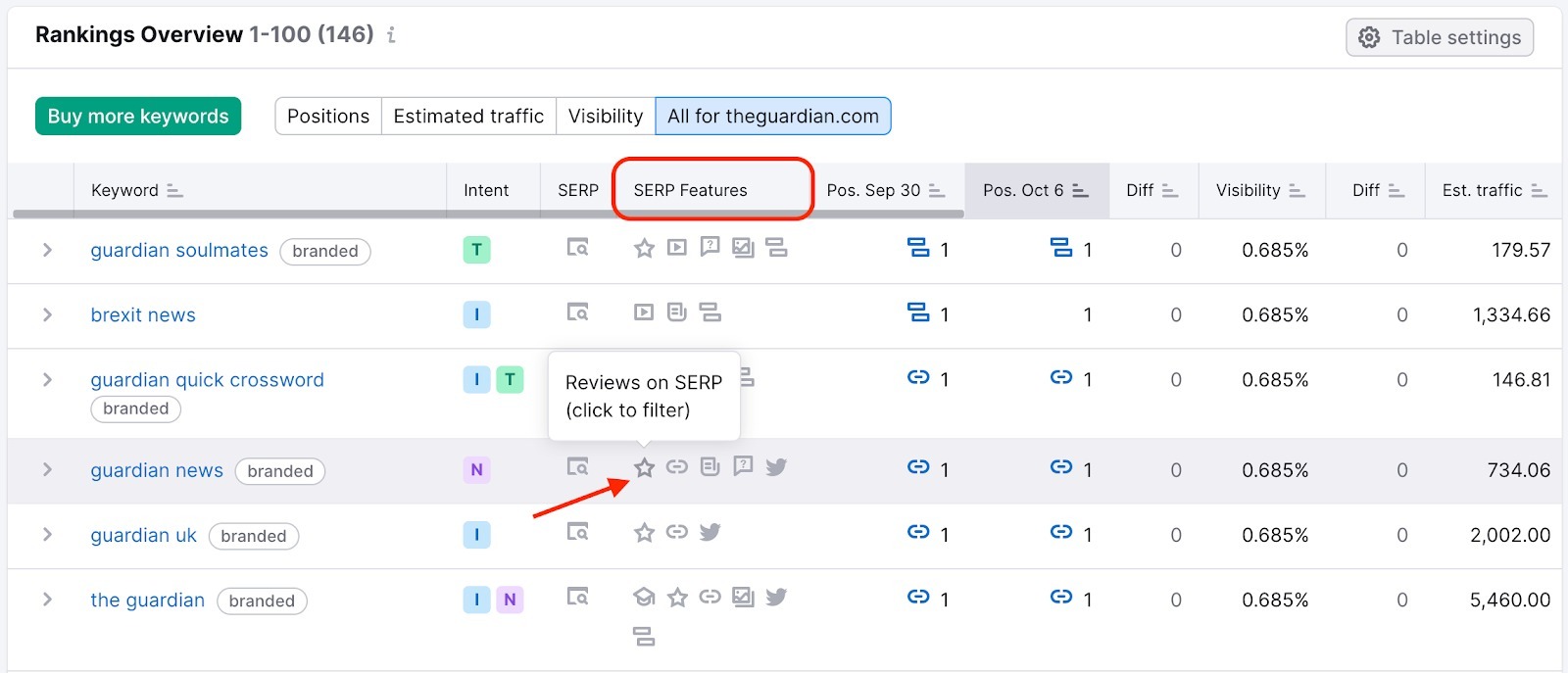
The landscape of SERP tracking tools is constantly evolving, especially with the rise of AI. Modern tools are now including filters specifically for "AI Overview" and other generative results.
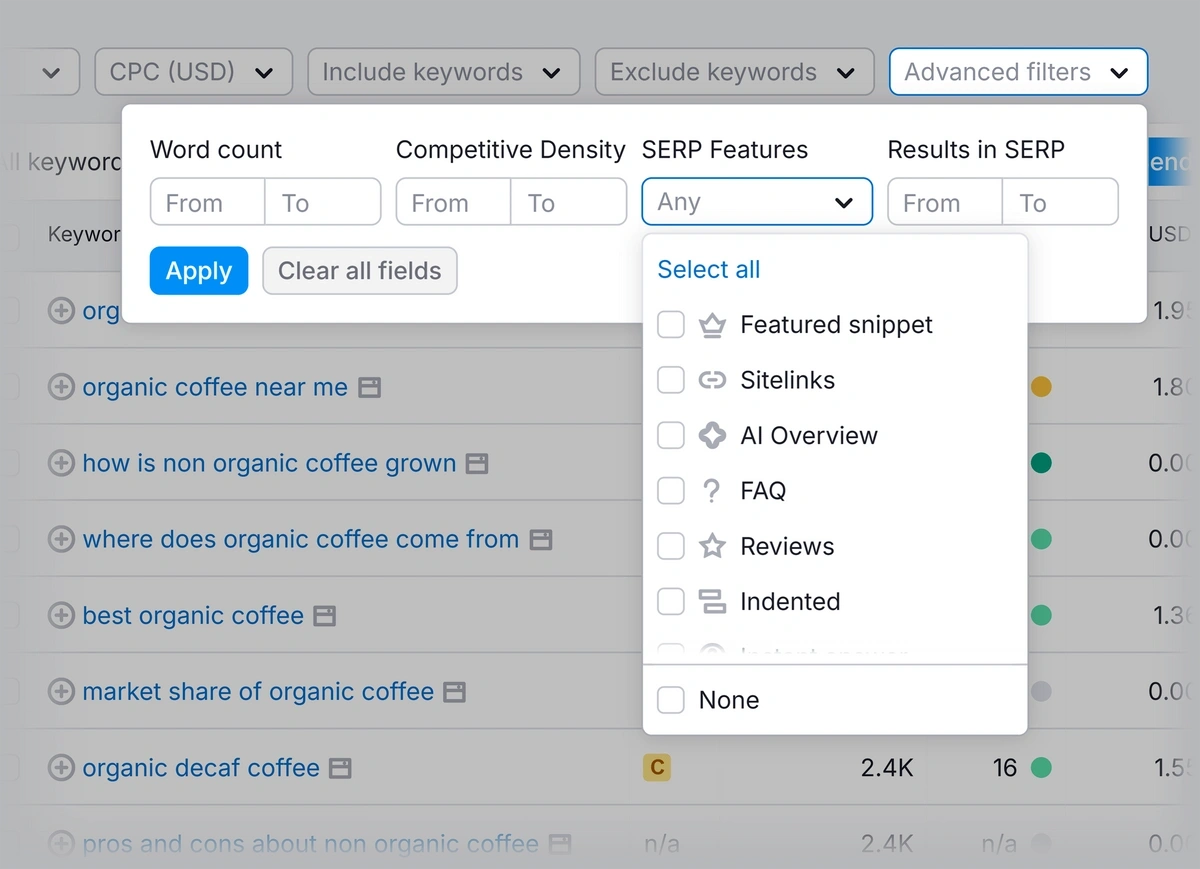
Test your understanding!
You are managing SEO for an e-commerce site selling organic coffee. In Ahrefs, you filter for your target keyword "best organic coffee beans" and see that you rank in position #3, but a competitor owns the Featured Snippet.
What are your next three steps to create an action plan to capture that snippet?
Show answer
- Analyze the Winner: Click the "SERP" dropdown in Ahrefs for that keyword to see the top 10 results. Open the competitor's page that owns the snippet and analyze its structure. What format are they using (paragraph, list, table)? How are their headings structured? What is the word count of the answer?
- Audit Your Page: Compare your own page against the competitor's. Does your page provide a clear, concise, "answer-first" summary near the top? Is it formatted in a similar, easily extractable way?
- Optimize and Redeploy: Revise your content to better match the format that Google is rewarding. For example, if the winner is using a bulleted list of the "Top 5 Beans," ensure your page has a similar, well-structured list. After updating, use GSC's "Request Indexing" feature to signal the change to Google.
4. Analyzing Trends and Taking Action
Tracking data is only useful if it leads to action. Your goal is to turn monitoring into a strategic feedback loop.
How to Monitor Featured Snippet Performance
Now let's connect the data to strategy. This final reading from the Semai AI article discusses how to analyze trends and identify triggers for content adjustments.
Please read the sections 'Analyzing Performance Trends Over Time' and 'Actionable Triggers for Content Adjustment'. Focus on the specific scenarios that should prompt you to revise your content.
Key actionable triggers from your monitoring include:
- Losing a Snippet: A sudden drop in impressions/clicks and a rise in average position for a key term. This requires immediate diagnosis.
- Low CTR on an Owned Feature: You own the snippet, but few people are clicking. This may mean your answer is too complete (a "no-click" search), or your title/description isn't compelling enough.
- High-Potential Opportunities: You rank on page one for a query that has a featured snippet owned by a weak competitor. This is a prime target for optimization.
5. The Future: From SERP Features to AI Citations
This entire process of optimizing for and tracking SERP features is excellent preparation for the next evolution of search: generative AI. The skills you use to get your content into a featured snippet are the same skills needed to get your content cited in Google's AI Overviews.
This shift moves us from simple rank tracking to Answer Engine Optimization (AEO) and Generative Engine Optimization (GEO). Specialized tools are emerging to track visibility not just in SERPs, but within the AI-generated answers themselves.
The 12 Best SERP Tracking Tools for SEO Pros in 2026
To understand this future-facing landscape, let's look at a guide to modern SERP tracking tools. This article from LLMrefs provides an excellent overview and introduces tools designed for the AI era.
Please read the sections on 'LLMrefs', 'Beyond the Blue Links', and 'A Hybrid Approach'. Focus on how the definition of tracking is expanding from 'position' to 'share-of-voice' within AI answers.
The key idea is a hybrid strategy: use established tools like Ahrefs/Semrush for traditional SERP feature tracking, and augment them with new tools like LLMrefs to measure your influence and citation frequency inside AI models. This comprehensive view is what will define successful SEO in 2026.
Conclusion
You have now completed the module on Advanced SERP Feature & Voice Search Optimization. You can analyze SERPs for opportunities, structure content to capture features, and now, track and measure your performance to prove ROI and refine your strategy.
Key Takeaways:
- Use Google Search Console as your primary data source, leveraging the 'Search appearance' filter and schema-specific reports to monitor performance and diagnose errors.
- Employ third-party tools like Ahrefs and Semrush to track competitor performance, identify opportunities, and analyze historical SERP feature data.
- Turn data into action by identifying triggers, such as losing a snippet or discovering a high-potential target.
- The future of tracking involves a hybrid approach, combining traditional SERP monitoring with new tools that measure your brand's visibility and citations within generative AI answers.
This concludes our focus on the user-facing side of on-page and SERP optimization. In our next module, we will pivot to the large-scale technical foundations that support enterprise-level websites. Our next lesson is: Set up a process for parsing server log files to analyze search engine bot behavior at scale. This is a fundamental skill in enterprise SEO for understanding and optimizing your crawl budget.