Hello! Welcome to the next lesson in your advanced SEO course.
In our previous lesson, we focused on identifying and targeting the conversational long-tail keywords that people use in voice search. We covered how to find these queries using GSC, free tools, and AI prompts.
Today, we'll build directly on that knowledge. Our learning outcome is to structure content to provide direct answers in formats preferred by voice search algorithms. It’s not enough to know what people are asking; you need to present the answers in a way that voice assistants and AI can easily find, understand, and read aloud. This skill is critical for optimizing for voice search and is also foundational for success in the era of generative AI search experiences like Google's SGE.
1. The Anatomy of a Voice Search Answer
Unlike traditional search, which presents a list of options, voice search aims to provide a single, definitive answer. To do this, assistants like Google Assistant, Siri, and Alexa need to extract information directly from a web page. This is why content structure is so important.
Let's start with a reading that explains how voice search works behind the scenes and what kind of content performs best.
Voice Search SEO: How to Optimize for Spoken Queries
The article 'Voice Search SEO: How to Optimize for Spoken Queries' from Search Engine Land provides an excellent breakdown of the mechanics of voice search and the content formats that assistants prefer. Understanding this process is key to creating voice-optimized content.
Please read the following sections: 'How voice search works: A simplified breakdown', 'What types of content perform well in voice search results?', and 'Voice search, AI overviews, and generative search'. Focus on how an assistant moves from a spoken query to a delivered answer and which content structures (like Q&As and lists) facilitate this process.
As the article highlights, voice assistants and generative AI models rely on passage-level understanding. They don't just look at your page title; they scan for the most relevant sentence, paragraph, or list that directly answers the user's query. Your job is to make that specific piece of information as easy as possible for them to find and use.
This is what a video from Surfer Academy calls optimizing for "AI extraction." It's about creating content that is modular and easily "lifted" into an AI overview or voice response.
AI SEO is Here: 7 Steps to Stay Visible in 2026 and Beyond
This short clip from 'AI SEO is Here: 7 Steps to Stay Visible in 2026 and Beyond' summarizes the core principles of structuring content for AI extraction.
Watch from 12:45 to 13:25. Pay attention to the list of elements mentioned: clean HTML, hierarchical headings, lists, tables, and Q&A blocks.
2. Core Content Structures for Voice Search
Now, let's get practical. There are several specific formatting and writing techniques you can use to make your content "answer-ready." These strategies are designed to help you capture featured snippets (or "position zero"), which are the source for over 40% of voice search answers.
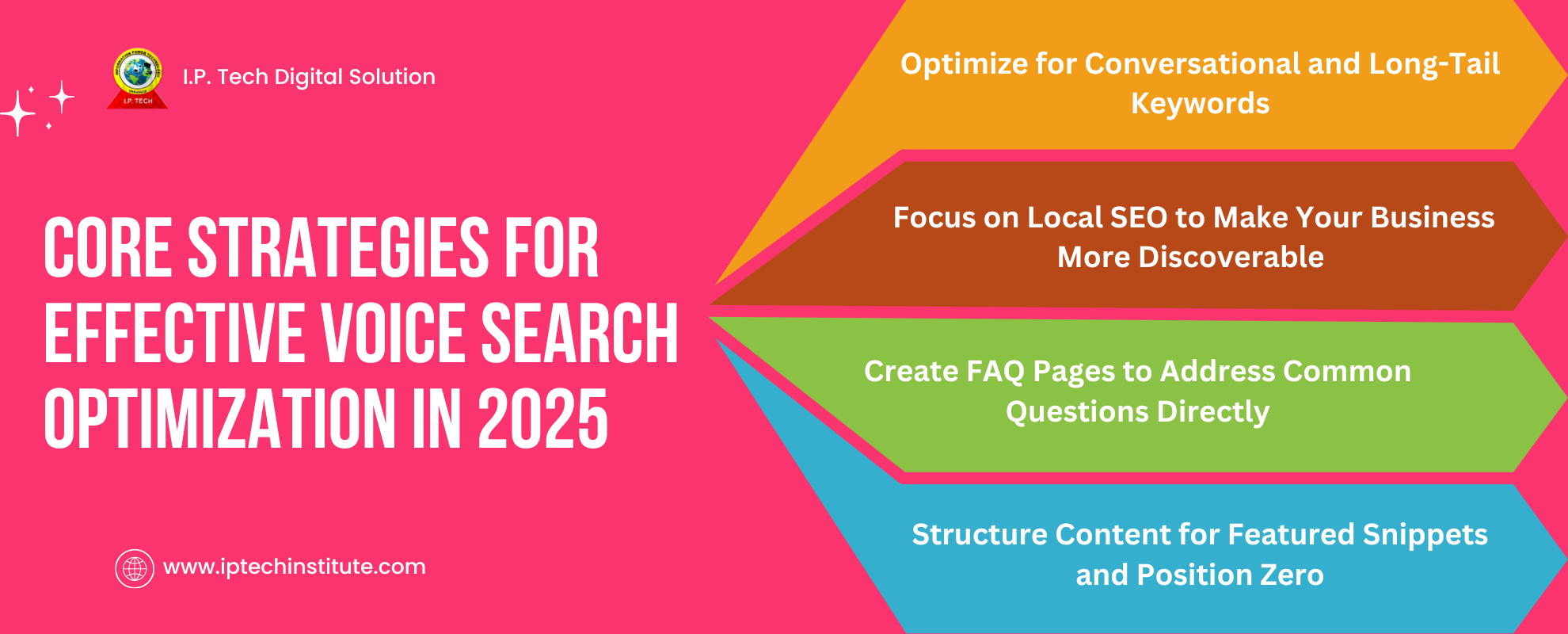
Here are the most effective structures:
The Inverted Pyramid: Answer First
This is the single most important principle. For any question-based query, you should provide a direct, concise answer at the very beginning of your content, ideally right below the heading. Then, you can use the rest of the article to elaborate with details, examples, and context.
- For Paragraph Snippets: Write a 40-50 word direct answer.
- For List Snippets: Create a bulleted or numbered list answering "how-to" or "what are" queries.
- For Table Snippets: Use a structured table for comparisons or data-heavy content.
The following video provides an excellent example of how to structure an introduction to capture a featured snippet.
How to Optimize Your Site for Voice Search
Let's watch a practical demonstration from the Rank Math SEO channel. This clip shows exactly how to craft an introduction that includes the four key elements for winning a featured snippet.
Watch the segment from 03:55 to 06:19. Notice how the examples provided are direct, conversational, concise, and include concrete examples—the four elements of a snippet-worthy answer.
Writing for Natural Language
Since voice queries are conversational, your content should be too.
- Use a simple, natural tone. As a general rule, aim for a 9th-grade reading level. Avoid jargon and overly complex sentences.
- Use question-based headings. Instead of a heading like "Meditation Benefits," use "What Are the Benefits of Meditation?" This directly matches the query.
- Create dedicated Q&A sections. Adding an FAQ section to your pages is a powerful way to target multiple long-tail questions in a format that voice assistants love.
Test your understanding!
Below is a paragraph from a fictional blog post about drip coffee makers. Rewrite it to be optimized for the voice search query, "How does a drip coffee maker work?" Apply the "answer-first" principle and use a more conversational tone.
Original Text:
The functionality of automated drip coffee makers is a fascinating process involving several key components. Water is first heated to an optimal temperature, generally between 195 and 205 degrees Fahrenheit, by a heating element within the machine's reservoir. This heated water is then transported via a tube system to a showerhead-like dispenser that is positioned above a filter basket containing the coffee grounds. The subsequent extraction process, where water saturates the grounds, results in brewed coffee dripping into the carafe below.
Show answer
Here is one possible rewrite:
A drip coffee maker works by automatically heating water and pouring it over coffee grounds. First, a heating element warms the water in the reservoir to the perfect temperature. Then, the hot water travels up a tube and sprinkles down from a showerhead over the coffee grounds in the filter basket. As the water soaks the grounds, it extracts the flavor, and the finished coffee drips down into the pot below.
Notice how this version starts with a direct, simple answer. The language is less academic ("perfect temperature" instead of a specific range), and the sentences are shorter, making it easier for a voice assistant to read aloud.
3. Technical Reinforcement with Schema Markup
While content structure is crucial, you can further improve your chances by giving search engines explicit technical signals using schema markup. Schema is code that helps search engines understand the context of your content. For voice search, a few types are particularly important.
FAQPageSchema: This markup tells Google that a section of your page is a list of questions and answers. It's perfect for making your FAQ sections discoverable.HowToSchema: This is ideal for step-by-step instructions, like recipes or tutorials. It structures the content in a way that allows an assistant to walk a user through a process.SpeakableSchema: This schema type was designed specifically for voice search to identify sections of an article best suited for audio playback.
The following video provides a practical walkthrough of how to implement Speakable and FAQ schema. Since you have extensive experience with SEO tools, seeing it implemented in a plugin like Rank Math will be straightforward.
How to Optimize Your Site for Voice Search
Let's return to the Rank Math SEO video for a hands-on guide to implementing schema for voice search. This will cover both Speakable and FAQ schema.
Watch the segments from 06:19 to 10:42 and 10:42 to 12:43. The first part (Speakable) is quite technical, showing how to define CSS selectors. The second part (FAQ) shows the simpler process of using a dedicated block in a CMS.
As shown in the video, implementing Speakable schema involves defining the specific CSS classes of the content you want to be read aloud.

It's important to note, as mentioned in the Search Engine Land article you read earlier, that Speakable schema is still in limited use, primarily for news publishers. However, implementing FAQPage and HowTo schema provides a much broader and more reliable benefit for voice search across all content types today.
Conclusion
You now have a complete framework for structuring your content to win in voice search. By combining clear, answer-first content with the right technical schema, you make it easy for voice assistants and AI models to select your content as the single best answer.
Key Takeaways:
- Voice search and generative AI rely on "answer-ready" content that can be easily extracted.
- The most effective structure is the inverted pyramid: provide a direct, concise answer first, then elaborate.
- Use formats that voice assistants prefer: short paragraphs, bulleted/numbered lists, tables, and Q&A sections.
- Write in a natural, conversational tone that mirrors how people speak, and use question-based headings.
- Reinforce your content's structure with technical signals using
FAQPage,HowTo, andSpeakableschema markup.
In our next lesson, we'll close the loop on SERP feature optimization. Now that you know how to structure content to capture features like snippets and PAA boxes, we'll focus on the learning outcome: Track and measure SERP feature performance using advanced Search Console and third-party tools. This will enable you to prove the value of your optimization efforts and identify new opportunities.