Hello! Welcome back to our module on AI-Powered Link Building & Outreach.
In our last lesson, we focused on using AI-powered tools to conduct a backlink gap analysis, generating a large, relevant list of potential link prospects. We learned that the first step in a modern link-building campaign is to systematically identify who is linking to your competitors.
However, a raw list of thousands of prospects isn't actionable. To be effective, we must focus our efforts on the opportunities that will provide the most value. This brings us directly to today's learning outcome: Analyze link quality and predict link value using AI-driven metrics and models.
We will move beyond traditional metrics like Domain Authority (DA) and Domain Rating (DR) to explore the nuanced, multi-faceted signals that AI models use to determine a link's true worth. This is about shifting your analysis from "is this a high-authority site?" to "is this a contextually relevant, trustworthy link that will drive meaningful results?"
1. The New Paradigm: From Simple Metrics to Predictive AI
Before we dive into specific tool features, it's crucial to understand why link analysis has become so complex. Search engines themselves use sophisticated machine learning models to evaluate backlink profiles. They don't just count links; they analyze patterns, context, and trust signals to identify manipulative behavior.

This reality has forced the SEO industry to evolve. Simply chasing a high link count or a high DR score is an outdated strategy. The future, which is already here, is about understanding a link's holistic quality.
To get a clear picture of this evolution, let's explore the core concepts driving modern backlink analysis.
Top Backlink Analysis Tools in 2026
The article 'Top Backlink Analysis Tools in 2026' from Webbb.ai perfectly frames the shift from basic metrics to intelligent analysis. It explains the 'why' behind the new generation of AI-driven tools.
Please read the introductory section titled 'The Evolution of Backlink Analysis: From Simple Metrics to Predictive AI.' Focus on the two key shifts described: the move from quantity to contextual quality and the rise of predictive and prescriptive analytics.
As you just read, the two main takeaways are:
- Context is King: A link's value is heavily determined by the semantic relevance of the linking page and domain to your own content.
- Analysis is Proactive: Modern tools aim to predict the impact of a link and prescribe actions, rather than just describing your current backlink profile.
2. The Anatomy of an AI-Assisted Link Quality Assessment
Now that we understand the strategic shift, let's get practical. When you have a list of prospects from the gap analysis we performed in the last lesson, you need a framework to qualify them. AI-powered tools provide several layers of metrics to do this efficiently.
We'll break this down into three core components of link quality: Relevance, Trust, and Risk.
A. Contextual and Topical Relevance
This is arguably the most important signal. A link from a lower-authority but highly relevant niche blog can be more valuable than a link from a generic, high-authority news site. AI helps us measure this relevance at scale.
Several tools offer proprietary metrics for this:
- Ahrefs' "Link Context" AI: As we touched on in the previous lesson, this feature goes beyond metrics by providing an AI-generated summary of the linking page's content, allowing you to instantly gauge its relevance without leaving the tool. (See Resource LINK, Section 1)
- Majestic's "Topical Trust Flow": This metric categorizes domains into hundreds of topics, showing you a site's authority within a specific niche. A site might have a high overall Trust Flow, but its Topical Trust Flow in "Software/Technology" is what truly matters for your business. (See Resource LINK, Section 3)
- Moz's "Topical Authority Score": Part of its new DA 3.0, this provides a similar function to Majestic's topical metric, segmenting a site's authority by category. (See Resource LINK, Section 4)
- CognitiveSEO's "Semantic Link Analysis": This tool creates a visual "Topical Map" of your backlink profile, clustering links by the semantic topic of the linking pages. This is excellent for identifying if your profile is balanced or overly reliant on one topic. (See Resource LINK, Section 5)
B. Trust and Authority
This is the traditional domain of metrics like DA and DR, but AI has added more sophisticated layers to measure genuine trustworthiness.
- Majestic's Trust Flow (TF): This metric is foundational. It measures a site's quality based on its proximity to a seed set of manually vetted, trusted websites. A high Trust Flow to Citation Flow (CF) ratio is often a quick indicator of a high-quality, non-spammy link profile. A site with high CF but low TF has many links, but they aren't from trusted sources. (See Resource LINK, Section 3)
- AI-Powered "Link Quality Score": Many platforms are now offering a single, composite "quality score" that uses machine learning to weigh dozens of factors (relevance, authority, user metrics, etc.) into one number.
C. Predictive Risk & Spam Detection
Just as important as acquiring good links is avoiding bad ones. AI is exceptionally good at pattern recognition, making it a powerful ally in identifying potentially harmful links before they affect your rankings.
- Semrush's "Toxicity Risk Score": This is a standout predictive feature. The tool's AI analyzes links against patterns known to be associated with spam or penalties and assigns a risk score. It can alert you to a sudden influx of risky links in near real-time, allowing you to be proactive. (See Resource LINK, Section 2)
- Moz's "Link Neighborhood" Analysis: This feature enhances its classic Spam Score by using network analysis. It helps you see if your backlinks are coming from sites that are themselves interlinked with spammy or penalized domains. This helps you avoid becoming part of a "bad neighborhood" by association. (See Resource LINK, Section 4)
This guide provides a concise summary of how these different metrics come together in a quality assessment workflow.
Ai Backlink Analysis and Outreach for: The 2026 Guide
The article 'Ai Backlink Analysis and Outreach for: The 2026 Guide' gives a great, practical summary of this process. It includes a table that crystallizes the key metrics used in an AI-driven link quality assessment.
First, read the short section 'Step 2: Link Quality Assessment.' Note the table that summarizes metrics like Domain Authority, Context Score, and Toxicity Risk. Then, review the section 'Key Metrics for AI Backlink Campaigns' to see how these metrics, including Trust Flow and an AI-powered 'Link Quality Score', are framed in the context of a campaign.
Test your understanding!
You are evaluating two potential link prospects for your project management software company.
-
Prospect A: A post on a generic business blog.
- DR: 85
- Topical Trust Flow (Business): 60
- Topical Trust Flow (Software): 5
- Toxicity Score: Low
- AI Link Context: The link is in the author's bio at the end of an article about "5 Ways to Improve Team Productivity."
-
Prospect B: A product comparison on a niche software review site.
- DR: 55
- Topical Trust Flow (Business): 40
- Topical Trust Flow (Software): 45
- Toxicity Score: Low
- AI Link Context: The link is an in-content anchor, "TaskMaster.ai is a great alternative for...", within a detailed comparison of project management tools.
Which prospect is more valuable and why?
Show answer
Prospect B is significantly more valuable.
Here's the reasoning based on AI-driven metrics:
-
Context and Topical Relevance: Prospect B is the clear winner. Its link is from a site with a high Topical Trust Flow in "Software" (45), making it extremely relevant. The AI Link Context confirms the link is perfectly placed within a comparative review, which is high-intent and contextually ideal. Prospect A, despite its high overall DR, has almost no topical authority in your niche (TTF of 5) and the link is in a less valuable author bio.
-
Authority vs. Relevance: This is a classic example of not being swayed by a high top-level metric (DR 85). The lower DR of Prospect B (55) is more than compensated for by its immense topical relevance. An algorithm will weigh the link from the niche software site much more heavily for ranking queries related to project management software.
3. Predicting Link Value: From Quality to Impact
Analyzing link quality is about assessing the inherent properties of a link. Predicting link value is about forecasting the impact that link will have on your SEO goals—namely, rankings and traffic.
This is an emerging area for AI, but tools are beginning to connect the dots. Instead of just showing you a list of links, they are starting to model the relationship between link acquisition and performance outcomes.
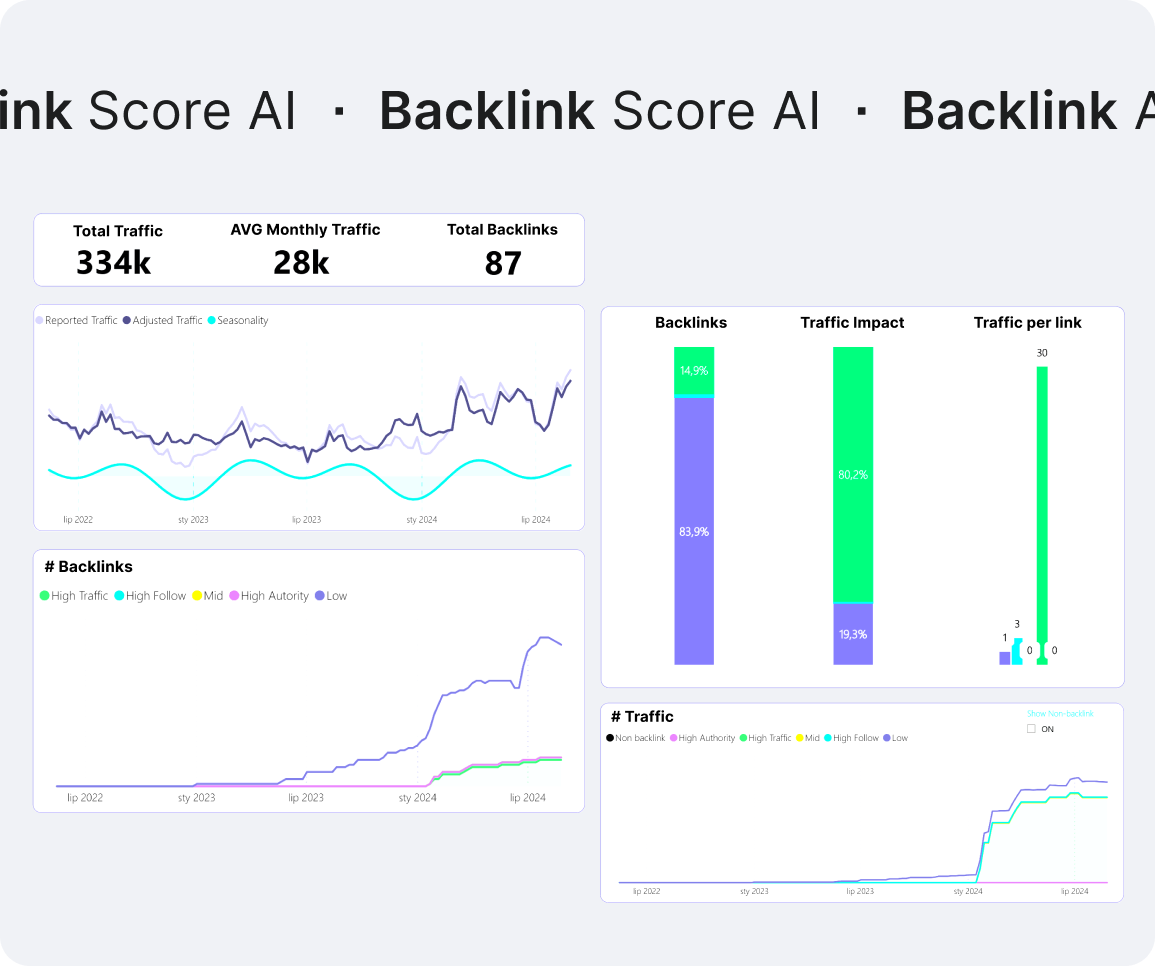
While direct traffic from a link is one benefit, the primary value for SEO is the "link equity" or "authority" passed, which boosts the ranking potential of the target page for its keywords. A link from a page that itself ranks for relevant keywords is often a strong predictor of high value. AI-driven tools help identify these by correlating link data with ranking data.
Furthermore, some tools are developing predictive scores for content itself:
- CognitiveSEO's "Link Attraction Score": This feature predicts a page's potential to attract backlinks based on its content elements (word count, visuals, data, etc.). By analyzing top-performing competitor pages, it gives you a blueprint for creating content that is inherently valuable and likely to earn links organically. (See Resource LINK, Section 5)
Conclusion
In this lesson, we moved from finding link prospects to qualifying them. You've learned that a modern, AI-driven approach to link analysis requires looking beyond a single metric and evaluating a link's contextual relevance, trustworthiness, and potential risk.
Key Takeaways:
- Link analysis mirrors Google's own evaluation: We use AI tools to assess context, trust, and quality because that's what search engine algorithms do.
- A comprehensive link quality assessment involves analyzing three pillars: relevance (Topical Trust Flow, Link Context), trust (Trust Flow, authority metrics), and risk (Toxicity Score, Spam Score).
- High top-level authority (DR/DA) is less important than high topical relevance.
- The ultimate goal of analysis is to predict value, which means identifying the links most likely to improve rankings and drive qualified traffic.
Now that you know how to build a list of prospects and, more importantly, how to distill it into a high-priority, qualified list, we're ready for the next step. In our next lesson, we will focus on efficiency and scale as we learn to automate prospect research and contact discovery for outreach campaigns using AI-powered tools.