Hello! Welcome to the first lesson in our module on AI-Powered Link Building & Outreach.
In the previous module, we mastered scaling local SEO, culminating in using AI to automate reputation management. We are now shifting our focus from on-site and local signals to building off-page authority—a critical pillar of SEO that has been profoundly reshaped by artificial intelligence.
Today's lesson addresses the learning outcome: Use AI tools to identify high-quality link building opportunities based on competitor backlink analysis. This is the foundational step in any strategic link-building campaign. Instead of manually searching for websites, we'll use a systematic, data-driven approach to find domains that are already predisposed to linking to sites in your niche.
We'll move beyond the traditional method of just finding who links to your competitors. The "2026" perspective you're interested in involves leveraging AI to understand the context behind those links, helping you prioritize the most valuable opportunities and even inform your content strategy.
1. The Core Strategy: Competitor Backlink Gap Analysis
The most efficient way to start a link-building campaign is to find websites that link to your competitors but not to you. This is called a backlink gap analysis. The underlying logic is simple: if a website has already linked to one or more of your competitors, they have demonstrated an interest in your topic and are therefore a warm prospect for your own outreach efforts.
However, not all links are created equal. Our goal is to find high-quality opportunities. But what does that mean in this context?
AI-Driven Link Prospecting: Find Valuable Backlinks Quicker
The article 'AI-Driven Link Prospecting' from The HOTH clearly defines the two most important qualities of a good backlink prospect. Please read the following section to ground your understanding of what we're looking for.
Read the section 'How AI Identifies High-Quality Link Prospects,' focusing on the two main qualities: Authority (measured by metrics like DA and DR) and Relevance (both direct and contextual). This will set the stage for how we evaluate the opportunities we find.
As the article explains, we are hunting for prospects that are both authoritative (trusted by search engines) and relevant (topically aligned with our content). AI-powered tools don't just find link prospects; they help us sift through thousands of possibilities to surface those that meet these two critical criteria.
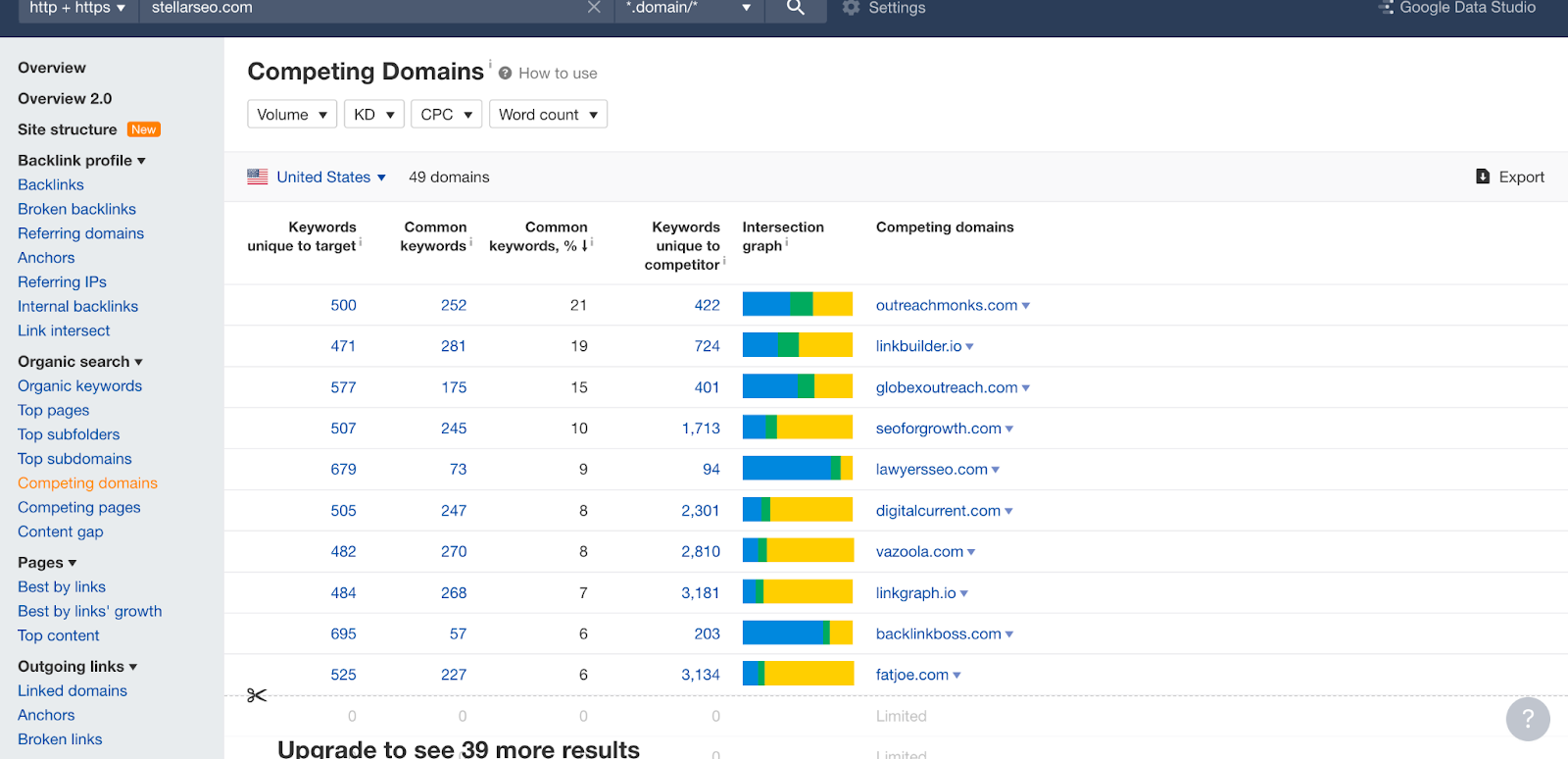
The first step in this process is identifying who your true SERP competitors are. You likely know your main business competitors, but your online competitors are those who consistently rank for your target keywords.
2. Practical Application: Ahrefs & Semrush Workflows
Since you're experienced with the major SEO suites, we'll focus on the specific tools within Ahrefs and Semrush designed for this task. These platforms have integrated AI to make this process more efficient and insightful.
The article "AI-Driven Link Prospecting" provides excellent, step-by-step walkthroughs for both tools.
Ahrefs: The Link Intersect Tool
Ahrefs' Link Intersect tool is the classic implementation of a backlink gap analysis. It allows you to find domains that link to your competitors but not to you.
AI-Driven Link Prospecting: Find Valuable Backlinks Quicker
Let's review the step-by-step process for using Ahrefs' Link Intersect tool.
Please read the section 'Ahrefs competitive analysis tool.' Focus on how to configure the tool by placing your domain in the 'Not linking to this target' field and your competitors in the 'But linking to these competitors' fields. Observe the resulting list of prospects.
The AI-Powered Evolution of Gap Analysis
Simply getting a list of domains is the traditional approach. The future of this process, which Ahrefs is already moving toward, involves a deeper, AI-driven analysis.
Top Backlink Analysis Tools in 2026
The article 'Top Backlink Analysis Tools in 2026' from Webbb.ai explains how this process is becoming more intelligent. Let's explore how AI adds a crucial layer of context.
Read the two subsections under 'Ahrefs 2026': 'Site Explorer & The New "Link Context" AI' and 'Ahrefs' Content Gap Meets Link Gap.' Focus on how these features move beyond just who is linking to why they are linking and what content you should create to earn those links.
As you just read, the evolution is significant:
- Contextual Analysis: AI features can summarize the content of the linking page, helping you instantly understand the context of your competitor's backlink. Is it a product review, a mention in a listicle, or a citation in a research piece? This saves hours of manual checking.
- Prescriptive Content Strategy: By integrating link gap data with content gap data, AI can suggest specific topics for you to create. It identifies content that has successfully earned links for your competitors that you are missing, providing a data-backed plan for creating link-worthy assets.
Semrush: The Link Building Tool
Semrush takes a slightly different, more automated approach with its Link Building Tool. It uses your target keywords and competitor list to proactively find and categorize prospects for you.
AI-Driven Link Prospecting: Find Valuable Backlinks Quicker
Now, let's examine the workflow in Semrush.
Read the section 'Semrush (Link-Building Tool and Copilot AI).' Follow the process of adding keywords and competitors to generate a prospect list. This tool essentially automates the discovery process and integrates it into a campaign management workflow.
The AI in Semrush's tool works by analyzing a wide range of sources—competitor backlink profiles, keyword mentions, guest post opportunities—and automatically collating them into a prioritized list for your outreach campaigns.

Test your understanding!
You are the SEO for a new project management software company, 'TaskMaster.ai'. Your main SERP competitors are Asana, Monday.com, and Trello.
- Using the Ahrefs Link Intersect tool, what domains would you input into which fields to start your analysis?
- After the tool generates a list of 5,000 domains, how would you use the AI-driven concepts we've discussed to prioritize this list without manually checking every site?
Show answer
-
Ahrefs Configuration:
- In the "Not linking to this target" field, you would enter your domain:
TaskMaster.ai. - In the "But linking to these competitors" fields, you would enter
asana.com,monday.com, andtrello.com.
- In the "Not linking to this target" field, you would enter your domain:
-
AI-Driven Prioritization:
- First, you would sort the list by Domain Rating (DR) to focus on the most authoritative sites.
- Next, instead of visiting each site, you would leverage "Link Context" AI. This feature would summarize why these sites are linking to your competitors. You'd prioritize prospects that are citing your competitors in articles like "Top 10 Project Management Tools" or "Asana vs. Monday," as these are perfect opportunities for you to be included.
- You would also use the integrated Content Gap analysis. This would tell you if all three competitors earned links from a popular blog because they each have a "Guide to Agile Methodologies," while you do not. This insight makes it clear that creating a superior guide on that topic should be your top priority to attract similar links.
3. AI-Assisted Prospecting with ChatGPT
While Ahrefs and Semrush are industry standards, you can also use general AI tools like ChatGPT to supplement your prospecting efforts, especially for finding broader opportunities beyond direct competitors.
This video demonstrates a practical, albeit more manual, approach using free tools. It's a great example of how you can use AI to assist with the legwork of prospecting.
ChatGPT FREE Backlinks: How I Create SEO Backlinks (AI Link Building)
This video from Julian Goldie SEO shows a few clever ways to use AI for prospecting without relying on a paid SEO suite. We'll focus on two specific techniques.
Please watch from 07:20 to 11:18. This covers two methods: Scraping SERPs (07:20 - 09:52): Using the Harper AI extension to scrape Google search results for relevant keywords to quickly build a list of potential sites. Niche Site Discovery (10:08 - 11:18): Using ChatGPT with the Web Pilot plugin to generate lists of smaller, niche-related websites that might be more receptive to outreach.
These methods are less targeted than a direct competitor gap analysis but are excellent for brainstorming and uncovering hidden gems that might not appear in a standard competitor report.
Conclusion
You have now learned the foundational strategy for AI-powered link prospecting. By systematically analyzing your competitors' backlink profiles, you can generate a large, highly relevant list of targets for your outreach campaigns.
Key Takeaways:
- Competitor backlink gap analysis is the most efficient method for identifying high-quality link prospects.
- Industry-standard tools like Ahrefs' Link Intersect and Semrush's Link Building Tool are designed specifically for this task.
- The role of AI is evolving from simply generating prospect lists to providing contextual analysis (understanding why a site links) and prescriptive insights (suggesting what content to create).
- General AI tools like ChatGPT can be used as a supplementary method for broader prospecting and discovering niche opportunities.
In our next lesson, we will build directly on this foundation. Now that we know how to find thousands of potential opportunities, we need a way to qualify them. We will learn how to analyze link quality and predict link value using AI-driven metrics and models, ensuring we focus our efforts only on the links that will truly move the needle.