In our last lesson, we explored the mean-field theory of the Ising model through the lens of the Landau free energy expansion. This powerful approach revealed a universal set of "classical" critical exponents () that emerge whenever fluctuations are neglected. This framework, however, is not limited to magnetic systems.
Today, we shift our focus from spins on a lattice to particles in a continuous space to study the liquid-gas phase transition. Our goal is to derive the van der Waals equation of state from physical arguments and show that it is a mean-field theory of the liquid-gas transition. We will see that this famous equation, often introduced phenomenologically, can be rigorously derived from a mean-field treatment of the canonical partition function. By analyzing its behavior near the critical point, we will uncover the deep connection between the liquid-gas transition and the magnetic phase transition, demonstrating that both are described by the same underlying mean-field structure.
1. From Microscopic Interactions to a Macroscopic Equation of State
The ideal gas law, , is a cornerstone of thermodynamics, but it is built on two key simplifications: particles are point-like, and they do not interact. To describe a real gas, and particularly its condensation into a liquid, we must account for the actual nature of intermolecular forces. A realistic pair potential typically features a strong short-range repulsion (a "hard core") and a weaker long-range attraction.
Our task is to incorporate these two features into the statistical mechanics of the gas. We will start with the canonical partition function for classical interacting particles and introduce approximations that are explicitly "mean-field" in nature.
The Hamiltonian for such a system is:
The canonical partition function separates into a momentum part and a configuration part. The momentum integral gives the usual thermal wavelength factor , where . The challenge lies in the configurational integral:
To evaluate this, we make two mean-field approximations:
-
Short-Range Repulsion: The hard-core repulsion means particles cannot overlap. The volume available to each particle is slightly less than the total volume . We approximate this by replacing in the ideal gas partition function with an effective available volume, , where is a constant related to the excluded volume per particle. This is a mean-field step as it replaces the complex, position-dependent excluded volumes with a single, average value, ignoring correlations in particle positions.
-
Long-Range Attraction: For the attractive part of the potential, , we assume the particles are, on average, uniformly distributed with density . The total potential energy is then approximated by its mean-field average:
Here, is a positive constant that represents the integrated strength of the attractive potential. This approximation is analogous to the mean-field treatment of the Ising model, where each spin feels an average magnetic field from all other spins, rather than their specific, fluctuating orientations.
The following resource provides a concise derivation of the van der Waals equation by incorporating these approximations into the partition function.
[PDF] VE Mean Field Theory of Condensation - MIT OpenCourseWare
This excerpt from Mehran Kardar's notes at MIT derives the van der Waals equation of state by directly approximating the canonical partition function.
Please read the section titled "Mean Field Theory of Condensation". Focus on how the partition function in eq. (V.57) is approximated to arrive at eq. (V.60). You'll see the excluded volume V-N\Omega/2 (our V-Nb) and the attractive energy term \exp(\beta u N^2/2V) (our \exp(\beta aN^2/V)) emerge. Then, follow the derivation of the Helmholtz free energy F in eq. (V.61) and the final step to obtain the pressure P_{can} in eq. (V.62), which is the van der Waals equation.
Following this derivation, the Helmholtz free energy is approximately:
Using the ideal gas free energy , we get:
The pressure is then found via the thermodynamic relation :
This is the celebrated van der Waals equation of state. We have shown that it is not just a phenomenological model but the direct result of a mean-field approximation applied to an interacting classical gas.
2. Isotherms and the Liquid-Gas Coexistence
The van der Waals equation provides a much richer description of fluid behavior than the ideal gas law. By plotting pressure versus molar volume () for fixed temperatures (isotherms), we can visualize the liquid-gas phase transition.
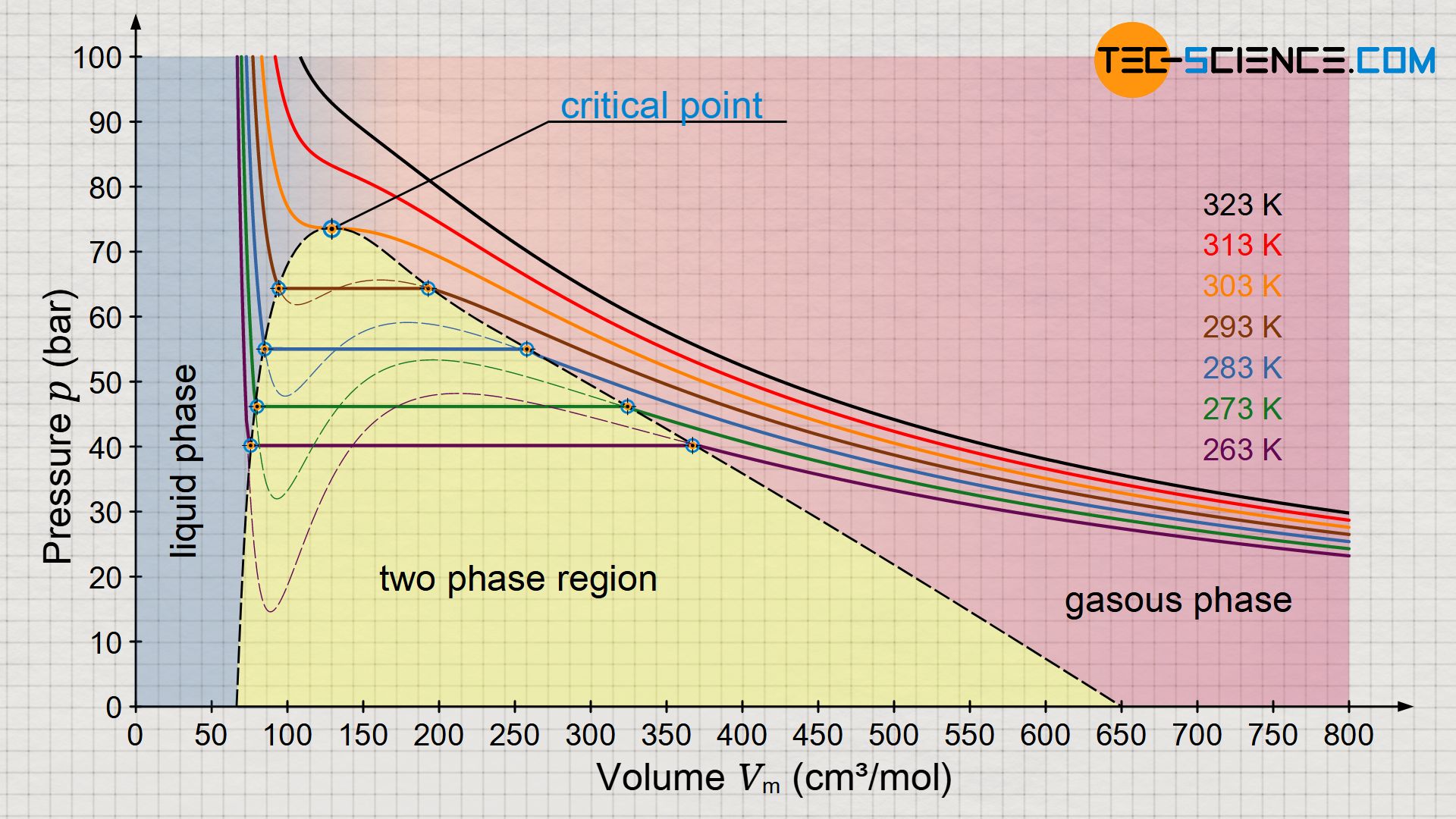
The following video provides an excellent walkthrough of the features of these isotherms.
This video from the "Physical Chemistry" channel explains the behavior of van der Waals isotherms at different temperatures.
Watch the first two parts of the video. The initial section explains how the cubic nature of the vdW equation in volume leads to either one or three real solutions for v at a given P and T. Then, from plotting the isotherms, observe how the shape changes from ideal-gas-like at high T to developing a "phase loop" below a certain critical temperature. Pay close attention to the explanation of the unphysical region where \partial P / \partial V > 0.
As the video explains, for temperatures below a critical temperature , the isotherms exhibit an unphysical "wiggle" where the pressure would increase with volume. This region of positive slope implies a negative compressibility (), which corresponds to a mechanically unstable state. This wiggle is a generic feature of mean-field theories when they describe a first-order transition.

To resolve this, we invoke the Maxwell construction. Thermodynamically, when liquid and gas coexist in equilibrium, they must have the same temperature, pressure, and chemical potential. This condition implies that the correct pressure for coexistence is given by a horizontal line (a "tie-line") positioned such that the area of the loop above the line (region II in the image) is equal to the area of the loop below it (region I).
Continuing with the same video, the final part explains this graphical fix.
Watch the segment on the Maxwell construction. It shows precisely how to draw the tie-line to construct the correct phase diagram from the unphysical vdW isotherms.
3. The Critical Point and its Universality
The transition from smooth, gas-like isotherms to those with a wiggle occurs at a single special point: the critical point (). This point is mathematically defined as the inflection point on the critical isotherm where both the slope and the curvature are zero:
These two conditions allow us to solve for the critical constants in terms of the microscopic parameters and . The algebra is straightforward but detailed. The following video provides a clear, step-by-step derivation.
This video, also from the "Physical Chemistry" channel, derives the critical constants for the van der Waals gas.
Watch the full video. It begins by setting up the problem, then carries out the differentiation and solves the resulting system of equations to find the critical volume v_c, the critical temperature T_c, and finally the critical pressure P_c.
Solving these equations yields:
Now we can make the crucial connection to our previous work. For the liquid-gas system, the order parameter is the difference in density between the liquid and gas phases, , which is related to . The role of the external magnetic field in the Ising model is played by the deviation from the critical pressure, . The analogy is:
- Order Parameter: (or )
- Conjugate Field:
- Temperature Control:
Given this analogy, we can calculate the critical exponents for the van der Waals gas and compare them to the mean-field Ising model.
Statistical Physics (PHY831): Part 3 - Interacting systems
This document from Duxbury's course at MSU calculates the critical exponents for the van der Waals gas.
First, briefly review the derivation of the critical point to confirm the results from the video. Then, focus on the section where the equation of state is expanded in terms of reduced variables \delta t, \delta p, \delta v. Follow the calculations to find the exponents: Exponent δ, by analyzing the critical isotherm (\delta t = 0). Exponent β, which describes the difference between liquid and gas volumes (v_g - v_l) below T_c. Exponent γ, by calculating the divergence of the isothermal compressibility \kappa_T, which is the analog of susceptibility \chi_T.
The calculations show that for the van der Waals gas:
- The volume difference between coexisting gas and liquid phases vanishes as , so .
- Along the critical isotherm, , so .
- The isothermal compressibility diverges as , so .
These are precisely the same exponents we derived for the mean-field Ising model. This is a profound result. It demonstrates that two vastly different physical systems—a magnet and a fluid—exhibit identical behavior near their critical points when described by mean-field theory. This is our first concrete example of universality.
Conclusion
In this lesson, we have demystified the van der Waals equation, revealing its foundations in the mean-field approximation of statistical mechanics. By treating short-range repulsion and long-range attraction as average effects, we derived the equation of state and analyzed its predictions for the liquid-gas phase transition.
Key Takeaways:
- The van der Waals equation arises from a mean-field approximation of the partition function for a gas with realistic intermolecular forces.
- The unphysical "wiggles" in the subcritical isotherms are a hallmark of mean-field theory describing a first-order transition and are corrected by the Maxwell construction.
- The analogy between the liquid-gas system (order parameter , field ) and the Ising model (order parameter , field ) is exact at the mean-field level.
- The critical exponents for the van der Waals gas are , identical to the classical exponents of the mean-field Ising model, highlighting the concept of universality.
The fact that mean-field theory predicts the same exponents for different systems suggests that the specific microscopic details become less important than general properties like the symmetry of the order parameter and the dimensionality of space near a critical point. However, as we saw in the previous lesson, these mean-field exponents do not agree with experimental values or exact solutions. In our next lesson, we will confront these discrepancies head-on and investigate the fundamental limitations of mean-field theory.