Welcome to Module 9. In our journey so far, we have built a powerful framework for understanding systems of non-interacting particles, from classical ideal gases to quantum systems of bosons and fermions. This has allowed us to explain phenomena as diverse as the heat capacity of solids and Bose-Einstein condensation. However, the vast majority of interesting phenomena in nature, such as the formation of a liquid from a gas or the spontaneous magnetization of a material, arise from the collective behavior of particles that do interact with each other.
In this lesson, we will make a pivotal transition and begin our study of interacting systems. Our goal is to define the Ising model Hamiltonian as a paradigm for interacting systems and cooperative phenomena. We will establish the model's mathematical formulation and, more importantly, explore why this seemingly simple construction has become one of the most important and influential "toy models" in all of theoretical physics, serving as the foundation for our modern understanding of phase transitions.
1. The Need for an Interacting Model
Up to this point, the Hamiltonians we've considered have typically been sums of single-particle energies. For particles, we could often write , where only depended on the coordinates or momentum of the -th particle. The particles were only aware of each other through the shared constraints of quantum statistics (e.g., the Pauli exclusion principle).
To describe phenomena like magnetism, we need a model where the energy of the system depends on the relative configuration of its constituent parts. The energy of one particle must depend on the state of its neighbors. The Ising model provides the simplest possible framework for this.
2. Defining the Ising Model Hamiltonian
Imagine a lattice (in any dimension ) where each site is occupied by a magnetic moment that can only point in one of two directions: "up" or "down". We represent the state of the spin at site by a variable , which can take the values (up) or (down).
The total energy of a configuration of such spins is given by the Ising Hamiltonian. The lecture notes from Steven Simon's course on Quantum Condensed Matter provide a concise definition.
[PDF] Lecture Notes for Quantum Condensed Matter II
These notes introduce the Ising model as the "hydrogen atom" of phase transitions, a theme we will explore throughout this lesson.
Please read the first two paragraphs of the chapter, starting from the Hamiltonian definition. This will formally introduce the key terms.
As you've just read, the standard form of the Ising Hamiltonian is:
Let's dissect this expression:
-
The Interaction Term:
- The notation signifies that the sum is taken over all pairs of nearest-neighbor sites on the lattice. For a 1D chain, each spin has 2 neighbors; for a 2D square lattice, it has 4.
- is the coupling constant, which sets the energy scale of the interaction.
- If (ferromagnetic), the energy is minimized when neighboring spins are aligned (). This term favors a state where all spins point in the same direction.
- If (antiferromagnetic), the energy is minimized when neighboring spins are anti-aligned (). This favors a checkerboard-like pattern. We will focus on the ferromagnetic case .
-
The External Field Term:
- represents an external magnetic field (we absorb factors like the magnetic moment into this term for simplicity).
- If , the energy is minimized when spins align with the field (). This term provides a global bias, favoring the "up" state for all spins.
The state of the system is determined by the competition between these energy terms and thermal energy, which promotes entropy and disorder. At high temperatures, the entropic tendency for spins to be randomly oriented dominates. At low temperatures, the energy term, which favors order, becomes more important.
3. Cooperative Phenomena: More Than the Sum of its Parts
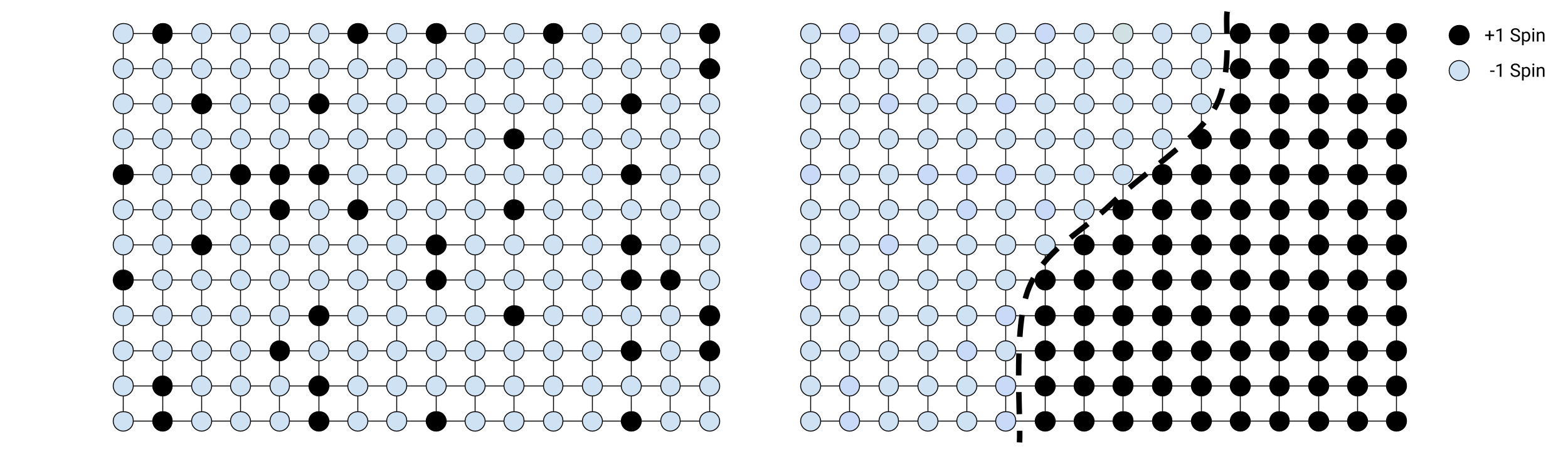
The crucial feature of the Ising model is that these simple, local interactions can give rise to complex, large-scale cooperative phenomena. A single spin "flipping" is a local event, but under the right conditions, the entire system can collectively decide to order itself, producing a macroscopic net magnetization even in the absence of an external field (). This spontaneous ordering is a phase transition.
The possibility of this collective action is highly dependent on the dimensionality of the lattice. An elegant analogy from a lecture by Prof. Leonard Susskind illuminates this point.
Statistical Mechanics Lecture 9
This Stanford lecture provides a superb intuitive build-up for why cooperative phenomena emerge in the Ising model and why dimensionality is key.
First, familiarize yourself with the context by watching the segment from the introduction of the 1D Ising Hamiltonian. Next, focus on the brilliant "game of telephone" analogy. This explains why a 1D chain cannot sustain long-range order at any finite temperature. A single "error" (a spin flip due to thermal energy) breaks the chain of information, and correlations decay exponentially with distance. Finally, listen to the argument for why higher dimensions are different, based on the idea of "error correction". In 2D or 3D, a spin receives "messages" from multiple neighbors. It can "outvote" a single erroneous neighbor, allowing order to be robustly transmitted over long distances. This is the essence of cooperative behavior.
As Susskind's analogy shows, in dimensions greater than one, the system gains a robustness that allows short-range interactions to establish long-range order. This ordering emerges as a phase transition when the temperature is lowered below a critical value, .
4. A Paradigm for Physics: Universality
The Ising model's importance goes far beyond magnetism. It serves as a paradigm because its essential physics—local degrees of freedom with interactions leading to collective ordering—applies to a vast range of systems.
A classic example is the lattice gas model, which describes a simplified liquid-gas system. David Tong's notes provide an excellent explanation of this equivalence.
In these lecture notes on Statistical Physics, David Tong demonstrates the versatility of the Ising model.
Read the short subsection The Lattice Gas. By making a simple change of variables, s_i = 2n_i - 1, where n_i \in \{0, 1\} indicates if a site is occupied or empty, the ferromagnetic Ising model becomes mathematically identical to a model of a gas with attractive forces between particles.
This remarkable mapping shows that:
- Spin up/down Site occupied/empty
- External magnetic field Chemical potential
- Spontaneous magnetization Phase separation into liquid and vapor
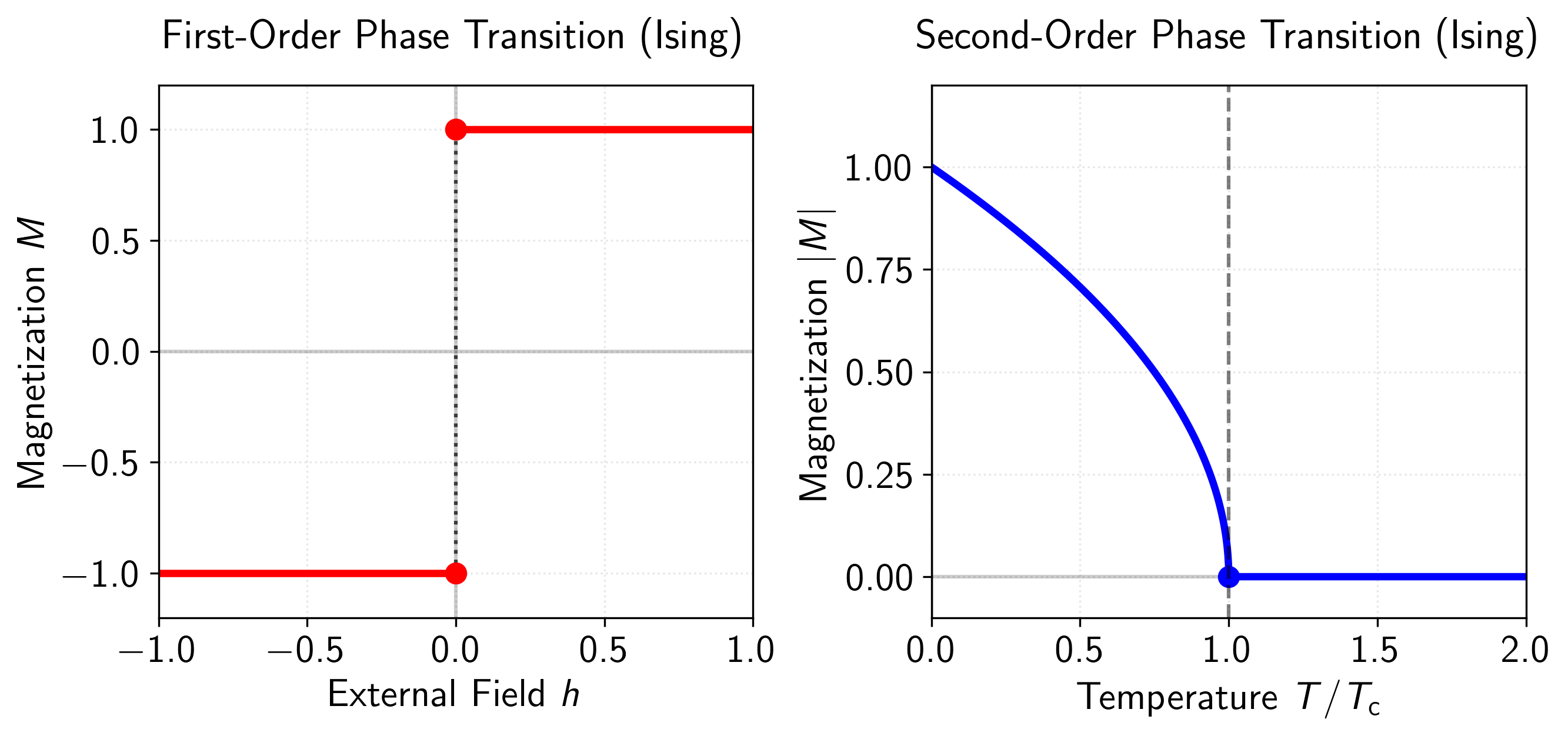
This is a deep concept in theoretical physics known as universality. Systems with entirely different microscopic constituents (magnetic moments, atoms in a fluid) can exhibit identical macroscopic behavior near their critical points if they share the same fundamental symmetries and dimensionality. The Ising model defines one of the most important universality classes.
[PDF] Lecture Notes for Quantum Condensed Matter II
Let's return to Simon's notes to formalize this idea of universality.
Read the section Universality Classes. The key takeaway is that critical phenomena are governed by symmetries and dimensionality, not by the microscopic details of the Hamiltonian.
Your own research experience with cellular automata and Barchan dunes, where simple local rules for sand grain movement generate complex, large-scale dune structures, is a beautiful analogy. The Ising model operates on a similar principle: simple, local interaction rules on a lattice can give rise to the rich, emergent, and universal behavior of phase transitions.
Conclusion
In this lesson, we have taken our first and most important step into the world of interacting many-body systems. We have formally defined the Ising model and, crucially, started to build an appreciation for its profound role in physics.
Key Takeaways:
- The Ising model describes interacting "spins" on a lattice via the Hamiltonian .
- The model captures the competition between the interaction energy , which favors order, and thermal energy (), which favors entropy and disorder.
- In dimensions , the local interactions can lead to cooperative phenomena, where the system develops long-range order and undergoes a phase transition at a critical temperature .
- The Ising model is a paradigm because its behavior is universal. It mathematically describes phenomena far beyond magnetism, such as the liquid-gas transition, and defines a fundamental universality class.
Now that we have defined the model, the natural next question is: how do we solve it? While an exact solution is possible in 1D (as hinted at by Susskind's lecture) and famously difficult but possible in 2D, it is unsolved in 3D. We must turn to approximations. In the next lesson, we will develop our first and most powerful approximation scheme: Mean-Field Theory. This will allow us to obtain a qualitative, and in some limits quantitative, understanding of the phase transition that the Ising model exhibits.