Welcome back. In our previous lessons, we have thoroughly explored the consequences of Bose-Einstein statistics for gases of conserved particles, culminating in our analysis of why BEC is a phenomenon exclusive to dimensions greater than two for a uniform gas. We are now prepared to extend this formalism to a different, yet profoundly important, physical system.
In this lesson, we will shift our focus from atoms to the collective excitations within a crystalline solid. Our goal is to derive the Debye model for the low-temperature specific heat of solids by treating phonons as a gas of bosons. This model was a major triumph of early quantum theory, successfully explaining the experimentally observed dependence of heat capacity at low temperatures, a feat that eluded classical physics. We will see how the statistical mechanics of a gas of non-conserved bosons provides a remarkably accurate description of a solid's thermal properties.
1. From Atomic Vibrations to a Phonon Gas
Imagine a crystalline solid not as a static arrangement of atoms, but as a lattice where each atom is coupled to its neighbors by spring-like forces. A disturbance at one point will not remain localized; it will propagate through the crystal as a collective vibration—a sound wave.
In classical physics, these waves can have any amplitude. Quantum mechanics, however, dictates that the energy of these vibrational modes is quantized. Each quantum of vibrational energy is called a phonon. In this framework, the thermal energy of a solid is pictured as a "gas" of these phonons.
There are crucial parallels and differences between a phonon gas and the atomic Bose gas we studied earlier:
- Bosons: Phonons have integer spin and obey Bose-Einstein statistics.
- Dispersion: Like any wave, a phonon has a frequency and a wavevector . Their relationship, the dispersion relation , determines the phonon's energy .
- Non-conserved Number: Unlike atoms in a sealed container, phonons are quasiparticles that can be created and destroyed. When a solid is heated, more phonons are created; when it cools, they are annihilated. This means there is no conservation law for the total number of phonons. Consequently, the chemical potential for a phonon gas is always zero, .
This last point is key. It makes the statistical treatment of phonons identical to that of photons in blackbody radiation. The average number of phonons in a mode with frequency is given by the Bose-Einstein distribution with :
Our task is to sum the energy over all possible phonon modes to find the total internal energy , and from there, the heat capacity .
2. The Debye Approximation
To proceed, Peter Debye proposed a simplified model in 1912 based on three central approximations. The following video gives an excellent overview of the historical context and the physical intuition behind Debye's thinking.
Solid State Physics | Lecture 2: Debye Model
This lecture from the "Learn Physics" channel introduces the Debye model as a successor to the flawed classical and Einstein models.
Watch the first few minutes to understand the motivation. The segment Debye's intuition explains the core idea of treating vibrations as quantized sound waves. The following part, up to the low temperature argument, explains how a distribution of frequencies is key to avoiding the failures of the Einstein model at low temperatures.
Let's now formalize Debye's assumptions.
Assumption 1: Linear Isotropic Dispersion
Debye assumed that phonons behave like ordinary sound waves in a continuous elastic medium, with a linear dispersion relation:
where is the speed of sound and . This is assumed to be true for all wavevectors. This is, of course, a simplification. A real crystal lattice is discrete, which leads to a more complex, periodic dispersion relation.
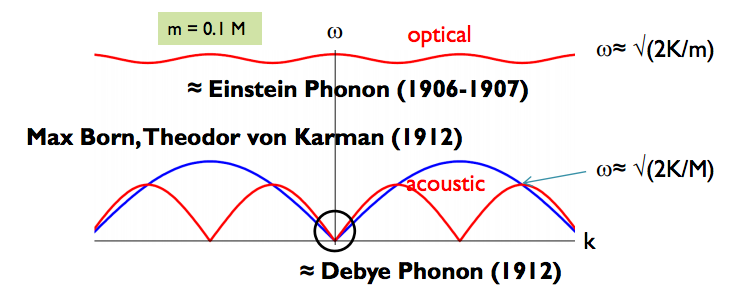
As the image shows, the linear approximation is only truly valid at low energies and momenta (). The success of the Debye model hinges on the fact that at low temperatures, only these low-energy modes are significantly populated.
Assumption 2: Density of States
Our next step is to count how many distinct vibrational modes exist in a given frequency range. This is the density of states, . The derivation involves "counting modes in a box," a fundamental technique in statistical physics.
Solid State Physics | Lecture 2: Debye Model
The same video provides a clear, step-by-step derivation of the density of states for waves in a 3D box.
First, pay close attention to the discussion on sound wave polarizations from light vs. sound. Unlike light (2 transverse polarizations), sound in a solid has three polarizations: one longitudinal and two transverse. This introduces a crucial factor of 3. Next, follow the detailed argument for counting modes in a 3D periodic box. The key result is converting the sum over discrete k-states to an integral over a continuous k-space, and then changing variables from k to \omega.
The result of this mode counting is the density of states for phonons:
where is the volume of the solid. The dependence comes directly from the volume of a spherical shell in 3D -space () combined with the linear dispersion ().
Assumption 3: The Debye Frequency Cutoff
If we were to integrate this density of states over all frequencies from 0 to , we would find an infinite number of modes. This is unphysical. A solid made of atoms has only vibrational degrees of freedom (each atom can move in 3 dimensions).
Debye resolved this by postulating a cutoff frequency, , such that the total number of modes equals :
Substituting our expression for and solving for gives the Debye frequency:
This cutoff is not arbitrary; its value is fixed by the atomic density () and the speed of sound. Associated with this frequency is the Debye temperature, , a characteristic property of each solid:
represents the temperature scale above which all vibrational modes can be excited.
3. Deriving the Heat Capacity
With all the pieces in place, we can now calculate the internal energy and heat capacity. The total energy is found by integrating the energy of each mode, , multiplied by its average occupancy and the density of states , up to the Debye frequency.
3 Quantum Gases‣ Statistical Physics by David Tong
David Tong's lecture notes on Statistical Physics provide a concise and rigorous derivation of the full Debye model.
Please read the subsection The Debye Model. This text walks you through all the steps we've just discussed and then performs the calculation for the internal energy E (which we are calling U) and the heat capacity C_V. Focus on how the calculation is handled in the low and high-temperature limits.
The expression for the internal energy is:
Substituting for and defining a dimensionless variable , this integral can be written as:
This integral does not have a simple closed-form solution, but its behavior in the low and high-temperature limits is exactly what we need.
Low-Temperature Limit ()
In this limit, the upper bound of the integral . The definite integral becomes a standard mathematical constant:
Substituting this back into the expression for gives:
The internal energy is proportional to . The heat capacity at constant volume is then:
This is the celebrated Debye law. It shows that at low temperatures, the heat capacity of a solid vanishes as the cube of the temperature, a result in excellent agreement with experiments.
High-Temperature Limit ()
In this limit, the upper bound . The integration variable is always small, so we can use the approximation . The integral becomes:
Plugging this into the expression for gives:
The heat capacity is therefore:
The Debye model correctly recovers the classical Dulong-Petit law at high temperatures. This is not a surprise; the cutoff was specifically constructed to ensure the total number of modes is , which is the foundation of the classical result.
4. Success and Limitations
The Debye model is a significant improvement over the Einstein model, which incorrectly predicts an exponential decay of at low temperatures. The Debye model's law provides a near-perfect fit for insulating solids.

Despite its success, it is important to remember the model's limitations, which stem from its simplifying assumptions.
3 Quantum Gases‣ Statistical Physics by David Tong
Tong's notes conclude with a critical look at the model's approximations.
Read the short section What's Wrong with the Debye Model?. It highlights that the linear dispersion relation is the most significant simplification and explains why the model still works so well.
For a physicist like you with experience in condensed matter, these limitations are clear: the true phonon density of states is not a simple function but a complex structure with so-called van Hove singularities, and the dispersion is not linear across the whole Brillouin zone. However, the model's triumph lies in capturing the correct low-energy physics, which dominates the thermal properties at low temperatures.
Conclusion
In this lesson, we have seen how to model the thermal properties of a solid by treating its quantized lattice vibrations, or phonons, as a gas of non-conserved bosons.
Key Takeaways:
- Phonons are quantized sound waves that obey Bose-Einstein statistics with zero chemical potential ().
- The Debye model makes three key approximations: a linear dispersion relation (), a resulting density of states , and a frequency cutoff to limit the total number of modes to .
- At low temperatures (), this model correctly predicts the experimentally observed Debye law for specific heat: .
- At high temperatures (), the model correctly recovers the classical Dulong-Petit law: .
We have now completed our survey of ideal Bose gases. We've seen how the same statistical foundation can describe phenomena as different as Bose-Einstein condensation in ultracold atoms and the heat capacity of a solid crystal. In the next module, we will turn our attention to the other half of the quantum world: particles that obey Fermi-Dirac statistics. Our first topic will be the ideal Fermi gas, the basic model for understanding electrons in metals.