Introduction
In our previous lessons on technical analysis, we focused on interpreting objective market data. You learned to analyze price action with indicators like Moving Averages, RSI, and MACD, and to confirm the strength of these movements with trading volume. This gave you a toolkit for reading the market's behavior.
Today, we shift our focus from the market to the investor. This lesson introduces the field of behavioral finance and addresses the learning outcome: Describe common cognitive biases that affect investors (e.g., overconfidence, herd mentality, loss aversion).
While fundamental and technical analysis provide logical frameworks for making investment decisions, they often assume that investors act rationally. Behavioral finance challenges this by acknowledging that we are human, and our decisions are frequently influenced by psychological factors.
Given your background in information technology, you're accustomed to systems that operate on logic and rules. An unexpected output from a program is a "bug" to be fixed. Behavioral finance, in a way, is the study of the predictable "bugs" in our own mental programming when it comes to money. Understanding these biases is the first and most critical step toward mitigating their impact on your investment results.
1. What is Behavioral Finance?
Traditional financial theory often assumes that markets are "efficient" and that investors act as rational agents, always making decisions to maximize their wealth. However, real-world observations often contradict this. Investors frequently make decisions that seem irrational, leading to predictable patterns of underperformance.
Behavioral finance combines psychology and economics to explain why this happens. It suggests that instead of being perfectly rational, we operate with bounded rationality, using mental shortcuts, or heuristics, to make decisions. While often useful, these shortcuts can lead to systematic errors in judgment, known as cognitive biases.
To get a solid introduction to this concept, let's watch a video that contrasts traditional finance with behavioral finance.
Behavioral Finance | Investor Irrationality
The video 'Behavioral Finance | Investor Irrationality' by The Plain Bagel provides an excellent explanation of why understanding our own psychology is crucial for investing. It sets the stage by contrasting the idealized 'rational investor' with how people actually behave.
Please watch the first three minutes of the video (00:00 - 02:57). Focus on: The core assumption of the Efficient Market Hypothesis (EMH) and why behavioral finance questions it. The concept of 'bounded rationality' and how we use mental shortcuts to make satisfactory, but not always optimal, decisions.
As the video explains, recognizing that our brains are built for efficiency, not necessarily for optimal financial analysis, is key. These mental shortcuts that serve us well in daily life can become significant liabilities in the investing world.
2. The Two Families of Bias: Cognitive and Emotional
As "The Plain Bagel" video begins to explain, investment biases can be broadly grouped into two categories: cognitive and emotional.
- Cognitive Biases: These are errors in thinking or processing information. They stem from faulty reasoning, memory errors, or statistical mistakes. You can think of them as an error in your mental "software." With awareness and better processes, they can often be corrected.
- Emotional Biases: These stem from feelings, impulses, and intuition. They are harder to correct because they are tied to our deeply ingrained human nature. The best approach is often not to eliminate the emotion, but to create a disciplined framework that prevents us from acting on it impulsively.
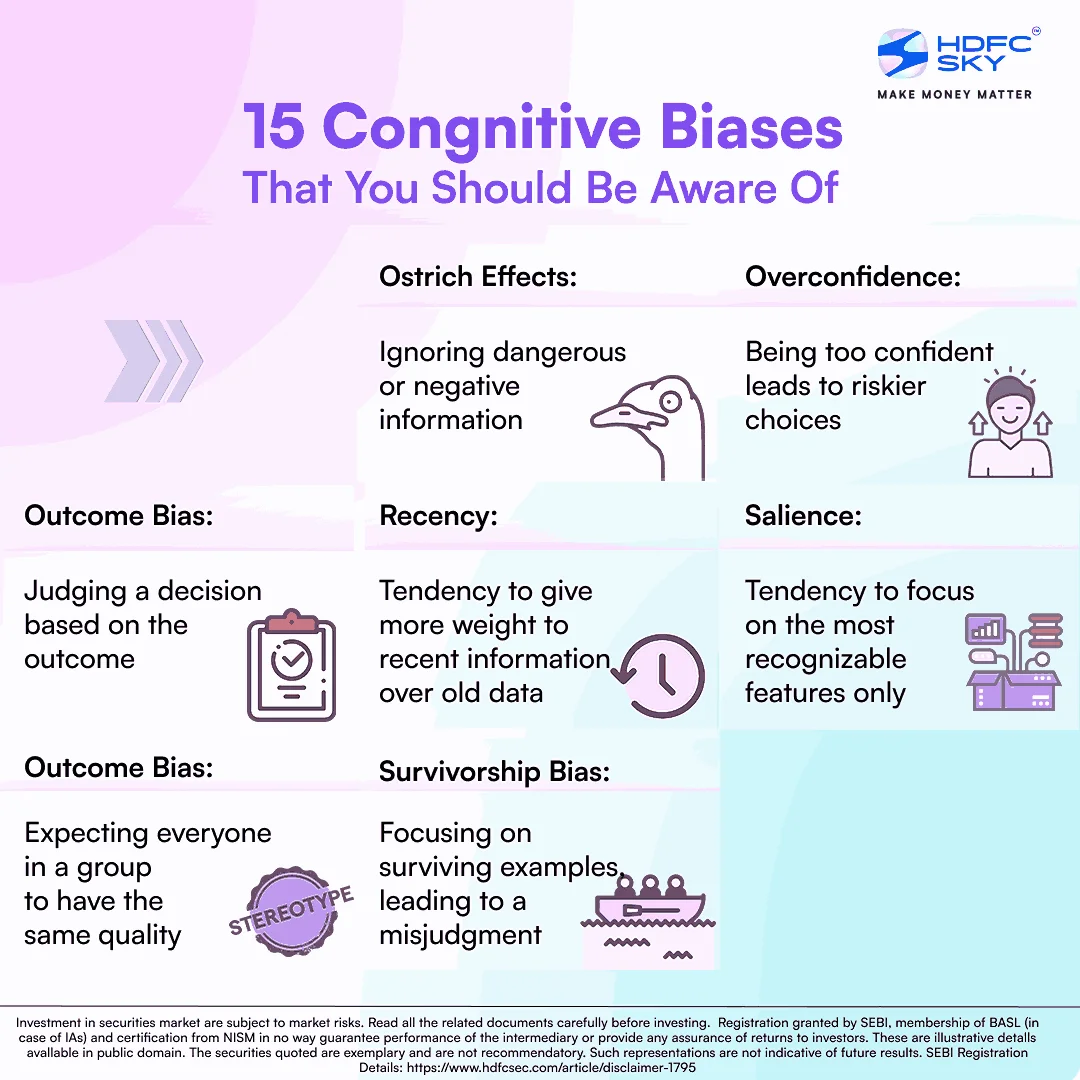

To see how these biases play out in real-world scenarios, let's watch a short animated video that illustrates several of the most common ones.
Behavioral Biases of investing
The video 'Behavioral Biases of investing' from HDFC Mutual Fund uses simple stories to demonstrate how different biases can lead to poor investment choices.
Watch the following segments to see these key biases in action: Confirmation Bias (00:47 - 01:36): Seeking out information that supports our existing beliefs. Overconfidence / Optimism Bias (02:16 - 02:50): Being overly positive about our abilities or future outcomes without sufficient evidence. Herd Mentality (02:50 - 03:27): Following the crowd due to fear of missing out (FOMO). Loss Aversion (03:27 - 04:11): The tendency to hold on to losing investments to avoid the pain of realizing a loss.
3. Key Biases Affecting Investors
Let's now focus on the three biases mentioned in our learning outcome. These are some of the most powerful and pervasive traps for investors.
Overconfidence Bias
This is the tendency to overestimate one's own knowledge, abilities, and the accuracy of one's information. An overconfident investor might trade too frequently, underestimate risks, and ignore evidence that contradicts their thesis. This is particularly dangerous after a few successful trades, which can create a false sense of expertise.
- Example: After making a 50% profit on a single stock, an investor believes they have a special talent for picking winners. They begin to take larger, less-diversified bets, convinced they can't lose.
Herd Mentality (Herding Effect)
This is the tendency for individuals to follow the actions of a larger group, whether those actions are rational or not. It's driven by two powerful emotions: the fear of missing out on a rising market (FOMO) and the perceived safety of being part of the crowd. Herding can cause market bubbles and crashes as investors collectively buy or sell in a panic.
- Example: A new technology stock is soaring and is all over the news. An investor buys shares at a high price without doing any research, simply because "everyone else is buying it" and they don't want to be left behind.
Loss Aversion
This is one of the most fundamental concepts in behavioral finance. It describes how the pain of losing is psychologically about twice as powerful as the pleasure of gaining. For example, the emotional impact of losing LKR 10,000 is much stronger than the positive feeling from gaining LKR 10,000.
This leads to irrational behavior, most notably holding onto losing stocks for too long in the hope they will "break even," while being too quick to sell winning stocks to "lock in a profit."
- Example: An investor buys a stock at LKR 100. It falls to LKR 70. Instead of selling and accepting the loss, they hold on, telling themselves, "I'll sell when it gets back to 100." This prevents them from reallocating that capital to a more promising investment.
4. Biases in the Colombo Stock Exchange (CSE)
These concepts are not just abstract theories; they have been studied and observed right in the market you plan to invest in. Understanding how these biases affect investors in Sri Lanka makes this knowledge immediately practical for you.
A 2014 study specifically researched the behavioral factors influencing investors at the Colombo Stock Exchange. I've highlighted the most relevant parts for you to review.
[PDF] Study on Investors of Colombo Stock Exchange, Sri Lanka
Let's look at the academic paper 'Study on Investors of Colombo Stock Exchange, Sri Lanka' by Lingesiya and Navaneethakrishnan Kengatharan. This will give you direct insight into the behavior of investors in your target market.
Please read the following sections of the paper. You don't need to understand every statistical detail; focus on the main ideas and conclusions: Abstract (Page 1): This gives a high-level summary of the study's purpose and findings. Section 2: Theoretical review... (Page 5): Skim this section to see the four main theories the researchers used: Heuristic, Prospect, Market, and Herding. Table 1. (Page 8): Look at this table. It clearly lists the biases studied under each theory (e.g., Overconfidence, Loss aversion, Herding). Section 5: Conclusion (Pages 21-22): This is the most important part. Read the answers to the three research questions. Pay close attention to which biases were found to have a 'moderate' or 'high' impact on CSE investors' decisions.
Here are the key takeaways from that study, which confirm the real-world relevance of what we've discussed:
- Herding, Heuristics (Overconfidence), and Prospect (Loss Aversion) all have a moderate impact on the decisions of individual investors at the CSE.
- Overconfidence was found to have a negative significant influence on actual investment performance.
- Herding (specifically the choice of stocks) also had a negative significant influence on performance.
A more recent 2022 study on the CSE during the economic crisis (Influence of behavioural factors towards individual stock investment..., Resource ID: LINK) reinforces this, finding that Heuristic factors (which include overconfidence and anchoring) significantly impacted investor decisions and performance. This shows that these psychological traps are not just theoretical but are actively shaping outcomes in the Sri Lankan market today.
Conclusion
This lesson has moved you from the "what" of market data to the "why" of investor behavior. You now understand that even with the best analytical tools, our own minds can be our worst enemies.
Key Takeaways:
- Investors are not always rational: Behavioral finance shows that psychological biases lead to predictable, and often costly, errors in judgment.
- Biases come in two forms: Cognitive (errors in thinking) and Emotional (driven by feelings).
- Three major biases to watch for are:
- Overconfidence: Believing you are better than you are, leading to excessive risk.
- Herd Mentality: Following the crowd, driven by fear of missing out.
- Loss Aversion: Fearing losses more than valuing gains, leading to poor decisions like holding losers too long.
- These biases are active in Sri Lanka: Studies on the Colombo Stock Exchange confirm that these psychological factors have a measurable impact on local investors' decisions and returns.
Preview of the Next Lesson:
Now that you are aware of these internal "bugs," what can you do about them? The best defense against emotional decision-making is a disciplined, rules-based system. In our next lesson, "Explain the use of stop-loss orders and position sizing to manage downside risk," we will explore practical tools designed to enforce this discipline. These risk management techniques are your primary defense against the very biases we've discussed today.