Introduction
In our last lesson, we explored the world of behavioral finance and identified the powerful cognitive biases—like overconfidence, loss aversion, and herd mentality—that can derail even the most well-researched investment plans. You saw evidence that these psychological traps significantly influence investors right here on the Colombo Stock Exchange.
Recognizing these biases is the first step. Today's lesson is about building your defense. We will cover the learning outcome: Explain the use of stop-loss orders and position sizing to manage downside risk.
These two tools are not just technical commands you give your broker; they are the core components of a disciplined, rules-based system designed to protect your capital. For someone with your background in IT and systems engineering, you can think of this as implementing a robust error-handling protocol for your investment process. It's how you control for the "bugs" in human psychology we discussed previously, ensuring that emotional impulses don't lead to catastrophic system failure—the loss of your investment capital.
1. The Stop-Loss Order: Your Automated Exit Strategy
The most direct way to combat loss aversion—the tendency to hold onto a losing stock hoping it will "come back"—is to decide your maximum acceptable loss before you even buy the stock. This is the purpose of a stop-loss order.
A stop-loss order is an instruction given to your broker to sell a stock if its price falls to a specific level, known as the stop price. Its primary function is not to guarantee a profit on a trade, but to protect your entire investment account from significant damage.
There are two main types of "stop" orders you should know.
Trading Up-Close: Stop and Stop-Limit Orders
To understand the mechanics, let's watch 'Trading Up-Close: Stop and Stop-Limit Orders' from Charles Schwab. This video provides a very clear, concise explanation of the two main types of stop orders and their critical differences.
Please watch the entire video (3 minutes and 45 seconds). Pay close attention to: How a stop order triggers a market order and its pros and cons (guaranteed execution, uncertain price). How a stop-limit order adds a second condition (the limit price) and its own trade-offs (price control, but no guarantee of execution). The example of an overnight price gap and how each order type would behave.
As the video illustrates, the choice between a stop order and a stop-limit order depends on your priority:
- Stop Order: Use when getting out of the position is more important than the exact price you get.
- Stop-Limit Order: Use when the price you receive is more important, even if it means you might not get out of the position at all.
These order types are directly available on the Colombo Stock Exchange. The official rulebook for the Automated Trading System (ATS) defines them clearly.
[PDF] Automated Trading Rules - Colombo Stock Exchange
To confirm that this is directly applicable to your goal of investing in Sri Lanka, let's look at the official documentation from the CSE itself. The resource is titled 'Automated Trading Rules'.
Please read section 1.3, 'Stop and Stop Limit Orders' (on page 7). You only need to read this short section to see how the CSE defines and handles these exact order types.
This confirms that when you open your brokerage account in Sri Lanka, these risk management tools will be at your disposal.
2. Position Sizing: Defining Your Risk Before You Trade
A stop-loss order is crucial, but it's only half of the equation. Setting a stop-loss at 10% below your purchase price doesn't mean much if that 10% loss represents 50% of your entire portfolio. This is where position sizing comes in.
Position sizing answers the question: "How many shares should I buy?" The answer depends not on how much you think you can make, but on how much you are willing to lose. This directly counters the overconfidence bias, which can tempt you into making excessively large bets.
Let's watch a brief introduction to this idea.
Risk Management and Position Sizing for Beginners - Trading Tutorial
The video 'Risk Management and Position Sizing for Beginners' explains why a stop-loss alone is insufficient. It introduces the concept of pre-determined risk as the key differentiator between professional trading and gambling.
Watch the segment from 00:52 to 03:21. Focus on the questions the presenter asks about a trade: 'How much money will we lose if we hit this stop loss?' and 'How many times in a row can we afford to hit this stop loss?'. These are the questions that position sizing answers.
The core principle is to transform the question from the emotional "How many shares should I trade?" to the logical "How many shares can I trade for my pre-defined maximum risk?"
3. How to Calculate Your Position Size
The process of position sizing is a simple, deterministic calculation—a short algorithm that you run before every single investment.
I recommend reading the following guide which lays out the steps clearly.
Stop Loss & Position Sizing Explained: How Pros Control Risk
The article 'Stop Loss & Position Sizing Explained: How Pros Control Risk' provides an excellent, no-nonsense guide to this process. It aligns perfectly with a systematic approach to investing.
Please read the following three sections from the article: 'How to Calculate Position Size (Step-by-Step)': This section gives you the simple, three-step process and the core formula. 'How Much Should You Risk Per Trade?': This provides professional guidelines on choosing your risk percentage (e.g., 1%). 'Stop Loss First, Position Size Second (The Golden Rule)': This reinforces the correct logical sequence.
Let's summarize the algorithm from the article:
-
Define Your Maximum Risk per Trade: Decide on a fixed percentage of your total investment capital that you are willing to risk on a single trade. Professionals typically use 1% to 2%. Let's use 1%.
- Total Capital: LKR 500,000
- Risk Percentage: 1%
- Maximum Rupee Risk: LKR 500,000 * 0.01 = LKR 5,000
-
Determine Your Stop-Loss Distance: Based on your analysis (which we'll cover more in later modules), you decide on your entry price and your stop-loss price. The difference is your risk per share.
- Entry Price: LKR 100
- Stop-Loss Price: LKR 90
- Stop Distance (Risk per Share): LKR 100 - LKR 90 = LKR 10
-
Calculate Position Size: Now, you simply divide your maximum Rupee risk by your risk per share.
Using our example:
This calculation tells you that for this specific trade idea, you can buy 500 shares. If your stop-loss at LKR 90 is hit, you will lose LKR 5,000 (500 shares * LKR 10), which is exactly 1% of your capital. You have perfectly controlled your downside.
Here is a visual representation of this process:

4. An Integrated Risk Management System
It's crucial to see stop-loss placement and position sizing as a single, integrated system.
- Your stop-loss is placed based on your analysis of the stock (e.g., below a key support level). It defines the price at which your original investment thesis is proven wrong.
- Your position size is then calculated based on that stop-loss level and your account's risk rules.
Notice the logic: the stop-loss is a discretionary decision based on analysis, but the position size is a non-discretionary, mathematical result. This removes emotion from the decision of how much to invest.
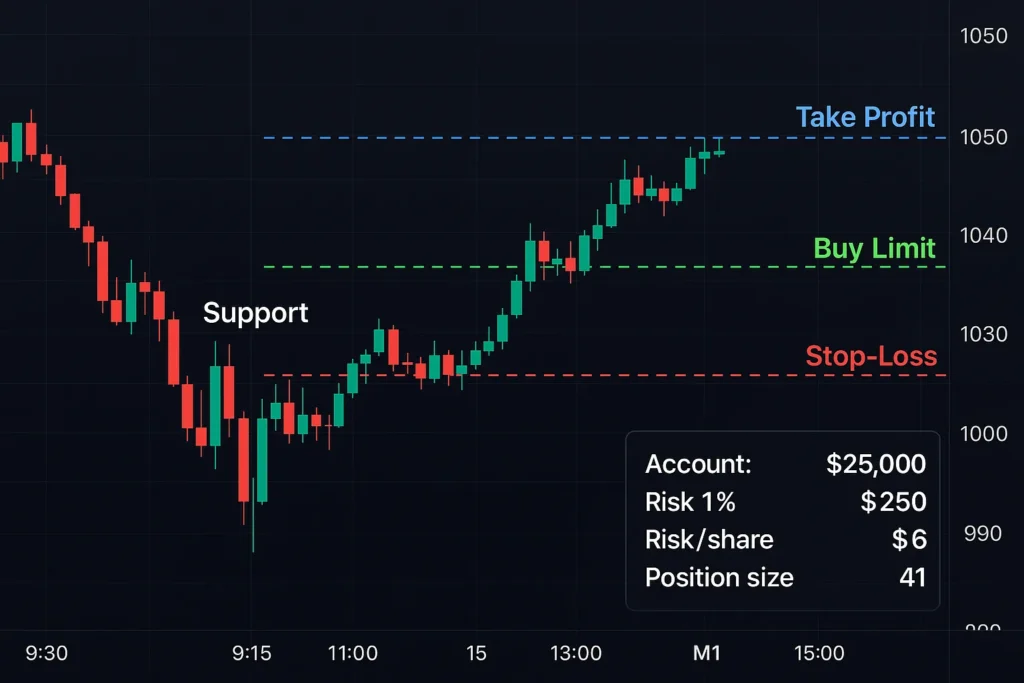
If your stop-loss needs to be wider (e.g., for a more volatile stock), the formula automatically forces you to buy fewer shares to keep the total Rupee risk constant. If the resulting position size is so small that transaction fees would make it impractical, it's a clear signal from your system: this trade is too risky for your account, and you should pass on it. Learning to skip a trade is a professional skill.
Conclusion
Today, you have learned the two most critical tools for capital preservation in investing. By implementing them, you build a firewall between your emotions and your money.
Key Takeaways:
- Stop-Loss Orders are pre-set sell orders that execute if a stock falls to your stop price, protecting you from large losses and countering the bias of loss aversion.
- Position Sizing is the process of calculating how many shares to buy based on a pre-defined maximum risk (e.g., 1% of your portfolio) and your stop-loss distance. This counters overconfidence.
- The Risk Management Formula is:
Position Size = Maximum Rupee Risk / (Entry Price - Stop-Loss Price). - These two tools form an integrated system: you first determine your logical stop-loss, and then you calculate your position size. This makes risk management a disciplined and systematic process.
Preview of the Next Lesson:
Now that you have a system for managing risk, how do you track your performance and learn from your decisions—both good and bad? In the next lesson, we will discuss the final piece of the psychological puzzle: "Explain the importance of maintaining an investment journal to track decisions and learn from outcomes." This practice will allow you to objectively review your trades, check if you followed your risk rules, and refine your strategy over time.