Introduction
Welcome to your next lesson. In our previous session, we drew a line between active investing (trying to beat the market) and passive investing (aiming to match the market). We established that active investing, or "stock picking," requires a hands-on approach involving deep research and analysis.
Today, we delve into the world of active investing to explore two of its most prominent and historically significant philosophies. If active investing is about picking individual stocks, how do you go about it? This question leads us to a classic debate: value investing versus growth investing.
This lesson will compare the core tenets of these two powerful strategies. By the end, you will be able to distinguish between a "value" stock and a "growth" stock, understand the logic behind each approach, and recognize the different metrics and mindsets they require. This is a foundational step in developing your own personal investment philosophy.
1. Defining the Two Philosophies
At the highest level, the difference between value and growth investing is about where you look for returns. Value investors look for what they believe are hidden bargains in the present, while growth investors look for companies they believe will generate exceptional returns in the future.
To get a clear overview, let's start with a video that breaks down both concepts.
The video 'Growth Vs Value Investing' from The Plain Bagel channel provides an excellent introduction to these two investment philosophies.
Please watch the following segments: Growth Investing Explained: (from 01:19 to 02:58) Value Investing Explained: (from 02:58 to 04:14) \nAs you watch, focus on the primary criteria each type of investor uses to select stocks.
As the video explains, these two approaches represent a fundamental divide in active investment strategy:
-
Growth Investing: This is the "fast and furious" approach. The primary focus is on a company's potential for rapid expansion. Growth investors are looking for "the next big thing"—companies with innovative products, expanding market share, or disruptive technology that can lead to above-average growth in revenue and profits. They are betting on the future.
-
Value Investing: This is the "slow and steady" approach, famously championed by investors like Benjamin Graham and Warren Buffett. The focus is on finding solid, established companies that are trading for less than their intrinsic value. Value investors are essentially bargain hunters, looking to buy stocks for less than they are truly worth, believing the market will eventually correct this mispricing. They are betting on the present value being misunderstood.
2. Identifying Growth vs. Value Stocks
How does an investor practically identify these different types of stocks? This is where your analytical skills come into play. Investors use financial metrics to screen for companies that fit their chosen philosophy. One of the most common metrics is the Price-to-Earnings (P/E) ratio, which we introduced in a previous module.
Let's return to the same video to see how this ratio is interpreted differently by each camp.
This next segment of the video explains how the P/E ratio helps differentiate between value and growth stocks.
Please watch the section on valuation (from 04:14 to 06:45). Notice how a 'high' or 'low' P/E ratio is not inherently good or bad, but rather an indicator of market expectations.
To summarize the key idea:
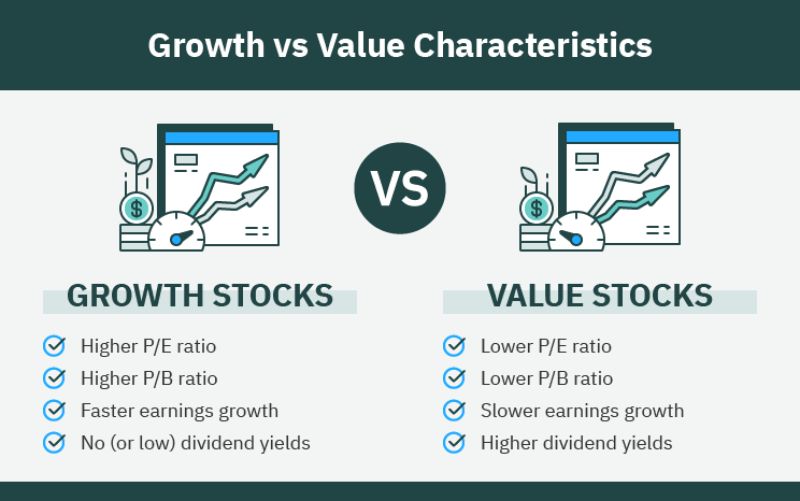
- Value investors typically look for companies with low P/E ratios. A low P/E can suggest that the stock is cheap relative to its current earnings.
- Growth investors are often willing to buy companies with high P/E ratios. They believe the company's future earnings growth will be so strong that it will justify the high current price.
The image below provides a great side-by-side comparison of the typical characteristics of growth and value stocks, including metrics like P/E, Price-to-Book (P/B), and dividend yield.
A Sri Lankan Context
This distinction is highly relevant to the Colombo Stock Exchange (CSE). Certain sectors naturally lend themselves to one category over the other based on the economic environment.
Understanding PE Ratios & Valuations in a Sri Lankan Context
To connect this to your goal of investing in Sri Lanka, let's read a short excerpt from the article 'Understanding PE Ratios & Valuations in a Sri Lankan Context' from Innovest Investments.
Please read the sections titled 'Low PE vs. High PE: What They Really Mean' and 'Why PE Alone Isn’t Enough'. This will give you concrete examples of Sri Lankan sectors that may fall into each category and provide a crucial warning about relying on a single metric.
As the article notes, simply finding a low P/E stock isn't enough. It could be a "value trap"—a company that is cheap for a good reason (e.g., declining business, poor management). This is why fundamental analysis of the business is critical for both strategies.
3. Comparing Risk, Reward, and Investor Mindset
No investment strategy is without risk. Growth and value investing simply present different risk-reward profiles.
Let's watch the final segments from The Plain Bagel video, which cover the pros and cons of each strategy.
Please watch the following two clips: Growth Investing Pros & Cons: (from 07:32 to 08:27) Value Investing Pros & Cons: (from 08:27 to 09:21) \nPay close attention to the concepts of a stock being 'priced for perfection' (growth) and the 'value trap' (value).
The legendary investor Howard Marks offers a more philosophical take on the risk difference. He frames it as investing in the present versus investing in the future.
90% Investors Misunderstand Growth vs Value Investing | Howard Marks | Stocks
In this short clip, investor Howard Marks explains the fundamental risk difference between the two approaches.
Watch the segment from 00:22 to 01:11 and from 02:36 to 02:57. He defines each strategy and then offers a memorable quote that captures the different mindsets.
Marks' quote, "The cautious seldom err or write great poetry," perfectly captures the trade-off. Value investing is often seen as the more cautious approach, focused on avoiding major errors by buying assets for less than they're worth. Growth investing is more akin to "writing great poetry"—it carries higher risk but holds the potential for spectacular, transformative returns.
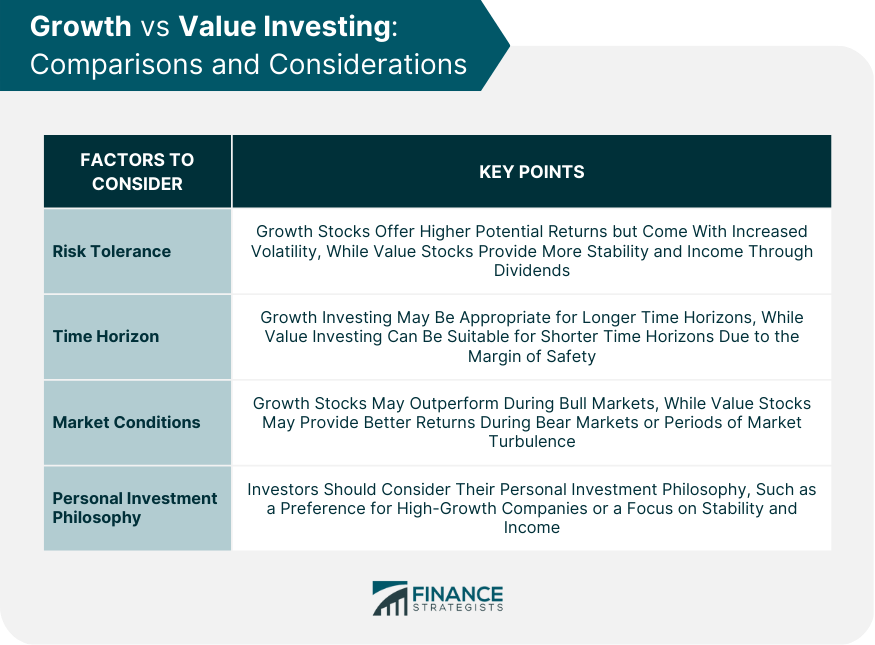
The following table summarizes the key considerations for an investor choosing between these paths.
4. A False Dichotomy? Growth at a Reasonable Price (GARP)
While we've presented these as two distinct paths, many successful investors argue that the line is blurry. After all, isn't the future growth potential of a company part of its present intrinsic value?
Warren Buffett, initially a strict value investor, evolved his thinking to say: "It's far better to buy a wonderful company at a fair price than a fair company at a wonderful price." This reflects an appreciation for quality and growth, not just cheapness.
This has led to hybrid strategies like Growth at a Reasonable Price (GARP). A GARP investor looks for companies that show consistent, above-average earnings growth but whose stock prices have not risen to speculative levels. They want growth, but they are not willing to overpay for it. This approach seeks to combine the best of both worlds.
Conclusion
Today, we have compared the two primary philosophies within active investing: value and growth. Understanding this distinction is crucial because it shapes which companies you look for, what metrics you prioritize, and what risks you are willing to take.
Key Takeaways:
- Value Investing focuses on buying stocks for less than their intrinsic worth. These are often stable, mature companies with low P/E ratios and may pay dividends. The key risk is the "value trap."
- Growth Investing focuses on buying companies with high future growth potential. These are often innovative, fast-expanding companies with high P/E ratios that reinvest earnings instead of paying dividends. The key risk is the company failing to meet lofty growth expectations.
- The choice between them depends on your personal risk tolerance, time horizon, and investment goals.
- The distinction is not absolute. Many successful investors, and hybrid strategies like GARP, incorporate elements of both value and growth.
Preview of the Next Lesson:
Now that we've discussed what to invest in (active vs. passive, value vs. growth), our next lesson will shift to how to invest over time. We will explore a powerful and practical technique called rupee-cost averaging, which can help you build wealth systematically and reduce the risk of trying to "time the market."