Introduction
Welcome to your new lesson. In our last session, we explored the philosophical divide between value and growth investing—two active strategies that focus on what stocks to buy. We learned that value investors hunt for bargains trading below their intrinsic worth, while growth investors seek companies with exceptional future potential.
Today, we shift our focus from what to buy to how you can invest systematically over time. One of the biggest challenges for any investor, new or experienced, is answering the question: "Is now a good time to invest?" Trying to "time the market"—buying at the absolute bottom and selling at the absolute top—is nearly impossible and often leads to anxiety and poor decisions.
This lesson introduces a powerful strategy that bypasses this problem: Rupee-Cost Averaging (RCA). You will learn what this concept means, how it works mathematically, and why it is one of the most recommended strategies for long-term investors. For someone with your background in IT, you can think of RCA as an automated, disciplined algorithm for investing that helps remove emotion from the equation.
1. What is Rupee-Cost Averaging?
Rupee-cost averaging is the practice of investing a fixed amount of money into a specific asset at regular intervals (e.g., LKR 10,000 every month), regardless of the asset's price. It is the Sri Lankan equivalent of what is more broadly known as Dollar-Cost Averaging (DCA).
The core mechanic is simple but powerful:
- When the price of the asset is high, your fixed investment amount buys fewer units.
- When the price of the asset is low, your fixed investment amount buys more units.
This disciplined approach helps you automatically buy more of an asset when it's "on sale" and less when it's expensive. To see this concept explained visually, please watch the short video below.
Rupee Cost Averaging in SIP | How It Can Benefit You | DSP Mutual Fund
The video 'Rupee Cost Averaging in SIP' from DSP Mutual Fund offers a clear and concise introduction to the topic and illustrates it with a numerical example.
Please watch the segment from 00:34 to 01:48. Pay close attention to how the number of units purchased changes each month even though the investment amount stays the same.
This strategy is most commonly implemented through a Systematic Investment Plan (SIP), which is an automated instruction you can give to a mutual fund or, in some cases, a stockbroker, to invest a certain amount from your bank account on a specific date every month.
2. How Rupee-Cost Averaging Works: The Math
Let's break down the mechanics with a clear example. Imagine you decide to invest LKR 5,000 every month into shares of a company. Look at how your investment would play out over six months with a fluctuating share price.
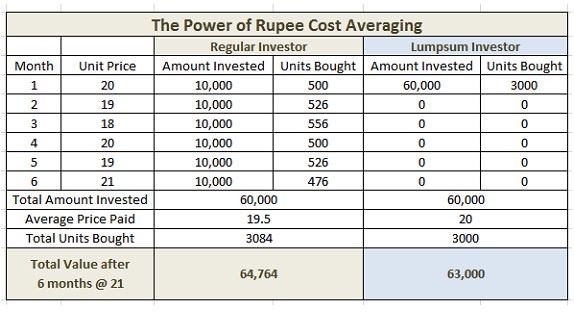
Let's analyze the table for the Regular Investor (RCA):
- Total Amount Invested: 6 months × LKR 10,000/month = LKR 60,000
- Total Units Purchased: 3,084
- Average Cost Per Unit: LKR 60,000 / 3,084 units = LKR 19.45
Now, look at the share prices over the six months (20, 18, 17, 19, 23, 21). The simple average of these prices is LKR 19.67. Notice that your average cost per unit (LKR 19.45) is lower than the average price during that period. This happens because you bought the most units in Month 3, when the price was at its lowest (17).
In contrast, the Lumpsum Investor who invested all LKR 60,000 in Month 1 bought all their units at LKR 20. RCA helped the regular investor achieve a better entry price over time.
3. The Benefits for Long-Term Investors
The mathematical effect we just saw leads to several powerful benefits, especially for investors with a long-term horizon.
What is Rupee Cost Averaging (RCA) and how does it work?
The article 'What is Rupee Cost Averaging (RCA) and how does it work?' from Tata Capital Moneyfy provides a detailed list of the advantages. Please read the following section to understand them in depth.
Please read the section titled 'Advantages of Rupee Cost Averaging'. It starts after the numbered list explaining how RCA works and ends just before 'Limitations of Rupee Cost Averaging'.
To summarize the key benefits:
- Reduces the Risk of Bad Timing: RCA removes the need to time the market. By investing consistently, you avoid the risk of deploying all your capital right before a market downturn.
- Removes Emotional Decision-Making: Greed and fear are an investor's worst enemies. An automated, disciplined approach like RCA prevents you from making impulsive decisions, such as panic selling during a dip or getting carried away by market hype.
- Promotes Discipline: It builds a healthy, consistent habit of saving and investing, which is fundamental to long-term wealth creation.
- Leverages Volatility: For a long-term investor, market dips are not a crisis but an opportunity. RCA automatically takes advantage of these dips by buying more shares at lower prices.
- Accessible and Affordable: You don't need a large lump sum to start. You can begin investing with smaller, regular amounts that fit your budget.
4. Important Limitations and Caveats
While powerful, RCA is not a foolproof strategy and it's crucial to understand its limitations.
How do I make money consistently?
The following video discusses where RCA works and, more importantly, where it doesn't. This is a critical point to understand before applying the strategy.
Please watch the segment from 06:38 to 08:32. The speaker explains why you must be selective about the assets you apply this strategy to.
As the video and other resources highlight, here are the main caveats:
- It Does Not Guarantee a Profit: RCA reduces the risk of timing, but it does not eliminate the risk of the asset. If you consistently invest in a company whose fundamentals are deteriorating and its stock price is trending towards zero, RCA will only help you lose money in a more disciplined way. Therefore, RCA should only be applied to fundamentally strong assets like blue-chip stocks, well-managed mutual funds, or broad market ETFs.
- Potential for Lower Returns in a Strong Bull Market: If the market rises consistently without any significant dips, a lump-sum investment made at the very beginning would have generated a higher return than averaging in over time. However, predicting such a market is impossible. RCA is a strategy that optimizes for a range of outcomes, not just the best-case scenario.
Conclusion
Today, you've learned about Rupee-Cost Averaging, a simple yet profound strategy for long-term investing. It is a powerful tool for building wealth while mitigating risk and removing the stress of trying to time the market.
Key Takeaways:
- Rupee-Cost Averaging (RCA) is the strategy of investing a fixed sum of money at regular intervals.
- It works by buying more units when prices are low and fewer units when prices are high, which can lower your average cost per unit over time.
- The primary benefits are removing emotion and market-timing risk, instilling investment discipline, and turning market volatility into an advantage.
- RCA is not a substitute for good research. It should only be used with fundamentally sound investments you believe in for the long term.
Preview of the Next Lesson:
RCA helps us manage the risk of when we invest. But how do we measure the risk of what we invest in? In the next lesson, we will introduce a key metric used to quantify this risk: beta. You will learn what beta is and how it measures a stock's volatility relative to the overall stock market.