Introduction
Welcome back. In our previous lesson, we established the critical role of asset allocation—how you divide your portfolio between major categories like stocks and bonds—in managing your overall investment risk. We saw that combining asset classes with different performance characteristics is the foundation of a resilient portfolio.
Now that you have a framework for allocating your capital, the next question is: what is your philosophy for selecting the investments within those asset classes? This brings us to one of the most fundamental debates in investing.
Today, we will explore two distinct investment strategies: active investing and passive investing. The goal of this lesson is to help you distinguish between these two approaches. Understanding their core differences in goals, methods, costs, and time commitment is a crucial step in defining what kind of investor you want to be.
1. Defining Active and Passive Investing
At its core, the difference between active and passive investing comes down to a single question: do you want to try and beat the market, or do you want to match the market's performance?
- Active Investing is a hands-on approach where the goal is to outperform a market benchmark (like the S&P 500 or, in Sri Lanka, the ASPI). This involves deep research, analysis, and judgment to select individual stocks or other assets that you believe will generate above-average returns. This is often called "stock picking."
- Passive Investing is a hands-off approach where the goal is simply to replicate the performance of a market benchmark. Instead of trying to pick winners, you buy a fund that holds all (or a representative sample) of the securities in that index.
To get a clear overview of this debate, let's watch a video that breaks down the definitions and the core philosophies behind each strategy.
The Active Vs Passive Investing Debate
The video 'The Active Vs Passive Investing Debate' from The Plain Bagel provides an excellent introduction to these two core strategies.
Please watch the following two segments: What is Active Investing? (from 01:49 to 02:30) What is Passive Investing? (from 02:30 to 03:25) \nFocus on the stated 'goal' of each strategy and the 'method' used to achieve it.
As the video explains, active investors believe they can find and exploit market inefficiencies to earn a superior return, known as alpha. Passive investors, on the other hand, often subscribe to the Efficient Market Hypothesis (EMH), which suggests that all known information is already reflected in stock prices, making it extremely difficult to consistently beat the market.
2. Pros and Cons in Practice
Choosing between these strategies has significant practical implications for your portfolio's cost, risk, and the amount of time you need to dedicate. Let's compare the two approaches by looking at their most common implementations: buying individual stocks (active) versus buying Exchange-Traded Funds or ETFs (passive).
What will get you more RICH? ETFs or Individual Stocks
The video 'What will get you more RICH? ETFs or Individual Stocks' from Investing Simplified breaks down the practical advantages and disadvantages of each approach.
Please watch the sections that cover the pros and cons: Pros of ETFs (Passive): (from 01:07 to 03:30) Note the points on diversification and low maintenance. Cons of ETFs (Passive): (from 03:30 to 05:08) Pay attention to the lack of control and potential for over-diversification. Pros of Individual Stocks (Active): (from 05:08 to 06:20) Focus on the potential for higher returns and full control. Cons of Individual Stocks (Active): (from 06:20 to 08:25) Note the points on higher risk and the time-intensive nature of research.
This practical comparison highlights a key trade-off. Active investing offers the potential for outsized returns and full control over your portfolio, but it demands significant time for research, higher risk, and often higher costs. Your background in data analysis with tools like Tableau and SQL is certainly an asset if you choose this path, as it equips you to analyze company fundamentals deeply.
Passive investing offers simplicity, broad diversification, and low costs, making it a "set-it-and-forget-it" style approach. This aligns well with a busy professional schedule but means you will never outperform the market—you will simply be the market.
3. A Structured Comparison and the Sri Lankan Context
To consolidate what we've learned, let's review a detailed textual breakdown and a summary table.
Passive Investing: Definition, Pros and Cons, vs. Active Investing
For a clear, written summary, let's turn to Investopedia's article 'Passive Investing: Definition, Pros and Cons, vs. Active Investing'. It lays out the arguments for and against each strategy in a very structured way.
Please read the sections titled 'Benefits and Drawbacks of Passive Investing' and 'Active Investing: Benefits and Drawbacks'. This will reinforce the key points from the video you just watched.
The table below provides a concise visual summary of the key differences between the two strategies.
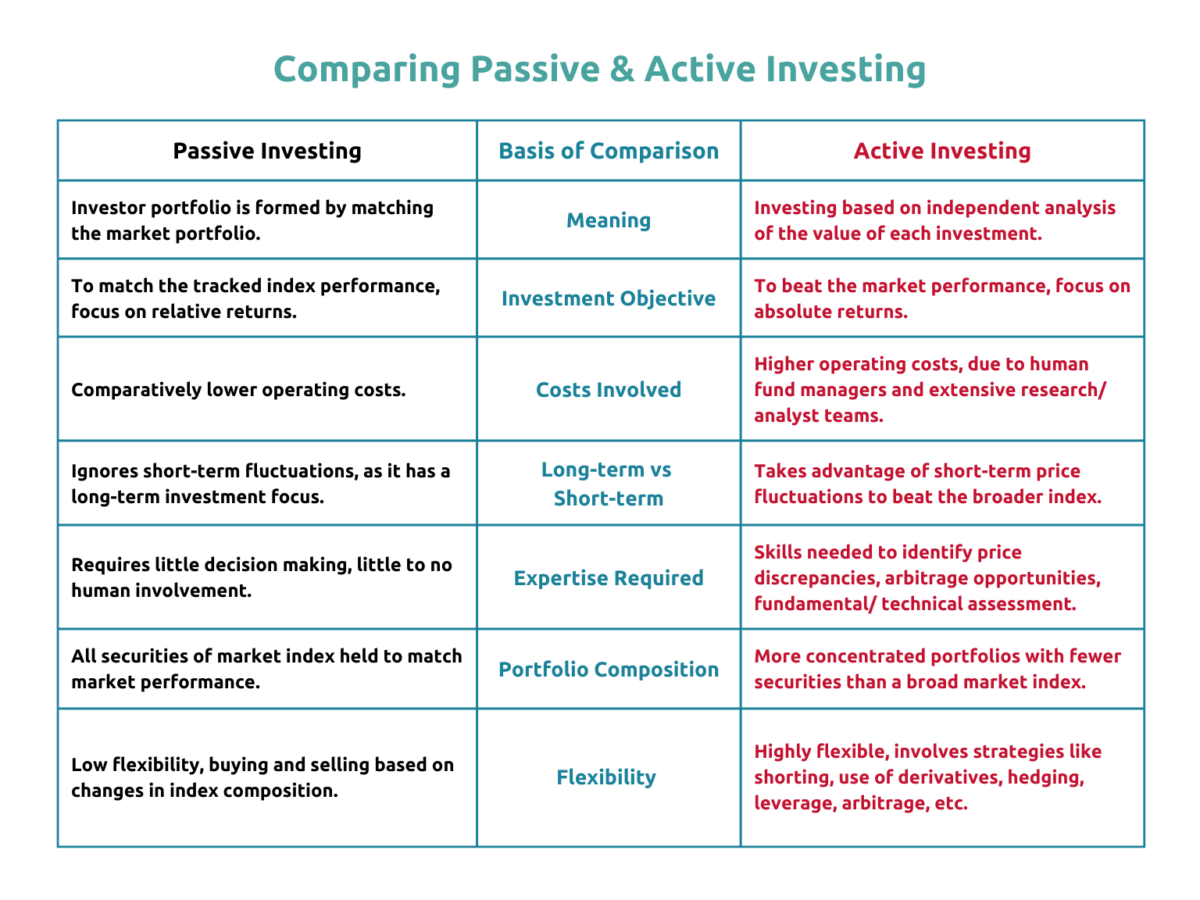
Bringing it to the Colombo Stock Exchange (CSE):
So, what does this mean for you as an investor in Sri Lanka?
- A passive investor would seek to match the performance of a major CSE index, like the All Share Price Index (ASPI). You would buy an index fund or an ETF that tracks the ASPI. Your return would mirror the performance of the overall market, as shown in the chart below.
- An active investor would look at the companies within the ASPI, analyze their financial statements and business models, and select a handful that they believe will grow faster than the average company. Your goal would be to generate a return that is higher than the ASPI's return.

Conclusion
Today we have distinguished between two fundamental investment strategies: active and passive. This choice is less about right or wrong and more about what aligns with your goals, personality, and the amount of time you are willing to commit.
Key Takeaways:
- Active Investing seeks to beat the market through research and stock picking. It offers higher potential returns but comes with higher risk, higher costs, and requires a significant time commitment.
- Passive Investing seeks to match the market by tracking a benchmark index. It is simpler, cheaper, and less time-consuming, but you give up the chance to outperform the market.
- The choice can be seen as Individual Stocks (Active) vs. Index Funds/ETFs (Passive).
- It is not a binary choice. Many investors use a hybrid approach, building a core portfolio with passive funds and using a smaller portion for active stock picking.
As you reflect on this, consider your own inclinations. Does the idea of deep-diving into company reports and financial models to find hidden gems excite you? Or does a strategy that allows you to benefit from the market's long-term growth with minimal effort sound more appealing?
Preview of the Next Lesson:
If the active approach piques your interest, you should know that "stock picking" itself has many sub-strategies. In our next lesson, we will explore two of the most famous active investing philosophies: value investing and growth investing.