Hello! Welcome to your next lesson.
In our last session, we discussed the two primary ways you can earn a return from owning shares: capital appreciation (the stock price going up) and dividends (the company sharing its profits). This distinction is key to understanding different investment strategies.
Now, we'll build on that by learning how to classify the companies themselves. After all, a large, established global bank is very different from a small, new technology startup. Today's lesson addresses this by exploring a fundamental concept used to measure and categorize companies. We will explain the concept of market capitalization and how companies are categorized by size.
Understanding market cap will help you quickly gauge a company's scale, which has important implications for its potential risk and return.
1. What is Market Capitalization?
When you hear financial news mention the "size" of a company, they aren't talking about its number of employees or buildings. They are almost always referring to its market capitalization, or "market cap" for short.
Market capitalization is the total market value of a company's publicly traded shares. It's a straightforward calculation.
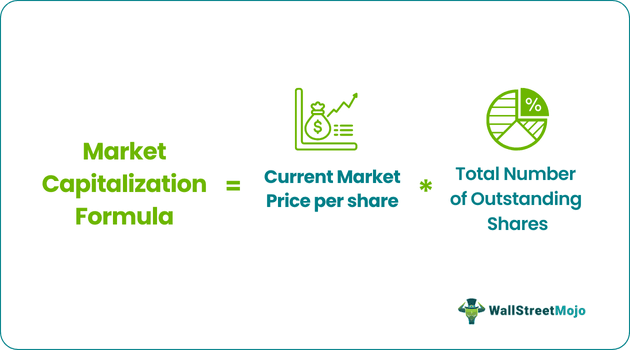
To see this in action, let's watch a short video that defines the term and walks through a calculation.
Market Capitalization explained
This video from The Finance Storyteller provides a clear definition of market capitalization and shows how it is calculated using a real-world example.
Please watch from 00:34 to 02:12. This section defines market capitalization, explains the formula, and shows you how to find the necessary information (share price and shares outstanding) to calculate it.
Why Market Cap is a Better Measure Than Share Price
A common mistake for new investors is to think a stock with a high price is a "bigger" or "more valuable" company than a stock with a low price. This is incorrect.
Imagine two companies:
- Company A: Share price is 1,000 LKR. It has 1 million shares outstanding.
- Company B: Share price is 50 LKR. It has 40 million shares outstanding.
Which company is larger in the eyes of the market?
- Company A Market Cap: 1,000 LKR/share × 1,000,000 shares = 1 Billion LKR
- Company B Market Cap: 50 LKR/share × 40,000,000 shares = 2 Billion LKR
Even though Company A has a much higher share price, Company B has a market capitalization twice as large. The share price alone is misleading; market cap gives you the full picture of a company's total market value. It reflects how much it would cost to buy every single share of the company at its current price.
2. How Companies Are Categorized by Size
Now that we can calculate a company's value, we can use that figure to categorize it. Globally, investors use a common set of labels based on market cap. While the exact dollar amounts can vary, the general framework is widely accepted.
The three primary categories are:
- Large-Cap
- Mid-Cap
- Small-Cap
There are also categories for the largest companies (Mega-Cap) and the smallest (Micro-Cap and Nano-Cap).
To understand the distinct characteristics of these categories, please read the following article. It does an excellent job of comparing them across several important factors for an investor.
Large Cap vs Mid Cap vs Small Cap Stocks: Key Differences
This article from Gotrade breaks down the key differences between large-cap, mid-cap, and small-cap stocks, which is essential for understanding their roles in a portfolio.
Please read from the beginning ('Market capitalization is one of the simplest ways...') down to the end of the 'Analyst coverage and information flow' subsection. Focus on the comparative aspects: how do these categories differ in terms of risk, growth potential, and performance in different economic conditions?
To consolidate what you've just read, here is a summary table of the key differences:
| Feature | Large-Cap (> $10 Billion) | Mid-Cap ($2 - $10 Billion) | Small-Cap (< $2 Billion) |
|---|---|---|---|
| Typical Companies | Well-established, often global leaders (e.g., banks, major conglomerates). | Established but still growing businesses. | Younger companies or those in niche markets. |
| Risk & Volatility | Lower. More stable and resilient in downturns. | Medium. A balance between stability and volatility. | Higher. More sensitive to market and economic shifts. |
| Growth Potential | Slower, more moderate growth. | Higher growth potential than large-caps. | Highest growth potential (and highest failure risk). |
| Returns | Often provide stable returns and dividends. | Potential for strong returns as they grow. | Potential for massive returns, but more inconsistent. |
| Liquidity | High. Easy to buy and sell large quantities. | Good, but can be less than large-caps. | Lower. Can be harder to trade without affecting the price. |
| Analyst Coverage | Extensive. Information is widely available. | Moderate. Potential for information gaps. | Limited. Less information available publicly. |
Note: The dollar values are general guidelines used in major international markets. The principles, however, apply to any stock market, including the Colombo Stock Exchange (CSE). The largest companies on the CSE are considered Sri Lanka's "large-caps."
3. Why This Matters for Your Investment Strategy
Understanding market cap isn't just an academic exercise. It directly informs your investment decisions and helps you manage risk.
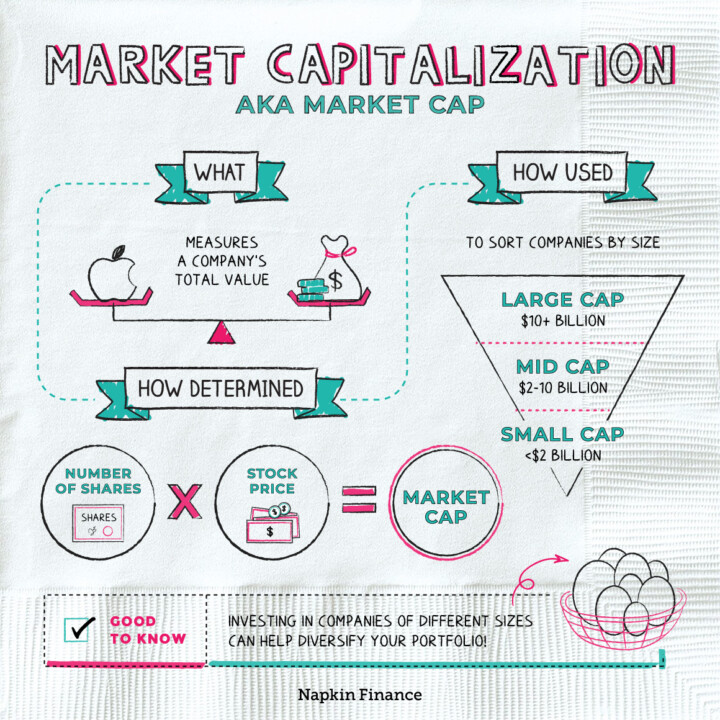
As the infographic and article suggest, different cap sizes play different roles in a portfolio:
- Large-caps can form the stable core of a portfolio, providing resilience.
- Mid-caps can add a boost of growth.
- Small-caps can be used for aggressive growth potential, but should be handled with care due to their higher risk.
It's also crucial to avoid a common misconception: Market cap is not a measure of quality. A massive large-cap company can be poorly managed and a bad investment, while a nimble small-cap company can be a well-run, future star. Market cap is a measure of size, and size implies certain risk and growth characteristics—nothing more.
Conclusion
Today, we've defined a crucial metric for evaluating companies. You now have a framework for classifying stocks that goes beyond just looking at the share price.
Key Takeaways:
- Market Capitalization is the total value of a company's shares, calculated as
Share Price × Number of Outstanding Shares. - Market cap is a far more accurate measure of a company's size than its share price.
- Companies are commonly categorized as large-cap, mid-cap, and small-cap, each with distinct risk, growth, and stability profiles.
- Large-caps tend to be more stable, while small-caps offer higher growth potential at the cost of higher risk.
- Understanding these categories is essential for building a diversified portfolio that aligns with your risk tolerance and investment goals.
Preview of the Next Lesson:
Now that you understand how companies are categorized by size, we can apply this knowledge directly to your goal of investing in Sri Lanka. In the next lesson, we will begin our deep dive into the Colombo Stock Exchange by describing its structure and key indices, such as the ASPI and the S&P SL20. You will see how these indices are heavily influenced by the performance of the largest "large-cap" companies on the exchange.