Hello! Welcome to the third module of our course, where we shift from general financial concepts to the specifics of your investment goal: the Colombo Stock Exchange (CSE).
In our last lesson, we defined market capitalization and saw how companies are categorized by size (large-cap, mid-cap, small-cap). We noted that the performance of large-cap companies often has a significant influence on the overall market.
Today, we'll see that principle in action. This lesson focuses on the first step of our practical guide to the CSE. Our goal is to describe the structure and key indices of the CSE (e.g., ASPI, S&P SL20). By the end of this lesson, you'll understand the key organizations that make up the stock market in Sri Lanka and how its overall performance is measured.
1. The Structure of the Colombo Stock Exchange
The term "stock market" often sounds abstract, but it's a system with a clear structure and defined players. At the heart of Sri Lanka's stock market is the Colombo Stock Exchange (CSE).
[PDF] Invest with the COLOMBO STOCK EXCHANGE
Let's start with a formal definition of the CSE. Please read this short excerpt from an introductory brochure by the CSE itself.
Please read the section titled 'Who we are' on page 3. This will clarify the CSE's primary role as the market operator and introduce its subsidiary, the CDS.
As you just read, the Colombo Stock Exchange (CSE) is the main organization responsible for operating the stock market. Think of it as the marketplace where buyers and sellers of shares meet. It also has a subsidiary called Central Depository Systems (Pvt.) Limited (CDS), which handles the crucial post-trade process of clearing and settlement (we'll cover settlement in a future lesson).
To visualize how these pieces fit together with other market participants, take a look at the following diagram.
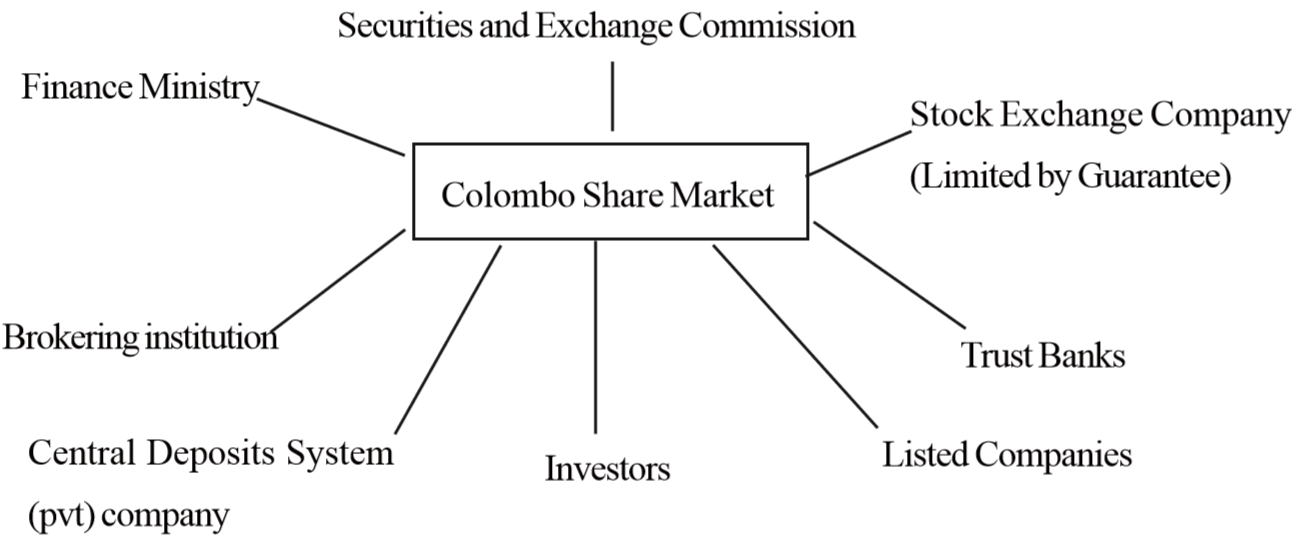
This diagram provides a clear map of the system:
- Investors (like you) and Listed Companies are the core participants, buying and selling ownership stakes.
- Stockbroking Institutions act as intermediaries, executing trades on behalf of investors.
- The Colombo Stock Exchange (CSE) provides the trading platform and infrastructure.
- The Central Depository System (CDS) handles the electronic record-keeping and transfer of shares.
- The Securities and Exchange Commission (SEC) is the government regulator that oversees the entire market to ensure it is fair and orderly. We will discuss its role in more detail later.
2. Measuring the Market: Stock Indices
Now that we understand the market's structure, how do we know if the market as a whole is going up or down on any given day? We use stock market indices.
[PDF] Methodology Revision of All Share Price Index (ASPI)
For a precise definition, let's look at this document from the CSE which explains the purpose of an index.
Read the answer to the first question, 'What is a stock market index and the purpose of it?'.
As the document states, an index is a statistical measure. It's like a snapshot that summarizes the direction of the entire market or a specific part of it. The CSE has two main indices that you will see mentioned constantly in financial news.

Let's break down what these two key performance indicators represent.
3. The ASPI: The All Share Price Index
The All Share Price Index (ASPI) is the broadest measure of the CSE's performance. As its name suggests, it includes all ordinary shares of companies listed on the exchange.
The ASPI is a market-capitalization weighted index. This directly connects to our previous lesson. It means that changes in the share prices of large-cap companies have a much greater impact on the index's value than changes in the prices of small-cap companies.
An Important Update: Float-Adjusted Market Cap
Historically, the ASPI used the full market capitalization of a company for its calculation. However, in 2022, the CSE updated its methodology to align with global best practices. The ASPI is now based on float-adjusted market capitalization.
This may sound complex, but the concept is straightforward. The "free float" refers to the shares of a company that are readily available for trading by the public. It excludes shares held by strategic, long-term holders like governments, founding families, or other corporations.
Think of it like this: Total market cap is the value of all shares, while float-adjusted market cap is the value of shares that are actually in play in the market. Using the float-adjusted value gives a more realistic picture of the market's day-to-day dynamics.
[PDF] Methodology Revision of All Share Price Index (ASPI)
This document from the CSE explains this change. It's a slightly more technical read, but your background in IT and data systems should make the logic clear.
Please read the answers to questions 3, 4, and 6 ('What is float adjusted market capitalization?', 'What is the ASPI methodology revision of 2022?', and 'What makes CSE to move for this kind of change?'). This will explain the 'what' and 'why' of this important methodology.
In summary, the ASPI gives you a comprehensive view of the entire market's performance, with an emphasis on larger companies, and is calculated using the portion of shares actively available for trading.
4. The S&P SL20: The Blue-Chip Index
While the ASPI tracks the whole market, the S&P Sri Lanka 20 (S&P SL20) is more selective. It is designed to track the performance of the 20 largest and most liquid companies listed on the CSE. These are often referred to as "blue-chip" stocks—large, stable, and well-established firms.
[PDF] Invest with the COLOMBO STOCK EXCHANGE
Let's return to the CSE's introductory brochure to get the official description of the S&P SL20.
In the 'Performance Indicators' section on page 10, please read the paragraph describing the S&P Sri Lanka 20.
Here are the key points about the S&P SL20:
- Constituents: It comprises the 20 largest (by float-adjusted market cap) and most liquid (most actively traded) stocks.
- Methodology: It is managed by S&P Dow Jones Indices, a global leader in index creation, which lends it international credibility.
- Purpose: It represents the performance of the top tier of the Sri Lankan market and is often used as a benchmark for investment funds.
- Capping: The influence of any single company in the S&P SL20 is capped (at 15%). This prevents one or two mega-companies from completely dominating the index's movement.
So, while the ASPI tells you what the entire market is doing, the S&P SL20 gives you a focused look at the performance of the market's largest and most significant players.
Conclusion
In this lesson, we have mapped out the basic operational structure of the Colombo Stock Exchange and demystified its two main performance benchmarks.
Key Takeaways:
- The CSE is a system composed of the exchange (CSE), the settlement body (CDS), regulators (SEC), brokers, and investors.
- Stock indices are statistical tools that measure the performance and direction of the market.
- The ASPI is the broad market index, tracking all listed companies, weighted by their float-adjusted market capitalization.
- The S&P SL20 is a selective index, tracking the 20 largest and most liquid "blue-chip" companies on the exchange.
- Both indices give you a quick way to gauge market health, but they tell slightly different stories: one about the overall market and the other about its top tier.
Preview of the Next Lesson:
Now that you understand the overall market structure and its main indices, we can start breaking the market down into its business components. In the next lesson, we will identify the major sectors listed on the CSE and their general characteristics. This will help you understand the types of businesses you can invest in, from banks and hotels to manufacturing and technology companies.