Hello! Welcome to the third lesson in our module on qualitative analysis.
Introduction
In our last lesson, you learned how to use a SWOT analysis to get a high-level view of a company's internal Strengths and Weaknesses, as well as the external Opportunities and Threats it faces. This framework is excellent for organizing your initial research.
Now, we're going to zoom in on the "Opportunities" and "Threats" quadrants. A company's success doesn't just depend on its own actions, but on the structure of the industry it operates in. Some industries are intensely competitive, with low profit margins for everyone, while others are more benign, allowing well-run companies to flourish.
Today, you will learn to use Porter's Five Forces framework to dissect the competitive landscape of an industry. This powerful tool, developed by Harvard Business School professor Michael Porter, helps you understand the underlying forces that drive industry profitability. Mastering this will allow you to assess the long-term attractiveness of an industry and the sustainability of a company's profits—a critical step in deciding where to invest.
What are Porter's Five Forces?
The core idea behind the framework is that the state of competition and profitability in an industry is determined by five fundamental forces. The collective strength of these forces dictates how the economic value created by an industry is shared between companies, their customers, and their suppliers.
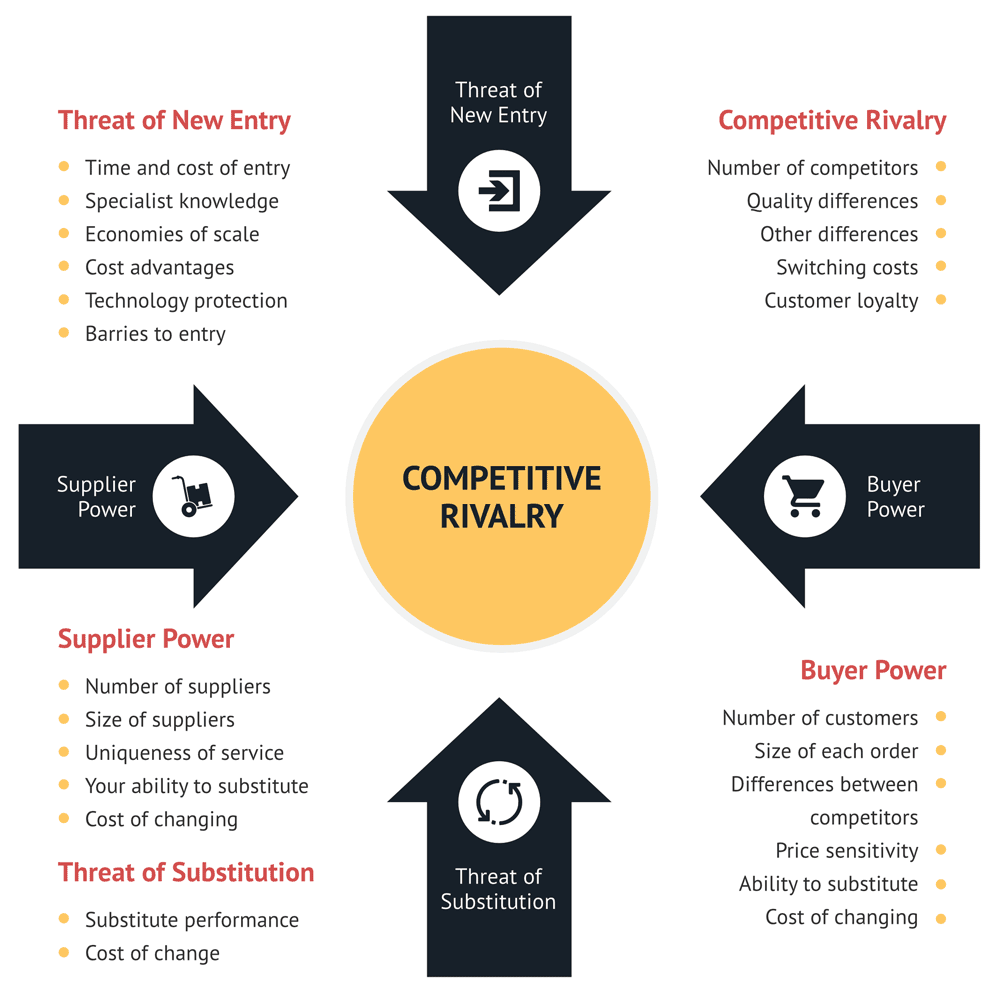
The five forces are:
- Competitive Rivalry: The intensity of competition among existing players.
- Threat of New Entrants: The ease with which new competitors can enter the market.
- Threat of Substitute Products or Services: The likelihood of customers finding a different way of doing what your industry does.
- Bargaining Power of Suppliers: The ability of suppliers to raise their prices or reduce the quality of their goods/services.
- Bargaining Power of Buyers: The ability of customers to drive prices down.
A strong force is a threat to industry profits, while a weak force represents an opportunity. To get a clear overview of the framework, let's watch the introductory part of a helpful video.
Porter's 5 Forces EXPLAINED | B2U | Business To You
This video from 'Business To You' provides an excellent introduction to Porter's Five Forces, explaining its purpose and how it relates to industry profitability.
Please watch the first 2 minutes and 54 seconds of the video. Focus on understanding the purpose of the model and the names of the five forces.
Deconstructing the Five Forces
Now, let's break down each force. As you go through these, think about them from an investor's perspective: an industry where these forces are weak is generally a more attractive place to invest.
We'll continue with the video, which uses the airline industry as a running example—an industry famously characterized by intense competition and low average profitability.
1. Competitive Rivalry
This force is at the center of the framework. It describes how intensely companies in an industry compete for market share and profits.
- Rivalry is HIGH (bad for profits) when: There are many competitors of similar size, industry growth is slow, products are undifferentiated (commodities), and it's difficult for companies to leave the industry (high exit barriers). This leads to price wars and higher marketing costs.
- Rivalry is LOW (good for profits) when: There are few competitors, the industry is growing fast, products are highly differentiated, and exit barriers are low.
Porter's 5 Forces EXPLAINED | B2U | Business To You
This section of the video details the factors that influence competitive rivalry.
Watch from 02:54 to 05:02. Notice how factors like the number of airlines and high fixed costs lead to intense rivalry.
2. Threat of New Entrants
This force measures how easy it is for new companies to enter an industry and compete. If it's easy, profits will always be under pressure. The defenses that existing companies have are called barriers to entry.
- Threat is HIGH (bad for profits) when: Barriers to entry are low. For example, it requires little capital, no special technology, and no government licenses. Think of opening a small local grocery store.
- Threat is LOW (good for profits) when: Barriers to entry are high. This could be due to massive capital requirements (e.g., building a new telecommunications network), strong patents, regulatory hurdles, or powerful brand names. In the tech world, the "network effect" (where a service becomes more valuable as more people use it) is a powerful barrier to entry for platforms like Facebook or a stock exchange.
Porter's 5 Forces EXPLAINED | B2U | Business To You
Now, let's examine the threat of new entrants and the concept of barriers to entry.
Watch from 05:02 to 07:40. Pay attention to the examples of barriers like capital requirements and access to distribution channels.
3. Threat of Substitute Products or Services
This is one of the trickiest but most important forces. A substitute is not a direct competitor's product, but a different product or service that meets the same underlying customer need.
- Threat is HIGH when: There are attractive substitutes with a better price-to-performance ratio. For example, video conferencing (Zoom, Teams) is a substitute for business travel (airlines).
- Threat is LOW when: There are no close substitutes for what the industry provides. For instance, there are few substitutes for emergency medical surgery.
Porter's 5 Forces EXPLAINED | B2U | Business To You
This part of the video explains the crucial difference between a competitor and a substitute.
Watch from 07:40 to 10:17. Focus on how substitutes place a 'ceiling' on the prices an industry can charge.
4. Bargaining Power of Suppliers
This force looks at how much power an industry's suppliers have to raise input prices or reduce the quality of their supplies, thereby squeezing industry profits.
- Supplier power is HIGH when: There are few suppliers, their product is critical and unique, and the cost of switching to another supplier is high. Think of a PC maker's dependency on Microsoft for the Windows OS.
- Supplier power is LOW when: There are many suppliers providing a commodity product, and switching is easy. For example, a restaurant has low supplier power from its vegetable vendors as it can switch easily.
Porter's 5 Forces EXPLAINED | B2U | Business To You
Let's look at the supply side of the equation.
Watch from 10:17 to 12:06. Note the airline industry's dependency on just two major aircraft suppliers (Boeing and Airbus) as a key source of supplier power.
5. Bargaining Power of Buyers
This is the flip side of supplier power. It measures the ability of customers to put the industry under pressure, demanding lower prices or higher quality.
- Buyer power is HIGH when: There are few buyers who purchase in large volumes, products are undifferentiated, and switching to a competitor is easy and cheap. Large supermarket chains like Keells or Cargills in Sri Lanka have high bargaining power over their smaller food suppliers.
- Buyer power is LOW when: There are many fragmented customers, the product is highly differentiated, and switching costs are high.
Porter's 5 Forces EXPLAINED | B2U | Business To You
Finally, let's analyze the power of customers.
Watch from 12:06 to 13:57. The video highlights how price comparison websites have significantly increased the bargaining power of buyers in the airline industry.
From Analysis to Investment Strategy
As an investor, your goal isn't just to list these forces, but to understand what they mean for a company's long-term profitability. An industry with five strong forces (like the airline industry) is fundamentally unattractive. It's a tough environment for any company to earn consistently high returns on its capital.
Conversely, an industry with five weak forces is highly attractive. Companies within it are protected from competition and have the power to price their products profitably. This protection is what Warren Buffett famously calls an "economic moat"—a sustainable competitive advantage that defends a company against attackers, just as a moat protects a castle.
Your task as an analyst is to identify companies that operate in attractive industries or have built strong moats to defend themselves even in tougher industries.
Analyzing Stocks With Porter's Five Forces
To solidify these ideas and see how they apply directly to stock analysis, please read the following short sections from an Investopedia article.
Read the introduction (the two paragraphs under the heading 'Porter's Five Forces') and the concluding section ('The Bottom Line'). These sections will reinforce the connection between this framework and evaluating a company's future performance as a stock.
Conclusion
You have now learned a systematic way to analyze the competitive structure of any industry. Porter's Five Forces moves you beyond analyzing a single company in isolation and forces you to consider the entire ecosystem it operates within.
Key Takeaways:
- An industry's profitability is shaped by five competitive forces: Rivalry, Threat of New Entrants, Threat of Substitutes, Supplier Power, and Buyer Power.
- A "strong" force is a threat to profitability, while a "weak" force is an opportunity for companies in the industry.
- The most attractive industries for investment are those where the five forces are weak, allowing companies to earn high, sustainable profits.
- This framework is essential for identifying industries and companies with durable competitive advantages, or "economic moats."
Preview of the Next Lesson:
We've just introduced the idea of an "economic moat." In our next lesson, we will dive deeper into this concept. You will learn to evaluate a company's competitive advantage and its sustainability, figuring out what makes the best companies in the world—and on the CSE—so difficult for competitors to challenge.