Hello! Welcome to the fourth lesson in our module on qualitative analysis.
Introduction
In our last lesson, we used Porter's Five Forces to analyze the competitive structure of an industry. You learned that some industries are brutally competitive, making it difficult for any company to earn sustained profits, while others are more benign. This analysis led us to a crucial question: how do the best companies consistently thrive, even in tough environments?
The answer lies in what legendary investor Warren Buffett calls an "economic moat"—a durable competitive advantage that protects a company from competitors, much like a moat protects a castle.
Today, we will dive deep into this concept. You will learn to identify the different types of economic moats and, just as importantly, evaluate how sustainable they are. Understanding a company's moat is one of the most critical skills in long-term investing, as it helps you separate truly great businesses from temporary successes.
What is an Economic Moat?
An economic moat is a structural business advantage that allows a company to protect its market share and profitability from competitors for an extended period. Think of a profitable company as a castle that generates treasure (profits). Capitalism ensures that competitors (invaders) will constantly try to attack this castle to get a piece of the treasure. The moat is the defense that keeps them at bay.
To get a vivid introduction to this idea, let's watch a short video.
What are economic moats | How to identify a company with sustainable competitive advantage
This video from Vivek Mashrani introduces the concept of economic moats using two great analogies: a local 'pani puri' vendor and a medieval castle. It clearly explains why high profits naturally attract competition and why a defense is necessary.
Watch the first 5 minutes and 44 seconds of the video. Focus on the core idea: a moat is a competitive advantage that protects a business's long-term profitability.
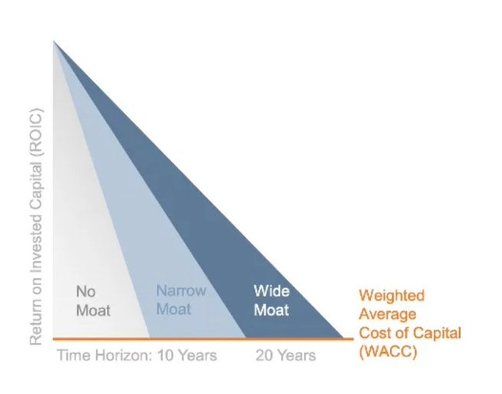
The key takeaway is that a strong moat allows a company to earn a high Return on Invested Capital (ROIC) for many years. ROIC measures how efficiently a company uses its money to generate profits. Without a moat, competition will eventually drive a company's ROIC down to its cost of capital—the point where it's no longer creating real value for shareholders.
The Sources of Competitive Advantage
So, what are these moats made of? Analysts have identified five primary sources of durable competitive advantage. Understanding these categories is the first step to identifying them in real companies.

Let's explore these five types, as categorized by the research firm Morningstar.
Competitive moat analysis: Identifying durable advantages
This article from Winvesta provides a clear and concise breakdown of the five main sources of economic moats. It will serve as our guide for this section.
Please read the section titled 'Morningstar identifies five distinct sources of competitive moats.' Focus on understanding the definition and examples for each of the five types: Network effects, Intangible assets, Switching costs, Cost advantages, and Efficient scale.
Now, let's see these moats in action with real-world examples. We'll use a series of short clips from the video we started with, which uses well-known Indian companies that are excellent case studies.
1. Intangible Assets (e.g., Brands, Patents, Licenses)
A powerful brand can create an emotional connection with customers, leading to loyalty and pricing power. Patents and government licenses create legal barriers that stop competitors from copying a product or entering a market.
- Example (Brand): Pidilite Industries owns brands like Fevicol and M-Seal. These names are so dominant that they have become synonymous with the product category itself (e.g., asking for "Fevicol" instead of "adhesive"). This allows Pidilite to "buy commodities and sell brands," earning high profit margins.
What are economic moats | How to identify a company with sustainable competitive advantage
Let's watch the case study on Pidilite to see a brand moat in action.
Watch from 12:23 to 16:45. Notice how the presenter connects the strong brand to the company's excellent financial performance, like high profit margins and return ratios.
2. Cost Advantage
A company with a significant and sustainable cost advantage can either undercut competitors on price to gain market share or sell at the market price and earn higher profit margins. This advantage can come from superior processes, better scale (economies of scale), or access to unique assets.
- Example (Low-Cost Production): Balkrishna Industries is a global player in specialized tires. By being one of the lowest-cost producers in the world, it can compete with premium brands like Michelin while earning even higher margins.
What are economic moats | How to identify a company with sustainable competitive advantage
This clip explains how Balkrishna Industries uses its low-cost advantage.
Watch from 25:52 to 27:55. Observe how being a low-cost producer translates directly into 'crazy operating margins' of over 25%.
3. Switching Costs
Switching costs are the "costs" or "pains" a customer incurs when changing from one provider to another. These can be financial (e.g., termination fees), procedural (e.g., migrating data), or effort-based (e.g., learning a new system). High switching costs lock customers in.
-
Your IT background provides a perfect analogy: Think about a large company running its infrastructure on AWS. Moving all its services, databases, and employee skills to Microsoft Azure or Google Cloud would be an immensely complex, risky, and expensive project. This creates a powerful switching cost moat for AWS.
-
Example (Financial Markets): The video uses CDSL (Central Depository Services Limited) in India. While not impossible, moving your entire stock portfolio from one depository to another is a cumbersome process, creating a sticky customer base.
What are economic moats | How to identify a company with sustainable competitive advantage
Let's see how switching costs apply in the financial services industry.
Watch from 30:52 to 32:10. The presenter identifies both switching costs and network effects as sources of CDSL's moat.
4. Network Effects
A network effect occurs when a product or service becomes more valuable as more people use it. This creates a self-reinforcing loop that can lead to a "winner-take-all" dynamic, as new users will naturally gravitate to the largest network. This is another concept that should be very familiar from your IT experience (e.g., social networks, operating systems, online marketplaces).
- Example (Platform Business): Info Edge, which operates job portal Naukri.com and has a stake in food delivery app Zomato. The more job seekers on Naukri, the more valuable it is for employers, which in turn attracts more job seekers.
What are economic moats | How to identify a company with sustainable competitive advantage
This clip on Info Edge demonstrates a classic network effect moat.
Watch from 28:35 to 30:46. Focus on how the value of the platform increases for all users as each new user joins.
5. Efficient Scale
This moat exists in markets where the potential customer base is limited, such that it can only support one or a few profitable competitors. A new entrant would realize that entering the market would lead to poor returns for everyone, so they stay out.
- Example (Regulated Exclusivity): City gas distribution companies like Indraprastha Gas or Mahanagar Gas in India. They are granted exclusive rights by the government to build and operate gas pipeline networks in specific geographic areas for a set number of years. It would be economically irrational for a competitor to build a parallel pipeline network.
What are economic moats | How to identify a company with sustainable competitive advantage
Let's look at the gas distribution sector as an example of an efficient scale/exclusivity moat.
Watch from 32:10 to 33:23. Note how the combination of distribution networks and government-mandated exclusivity creates a powerful moat.
The Durability of a Moat: Is It Widening or Narrowing?
Identifying a moat is only half the battle. The most important question an investor can ask is: Is the moat getting wider or narrower? No moat is guaranteed to last forever. Technological disruption, strategic blunders, or shifts in consumer behavior can erode even the strongest competitive advantages.
Competitive moat analysis: Identifying durable advantages
To understand how moats can be destroyed, let's return to the Winvesta article. This section provides critical historical examples of great companies that lost their moats.
Read the section titled 'Moat durability requires constant monitoring for erosion signals.' Pay close attention to the warning signs of moat deterioration and the cautionary tales of Kodak, Nokia, and Intel.
The key is to constantly monitor a company's competitive position. Signs of a narrowing moat include:
- Declining market share.
- Falling profit margins.
- A competitor launching a clearly superior product.
- A company failing to adapt to a major technological shift.
Conclusion
In this lesson, you moved from analyzing an industry's structure to evaluating a specific company's place within it. You learned that the best long-term investments are often companies protected by a strong and durable economic moat.
Key Takeaways:
- An economic moat is a sustainable competitive advantage that protects a company's profits from competition.
- The five primary sources of moats are: Intangible Assets, Cost Advantage, Switching Costs, Network Effects, and Efficient Scale.
- A moat must be durable. Investors must constantly assess whether a company's moat is widening or narrowing by looking for warning signs like eroding market share or compressing margins.
- Identifying a company's moat is a blend of qualitative business understanding and quantitative verification through financial metrics like high and stable ROIC and profit margins.
Preview of the Next Lesson:
A company's moat is not static; it is constantly being affected by changes in the world around it. In our next lesson, we will "Analyze industry trends and their potential impact on a company's future performance." We will look at how technological, social, and economic trends can either strengthen a company's moat or render it obsolete.