Hello! Welcome back to our module on Qualitative Analysis.
Introduction
In our last lesson, we explored the concept of a business model—the fundamental blueprint that explains how a company creates, delivers, and captures value. You learned to identify common models like the retailer, subscription, and financial services models, and we saw how they apply to major companies on the Colombo Stock Exchange (CSE).
Knowing what a company's business model is provides the context. Now, we need a tool to evaluate how well that model is positioned for success. This lesson introduces a classic strategic planning tool that is invaluable for investors: the SWOT analysis.
By the end of this lesson, you will be able to conduct a SWOT analysis (Strengths, Weaknesses, Opportunities, and Threats) for a given company. This framework will help you systematically organize your thoughts about a company's internal capabilities and the external environment it operates in, forming a crucial part of your investment research process.
1. Understanding the SWOT Framework
SWOT is an acronym for:
- Strengths
- Weaknesses
- Opportunities
- Threats
It’s a simple yet powerful framework used to assess a company's competitive position. To get a quick overview, let's watch a short video.
How to Perform a SWOT Analysis
This video from OnStrategy clearly defines SWOT and, most importantly, introduces the core distinction between internal and external factors.
Watch the video from the beginning to 01:40. Pay close attention to how it separates the four elements into an 'internal perspective' and an 'external perspective'.
As the video explained, the analysis is typically organized into a 2x2 grid. The key distinction to always remember is:
- Internal Factors: Strengths and Weaknesses. These are attributes of the company itself and are largely within its control. Examples include brand reputation, patents, or an inefficient manufacturing process.
- External Factors: Opportunities and Threats. These exist in the environment outside the company, and the company must react to them. They are largely beyond the company's direct control. Examples include new market trends, government regulations, or a competitor's actions.
Here is a standard template for a SWOT analysis.

Your experience in TechOps involves understanding the internal capabilities of a system (its architecture, performance, limitations) and the external environment it interacts with (user load, network conditions, security threats). SWOT analysis applies this same systems-thinking approach to a business.
2. How to Populate the Four Quadrants
To conduct a SWOT analysis, you need to gather information and sort it into the correct quadrants. Let's explore what goes into each one.
SWOT Analysis | Strategic Framework + Template
The article 'SWOT Analysis' from Wall Street Prep provides concise definitions, guiding questions, and clear examples for each of the four quadrants. This will help you understand what to look for when analyzing a company.
Please read the sections titled 'Internal vs. External SWOT Analysis', 'Strengths in SWOT Analysis', 'Weaknesses in SWOT Analysis', 'Opportunities in SWOT Analysis', and 'Threats in SWOT Analysis'. Focus on the questions and examples provided for each category.
To summarize the key ideas from the reading:
- Strengths (Internal, Positive): What are the company's competitive advantages? What does it do better than others?
- Examples: Strong brand name, loyal customer base, proprietary technology, efficient distribution network.
- Weaknesses (Internal, Negative): Where does the company lag? What are its limitations?
- Examples: High debt, outdated technology, weak brand, lack of a key skill.
- Opportunities (External, Positive): What external trends or events can the company capitalize on for growth?
- Examples: A new unserved market, favorable government policies, new technology it can adopt, a competitor going out of business.
- Threats (External, Negative): What external factors could harm the business?
- Examples: A new, aggressive competitor, changing consumer preferences, unfavorable regulations, an economic downturn.
Here is an example of what a filled-out SWOT analysis might look like for a hypothetical company.
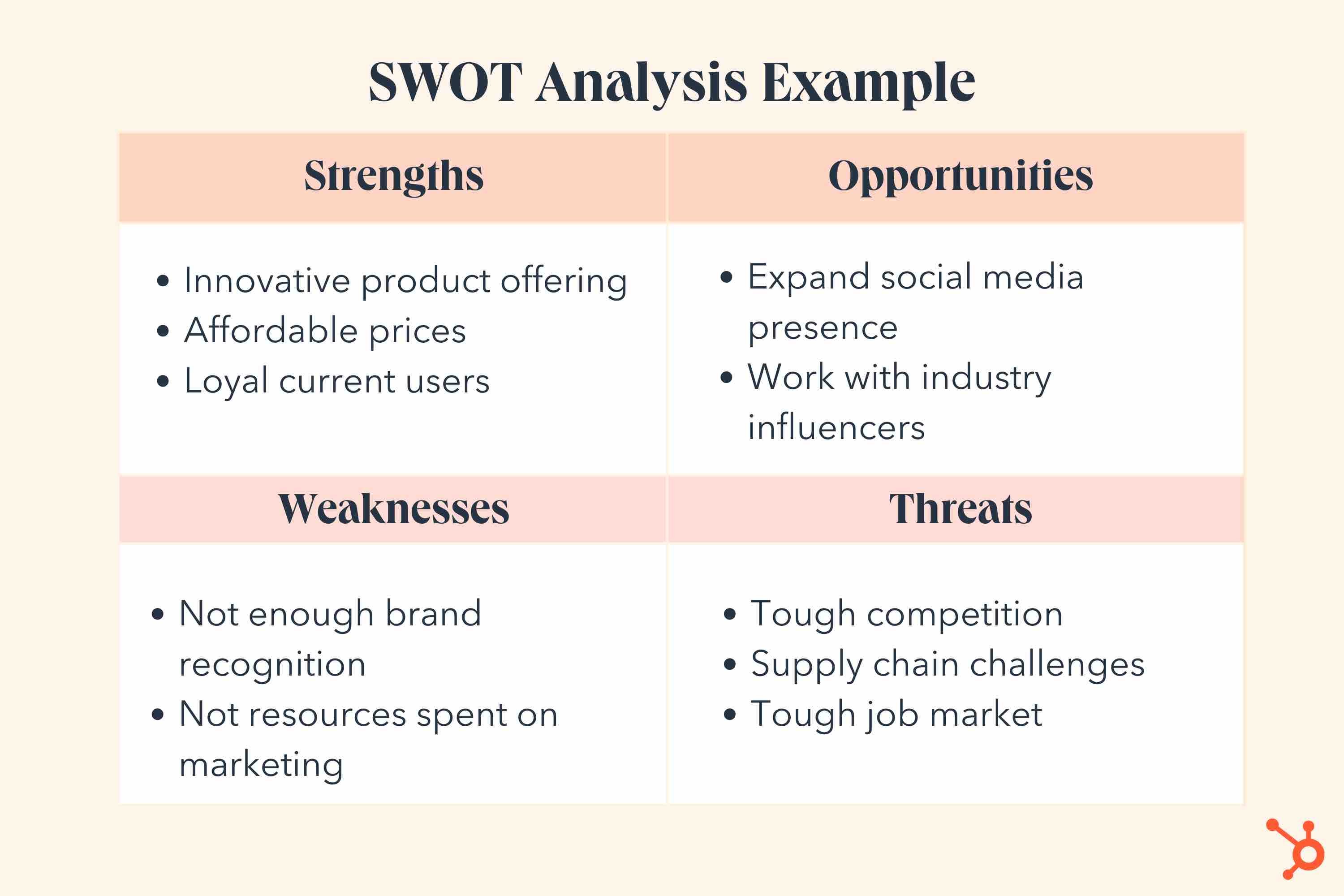
3. From Analysis to Strategic Insight
A SWOT analysis is more than just a list. Its real power comes from connecting the quadrants to reveal potential strategies. As an investor, you are trying to assess whether the company's management is making smart decisions based on its position.
The following video explains how to analyze the interconnections between the quadrants to develop action plans.
How to do a SWOT Analysis: Step-by-Step Guide to SWOT Like a Pro!
This clip from Mike Clayton's 'How to do a SWOT Analysis' explains how to move from listing points to finding actionable insights by looking at the interactions between the quadrants.
Watch the video from 04:53 to 06:36. Focus on the questions it poses, such as 'How can strengths mitigate threats?' and 'How can opportunities allow you to deal with weaknesses?'.
This leads to four key strategic questions:
- Strengths-Opportunities (S-O): How can the company use its strengths to take advantage of opportunities? (This is a strategy for growth).
- Strengths-Threats (S-T): How can the company use its strengths to minimize or avoid threats? (This is a defensive strategy).
- Weaknesses-Opportunities (W-O): How can the company use opportunities to overcome its weaknesses? (This is a strategy for improvement).
- Weaknesses-Threats (W-T): How can the company minimize its weaknesses to avoid threats? (This is a survival strategy, aiming to reduce exposure).
4. A Practical Example: Sri Lanka Telecom PLC (SLT)
Let's apply this thinking to Sri Lanka Telecom (SLT), a company we briefly touched on in the last lesson. This is not an exhaustive analysis, but an illustration of the process.
- Strengths:
- Extensive, nationwide fixed-line and fiber optic network (a significant infrastructure asset).
- Strong government backing and established brand recognition.
- Weaknesses:
- Perception of bureaucratic processes and slower customer service compared to more agile competitors.
- Potential for high fixed costs associated with maintaining a large, legacy infrastructure.
- Opportunities:
- Growing demand for high-speed broadband (Fiber-to-the-Home) across Sri Lanka.
- Expansion into new digital services like cloud computing, data centers, and Internet of Things (IoT), leveraging their core infrastructure.
- Threats:
- Intense competition from mobile operators (e.g., Dialog, Mobitel) who are also major players in the data market.
- Rapid technological change that could require significant new investment to stay competitive.
- Potential for adverse changes in government regulation or telecommunication policies.
Now, let's connect the dots strategically:
- (S-O Strategy): SLT can use its extensive fiber network (Strength) to aggressively capture the growing demand for high-speed broadband (Opportunity).
- (S-T Strategy): SLT can leverage its government backing and established infrastructure (Strength) to weather price wars or regulatory pressures from competitors (Threats) more effectively than smaller players.
- (W-O Strategy): The opportunity to offer high-value digital services (Opportunity) could force SLT to improve its customer service and internal processes (Weakness) to cater to demanding enterprise clients.
As an investor, you would look for evidence that SLT's management is actively pursuing these kinds of strategies.
Conclusion
Today, you've added a powerful analytical framework to your toolkit. The SWOT analysis provides a structured way to move beyond a company's financial statements and assess its strategic position in the real world.
Key Takeaways:
- SWOT Analysis is a framework for assessing a company's Strengths, Weaknesses, Opportunities, and Threats.
- Strengths and Weaknesses are internal factors that the company can control.
- Opportunities and Threats are external factors in the environment that the company must respond to.
- The true value of a SWOT analysis lies in connecting the quadrants to identify potential strategies and evaluate a company's ability to navigate its environment.
Preview of the Next Lesson:
The SWOT analysis gives us a broad view of the external environment (Opportunities and Threats). In our next lesson, we will zoom in on a critical part of that environment: the competition. We will learn to apply Porter's Five Forces framework to assess the competitive landscape of an industry, giving you an even more sophisticated tool to understand a company's long-term profit potential.