Welcome back. In our previous lessons on CPM and PERT, we built a comprehensive understanding of project scheduling, first under certainty and then under uncertainty. We now have a robust schedule for the boudoir photoshoot project. However, this schedule was created with a critical implicit assumption: that all the resources needed are available in unlimited quantities whenever a task is ready to start.
This lesson confronts that assumption. Today, we will introduce the concept of resource constraints and learn how to manage them using Resource Leveling. Your learning outcome is to use Resource Leveling to create a practical photoshoot schedule that prevents model fatigue by smoothing energy expenditure across the session. This moves our planning from a purely time-based perspective to a more realistic, resource-constrained model, ensuring the quality of the final "product" by managing the primary human resource—the model.
The Problem of Resource Over-allocation
In any project, resources—be it people, equipment, or capital—are finite. The schedule produced by CPM or PERT, which prioritizes starting tasks as early as possible, often leads to periods where the demand for a specific resource exceeds its availability. This is known as resource over-allocation.
In our photoshoot scenario, the most critical, renewable, yet limited resource is the model's energy and focus. High-intensity poses, rapid outfit changes, and prolonged shooting periods can drain this resource, leading to fatigue. Fatigue diminishes the quality of the poses and expressions, directly compromising the project's goal of maximizing "sexiness."
What is resource leveling? (Techniques and examples)
This article from Asana provides a clear introduction to resource leveling and its purpose.
Please read the introductory sections What is resource leveling? and When to use it. Pay attention to the core goal: resolving over-allocation to ensure a project can be completed with the available resources. The point about preventing task overloading is directly analogous to preventing model fatigue.
Resource Leveling vs. Resource Smoothing
As an operations research professional, you will appreciate the precise distinction between two related techniques: Resource Leveling and Resource Smoothing. The terms are often used interchangeably, but they represent different strategies driven by different primary constraints.
- Resource Leveling: This is the technique you use when resources are the primary constraint and the project deadline is flexible. To resolve an over-allocation, you are willing to delay tasks, even if it means extending the project's final completion date. This often changes the project's critical path.
- Resource Smoothing: You use this technique when the project deadline is the primary constraint and cannot be changed. You adjust activities only within their available float (or slack). The goal is to "smooth out" resource usage without affecting the critical path or the project's end date. If the over-allocation cannot be solved within the existing float, smoothing is not a viable option.
This video provides a succinct visual comparison.
PMP Exam Tips: Resource Levelling vs Resource Smoothing
Helena Liu's video offers a very clear side-by-side explanation of the two techniques, emphasizing their impact on the project timeline.
Watch the segments on resource leveling, where the project end date changes, and resource smoothing, where it does not. The final compare and contrast section crisply summarizes the key differences.
For our objective of preventing model fatigue, we will assume the total time for the photoshoot is flexible to ensure a high-quality outcome. Therefore, Resource Leveling is the primary technique we will employ. We are prioritizing the resource (model's energy) over the schedule.
Visualizing Resource Demand: The Resource Histogram
The most effective way to identify resource over-allocation is with a resource histogram. This is a bar chart that plots the amount of a resource required per unit of time against the project schedule.
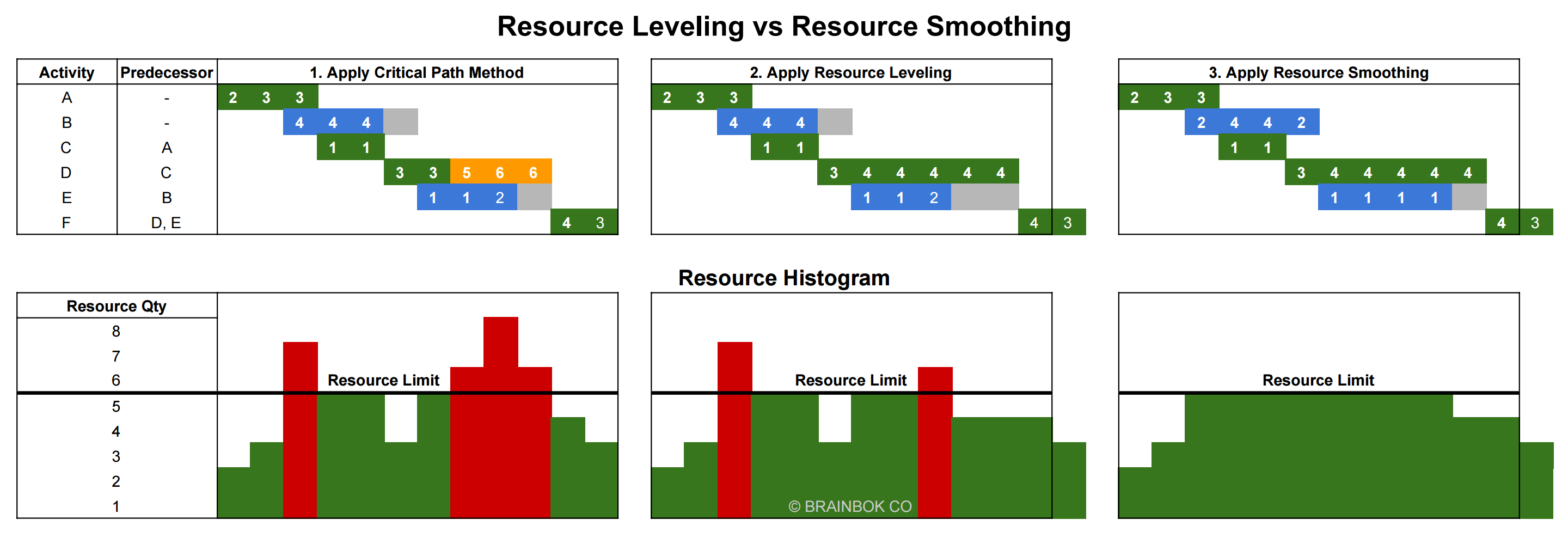
Let's focus on the first column, "Apply Critical Path Method." The histogram below the Gantt chart shows the total quantity of resources needed at each point in time. The horizontal "Resource Limit" line indicates the maximum available supply. The red bars signify periods of over-allocation where the project, as planned, is not feasible. This is precisely the problem we need to solve.
Applying Resource Leveling to the Boudoir Photoshoot
Let's apply a systematic process to our photoshoot project. We will use the expected durations (tₑ) calculated in our PERT lesson.
Step 1: Define Resource Capacities and Demands
First, we must quantify our resource. Let's create a metric called "Energy Units" (EU) to represent the model's energy expenditure.
- Resource Capacity: Based on experience, we determine the model can sustainably expend a maximum of 5 EU per hour. This is our "Resource Limit."
- Resource Demands: We assign an EU/hour cost to each activity.
| Task ID | Activity | tₑ (hrs) |
Energy Demand (EU/hr) |
|---|---|---|---|
| A | Concept & Wardrobe | 3.0 | 1 (Low mental effort) |
| B | Lighting Setup | 4.0 | 0 (Model is waiting/resting) |
| C | Accessory Selection | 2.0 | 1 (Low physical effort) |
| D | Makeup & Hair | 3.2 | 1 (Model is passive) |
| E | Look 1 Shoot | 2.0 | 4 (High intensity) |
| F | Look 2 Shoot | 3.0 | 5 (Very high intensity) |
| G | Image Review | 2.2 | 0 (Model is resting) |
Step 2: Establish the Initial Schedule and Resource Histogram
Using the early start times from our CPM/PERT analysis, we map out the initial schedule and the corresponding resource usage.
- Critical Path: A → C → D → F → G (Total Duration: 13.4 hours)
- Non-Critical Tasks: B and E have float.
Let's build the resource histogram for this initial plan:
| Time Interval (hrs) | Active Tasks | Total EU/hr | Status |
|---|---|---|---|
| 0.0 - 3.0 | A | 1 | OK |
| 3.0 - 5.0 | C, B | 1 + 0 = 1 | OK |
| 5.0 - 7.0 | D, B | 1 + 0 = 1 | OK |
| 7.0 - 8.2 | D | 1 | OK |
| 8.2 - 10.2 | E, F | 4 + 5 = 9 | OVER-ALLOCATED |
| 10.2 - 11.2 | F | 5 | OK |
| 11.2 - 13.4 | G | 0 | OK |
As the table shows, there is a severe over-allocation in the period from 8.2 to 10.2 hours, where both Look 1 and Look 2 are scheduled concurrently. The demand of 9 EU/hr far exceeds the sustainable limit of 5 EU/hr. This is where fatigue would set in, jeopardizing the quality of both looks.
Step 3: Apply Leveling by Delaying Tasks
To resolve this conflict, we must delay one of the conflicting tasks. The standard heuristic is to first delay the task with the most float.
- Identify Conflicting Tasks: The conflict is between Task E (Look 1) and Task F (Look 2).
- Check Criticality: Task F is on the critical path. Task E is not.
- Delay the Non-Critical Task: We must delay Task E.
The initial plan had Task F (critical) running from 8.2 to 11.2 hours. To resolve the conflict, we can schedule Task E to begin only after Task F is complete.
- New Start Time for E: 11.2 hours
- New Schedule for E: 11.2 to 13.2 hours
- Resulting Resource Usage:
- Time 8.2 - 11.2: Task F is active (5 EU/hr). OK.
- Time 11.2 - 13.2: Task E is active (4 EU/hr). OK.
The over-allocation is resolved. However, we must check the impact on the project's completion.
Step 4: Update the Schedule and Critical Path
Task G (Image Review) has predecessors E and F. It can only start after both are finished.
- In the original plan, F finished at 11.2 and E at 10.2. So G started at 11.2.
- In our leveled plan, F finishes at 11.2 and E now finishes at 13.2.
- Therefore, the earliest G can start is now 13.2 hours.
The end of the project is now pushed out:
The project duration has increased from 13.4 to 15.4 hours. By delaying a non-critical task (E), we caused it to push back a subsequent critical task (G), effectively making the path through E part of the new critical path. This is a classic outcome of resource leveling.
This short video walks through a similar example, showing how delaying one task to resolve a resource conflict extends the overall schedule.
Resource Leveling versus Resource Smoothing - Key Project Management Concepts from the PMBOK
This video by David McLachlan clearly demonstrates how resource leveling works with a simple "Sue and Tom" example.
Watch the section on resource leveling. Notice how shifting Sue's second activity to resolve the time conflict inevitably pushes out the project's total duration, illustrating the fundamental trade-off.
Application to the Hotwife Intimacy Scenario
The same logic applies directly to optimizing an intimate encounter. Here, the "resource" is a combination of physical energy, emotional presence, and desire. The "project" is the encounter itself, and the "tasks" are the different phases or activities within it.
- Activities:
A(Intimate dinner),B(Intense scene),C(Relaxed cuddling/aftercare),D(Second intense scene). - Resource Demand: Dinner (
A) and cuddling (C) are low-energy. The scenes (BandD) are high-energy. - Resource Limit: The hotwife has a limit to how much high-intensity activity can be enjoyed before experiencing emotional or physical fatigue.
- Initial Plan (CPM-based): Schedule
AthenB,C, andDas soon as possible. This might placeBandDtoo close together, causing an "over-allocation" of energy demand. - Resource Leveling: Instead of scheduling
BandDback-to-back, the hotwife would use leveling logic to delayD. She would ensure that the low-energy "task"C(aftercare) is placed betweenBandD. This extends the total duration of the "project," but it prevents burnout and ensures that both intense scenes are experienced at peak energy and enthusiasm, thus maximizing overall satisfaction.
Conclusion
Today, we've added a crucial layer of realism to our project management toolkit. By moving beyond time-only scheduling, we can create plans that are not just theoretically optimal, but practically feasible.
Key Takeaways:
- Resource Leveling is a technique to resolve resource over-allocations by delaying tasks when resource availability is the primary constraint.
- The trade-off for leveling is often an extension of the project's total duration and a change in its critical path.
- A Resource Histogram is the essential tool for visualizing resource demand over time and identifying periods of over-allocation.
- By quantifying an intangible resource like a model's "energy," we can apply this OR technique to optimize for subjective but critical outcomes like performance quality.
In this lesson, we saw how resource constraints can lengthen a project. In our next session, we will explore the opposite problem. What if we need to finish the photoshoot sooner than the critical path suggests? We will investigate Project Crashing, a technique for strategically adding resources to shorten the project duration, and analyze the cost-benefit trade-offs involved.