Welcome back. In our previous lesson on project crashing, we focused on a reactive strategy: how to accelerate a project timeline when facing an urgent deadline by making calculated time-cost trade-offs. We learned to systematically shorten the critical path in the most economical way.
Today, we shift our perspective from reaction to prevention. Instead of asking "How can we fix this problem faster?", we will ask, "How can we prevent this problem from happening in the first place?". This proactive approach to risk management is formalized in a powerful technique known as Failure Mode and Effects Analysis (FMEA).
Your learning outcome for this lesson is to apply Failure Mode and Effects Analysis (FMEA) to identify and rank potential failure points in both the photoshoot workflow and the hotwife's encounter planning process. You will learn how to deconstruct a process, anticipate what could go wrong, and prioritize those risks in a systematic way.
What is Failure Mode and Effects Analysis?
At its core, FMEA is a structured method for identifying and preventing potential failures in a process, product, or service before they occur. Originally developed in high-stakes environments like NASA, its logic is universally applicable for improving reliability. Given your background in operations research, you can think of FMEA as a systematic algorithm for identifying and quantifying the risk variables within a system, providing a crucial input for any subsequent optimization or reliability modeling.
The analysis revolves around three key questions for each step in a process:
- Failure Mode: In what ways can this step fail?
- Effects: What are the consequences if it does fail?
- Causes: What are the root causes that could lead to this failure?
To quantify and prioritize the risks associated with each failure mode, FMEA uses three numerical ratings.
Minimizing Risks: How to Apply FMEA in Services - iSixSigma
This article from iSixSigma provides a concise introduction to the core concepts of FMEA. It clearly defines the purpose of the analysis and its key evaluation criteria.
Please read the first part of the article, from the beginning down to the formula for the Risk Priority Number. Focus on the definitions of failure modes and the three characteristics used for analysis: Severity, Occurrence, and Detection.
As the reading explains, the three ratings—Severity (S), Occurrence (O), and Detection (D)—are multiplied to calculate a Risk Priority Number (RPN).
This RPN serves as a quantitative index to rank and prioritize failure modes. The higher the RPN, the more critical the risk, signaling a clear priority for corrective action.
The FMEA Process: A Step-by-Step Guide
Performing an FMEA is not an arbitrary exercise but a methodical progression through a standardized form. The process ensures that all aspects of a potential failure are considered.
The image below shows a typical Process FMEA (PFMEA) form, detailing the columns that guide the analysis. Notice the flow from identifying the process step, to defining the failure mode, its effects and causes, and finally assessing the risk.
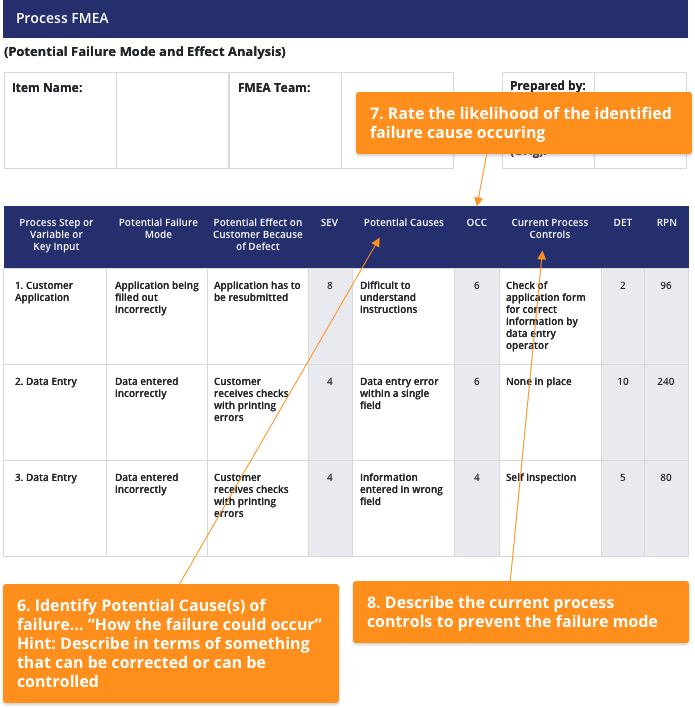
To fully understand how to complete this analysis, we'll walk through the sequence of steps.
Process FMEA | Process Failure Mode & Effects Analysis - Quality-One
This guide from Quality-One provides a detailed, step-by-step breakdown of how to perform a Process FMEA. It logically groups the steps into distinct sections of the analysis.
Please read the section How to Perform Process FMEA. Then, review the detailed explanations for each part of the analysis: Section 1: Focus on how to define the Process, Requirement, Failure Mode, Effects, and Severity. Pay attention to the typical 1-10 rating scale for Severity. Section 2: Understand how to identify Causes, Prevention Controls, and Occurrence. Notice how prevention controls are meant to reduce the likelihood of a cause. Section 3: Learn about Detection Controls and the Detection rating. The key distinction here is that these controls find failures, whereas prevention controls stop them. Section 4: This section explains how to calculate the RPN and formulate Recommended Actions. Crucially, it notes that high Severity scores (e.g., 9 or 10) demand action regardless of the final RPN.
To summarize the process:
- Deconstruct the Process: Break down the overall process into discrete steps or functions.
- Identify Failure Modes: For each step, brainstorm how it could potentially fail to meet its requirements.
- Analyze Effects: Determine the consequences of each failure mode.
- Rate Severity (S): On a scale (typically 1-10), how severe is the impact of the effect? (1 = no effect, 10 = catastrophic).
- Identify Causes: For each failure mode, determine the possible root causes.
- Rate Occurrence (O): How frequently is each cause likely to occur? (1 = extremely unlikely, 10 = almost certain).
- Identify Controls: List existing process controls that either prevent the cause or detect the failure mode.
- Rate Detection (D): How likely are the current controls to detect the failure before it has an impact? (1 = certain detection, 10 = no chance of detection).
- Calculate RPN: Multiply S x O x D.
- Prioritize and Act: Develop recommended actions to reduce the highest RPNs. The primary goal is to lower Severity or Occurrence, or to improve Detection.

Application 1: FMEA for the Boudoir Photoshoot Workflow
Let's apply this to the boudoir photoshoot. First, we outline the high-level process steps:
- Makeup & Hair Styling
- Wardrobe & Accessory Selection
- Lighting Setup
- Posing & Direction
- Image Capture
Now, let's perform a partial FMEA for two of these steps.
Process Step: 2. Wardrobe & Accessory Selection
- Failure Mode: A key lingerie piece is found to be damaged (e.g., torn lace, broken strap).
- Potential Effect: Photoshoot is delayed while a replacement is sought or a repair is attempted. The intended "look" is compromised, affecting the final product. Model's confidence and energy are disrupted.
- Severity (S): 7. A significant disruption that impacts the schedule and quality, but is potentially recoverable.
- Potential Cause: The item was damaged from previous use or improper storage.
- Occurrence (O): 4. Delicate lingerie can be fragile; this is not a rare event.
- Current Controls (Prevention/Detection): A quick visual check of wardrobe items before the model dresses.
- Detection (D): 3. The damage is likely to be caught before shooting begins, but if it's a small tear, it might be missed until the model is already on set.
- RPN:
- Recommended Action:
- Implement a formal wardrobe inspection checklist to be completed 24 hours before the shoot.
- For critical, high-impact outfits, procure a backup piece.
Process Step: 4. Posing & Direction
- Failure Mode: The chosen pose appears awkward or unflattering on camera.
- Potential Effect: The "sexiness" and artistic quality of the shot are severely diminished. Wasted time and effort. Model may feel frustrated or insecure.
- Severity (S): 9. This failure directly undermines the primary objective of the photoshoot.
- Potential Cause: 1) Photographer provides unclear verbal cues. 2) The pose is not well-suited to the model's body type. 3) Misalignment between the moodboard concept and execution.
- Occurrence (O): 6. Achieving perfect posing is a common challenge that requires continuous adjustment.
- Current Controls (Detection): Photographer reviews images on the camera's LCD screen immediately after capture ("chimping").
- Detection (D): 2. The problem is very likely to be detected immediately, allowing for a quick correction.
- RPN:
- Recommended Action:
- Create a visual posing guide (tear sheets) for each look.
- The photographer should demonstrate the pose themselves.
- Schedule a brief posing practice session before the main shoot begins.
Notice that even though the second failure has a lower detection rating, its RPN is higher due to its very high severity and occurrence. This, plus the Severity score of 9, makes it a top priority for action.
Application 2: FMEA for the Hotwife's Encounter Planning
The FMEA framework is just as effective for analyzing personal and relational processes. Let's apply it from the hotwife's perspective to her encounter planning.
Process: Planning an intimate encounter with the bull.
Process Step: 1. Negotiating Availability and Scheduling
- Failure Mode: A scheduling conflict arises after the date has been agreed upon (e.g., the hotwife or bull forgets another commitment).
- Potential Effect: The encounter is cancelled last-minute, leading to significant disappointment and frustration. The emotional momentum is lost. It could create scheduling "debt" that complicates future planning.
- Severity (S): 8. A highly undesirable outcome with strong emotional consequences.
- Potential Cause: Using informal communication (e.g., casual texts) for scheduling. No centralized calendar to track all parties' commitments (hotwife, bull, husband).
- Occurrence (O): 5. In busy lives with multiple commitments, such conflicts are moderately frequent without a robust system.
- Current Controls (Detection): A confirmation text a day or two before the planned date.
- Detection (D): 4. A last-minute confirmation helps, but often the conflict is discovered too late to reschedule without disappointment.
- RPN:
- Recommended Action:
- Implement a shared digital calendar (e.g., a dedicated Google Calendar) visible to both the hotwife and bull for proposing and confirming dates.
- Establish a clear protocol: dates are only "confirmed" once accepted in the calendar, not via text.
- Set an automated calendar reminder for 72 hours before the event for a final check-in.
This RPN of 160 is significantly high, indicating a critical failure point in the process that warrants immediate improvement to ensure the reliability and emotional stability of the arrangement.
Conclusion
Today, we've moved from reacting to project pressures to proactively engineering reliability into a system. You've learned how Failure Mode and Effects Analysis provides a rigorous framework for anticipating and mitigating risks.
Key Takeaways:
- FMEA is a proactive tool: It identifies potential failures in a process before they happen.
- Risk is quantified: The Risk Priority Number (RPN) is calculated from Severity (S), Occurrence (O), and Detection (D) ratings, providing a logical basis for prioritizing action.
- High Severity is a red flag: Any failure mode with a high Severity score (typically 9 or 10) should be addressed, regardless of its overall RPN.
- The goal is action: The output of an FMEA is not just a table of numbers, but a set of concrete, recommended actions to reduce risk by improving the process.
You have now added a powerful risk assessment tool to your operational toolkit. In our next lesson, we will continue our exploration of reliability by examining Mean Time Between Failures (MTBF). While FMEA helps us understand how things can fail, MTBF will help us quantify how often they do, providing another critical metric for managing and predicting system performance.